

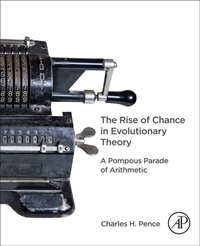
The Rise of Chance in Evolutionary Theory
A Pompous Parade of Arithmetic
Published on 26. November 2021
Book
Paperback/Softback
190 pages
978-0-323-91291-4 (ISBN)
Description
The Rise of Chance in Evolutionary Theory: A Pompous Parade of Arithmetic explores a pivotal conceptual moment in the history of evolutionary theory: the development of its extensive reliance on a wide array of concepts of chance. It tells the history of a methodological and conceptual development that reshaped our approach to natural selection over a century, ranging from Darwin's earliest notebooks in the 1830s to the early years of the Modern Synthesis in the 1930s. Far from being a "pompous parade of arithmetic,? as one early critic argued, evolution transformed during this period to make these conceptual and technical tools indispensable.
This book charts the role of chance in evolutionary theory from its beginnings to the earliest days of modern evolutionary theory, making it an ideal resource for evolutionary biologists, historians, philosophers, and researchers in science studies or biological statistics.
This book charts the role of chance in evolutionary theory from its beginnings to the earliest days of modern evolutionary theory, making it an ideal resource for evolutionary biologists, historians, philosophers, and researchers in science studies or biological statistics.
Reviews / Votes
"...Charles Pence's excellent new book provides a rich and detailed history that carefully inspects the traditional account of biometrics, plotting the emergence of statistical thinking in evolutionary theory. The author argues that Darwin informally made room for chance by conceptualizing natural selection not as a law but as a tendency, but a tendency that constrained sources of chance that might otherwise affect evolutionary outcomes. For Pence there is a tension here, which prevented a full commitment to a probabilistic theory, due to the deterministic philosophies of science in which Darwin was schooled. Nonetheless, Darwin created" --The Quarterly Review of Biology"The goal of the book is to explain how evolutionary theory, specifically, natural selection, became a mathematical and statistical theory...a well written and important contribution to both the history and philosophy of biology. I would also recommend the book to scholars working on the role of mathematics in science and on modeling." --Ehud Lamm, Springer
More details
Language
English
Place of publication
Oxford
United Kingdom
Publishing group
Elsevier Science & Technology
Target group
Professional and scholarly
Researchers and academics in evolution and evolutionary biology, history of science, philosophy of science, and science studies; Advanced undergraduate students in evolution/evolutionary biology, statistics, history, or philosophy
Dimensions
Height: 235 mm
Width: 191 mm
Weight
410 gr
ISBN-13
978-0-323-91291-4 (9780323912914)
Copyright in bibliographic data and cover images is held by Nielsen Book Services Limited or by the publishers or by their respective licensors: all rights reserved.
Schweitzer Classification
Other editions
Additional editions
E-Book
11/2021
Academic Press
€109.00
Available for download
Person
Charles H. Pence is Charge de cours (Assistant Professor) at the Institut superieur de philosophie, and director of the Center for the Philosophy of Science and Society (CEFISES) at the Universite catholique de Louvain, Belgium. Previously, he was Assistant Professor and Director of the LSU Ethics Institute at Louisiana State University. He is the author of 2 books and over 20 articles and book chapters on the philosophy and history of evolutionary theory. His work centers on the integrated philosophy and history of biology, with a particular focus on the introduction and contemporary use of concepts of chance and methods of statistics in evolutionary theory.
Content
1. Chance governs the descent of a farthing: Charles Darwin
2. The wonderful form of cosmic order: Francis Galton
3. The only ultimate test of the theory of natural selection: The Early Years of Biometry
4. Here is the true gospel: Biometry After Mendelism
5. Reconciling the biometrical conclusions: Evolution from 1906 to 1918
6. What natural selection must be doing: R. A. Fisher's Early Synthesis
7. Conclusions, historiographical and philosophical Index
2. The wonderful form of cosmic order: Francis Galton
3. The only ultimate test of the theory of natural selection: The Early Years of Biometry
4. Here is the true gospel: Biometry After Mendelism
5. Reconciling the biometrical conclusions: Evolution from 1906 to 1918
6. What natural selection must be doing: R. A. Fisher's Early Synthesis
7. Conclusions, historiographical and philosophical Index