

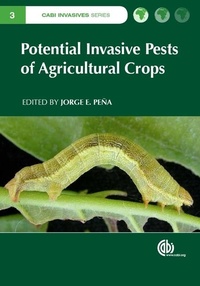
Potential Invasive Pests of Agricultural Crops
Published on 26. June 2013
Book
Hardback
464 pages
978-1-84593-829-1 (ISBN)
Description
Invasive arthropods cause significant damage in agricultural crops and natural environments across the globe. Potentially threatened regions need to be prepared to prevent new pests from becoming established. Therefore, information on pest identity, host range, geographical distribution, biology, tools for detection and identification are all essential to researchers and regulatory personnel. This book focuses on the most recent invasive pests of agricultural crops in temperate subtropical and tropical areas and on potential invaders, discussing their spread, biology and control.
More details
Series
Language
English
Place of publication
Wallingford
United Kingdom
Product notice
sewn/stitched
Cloth over boards
Dimensions
Height: 246 mm
Width: 175 mm
Thickness: 30 mm
Weight
1179 gr
ISBN-13
978-1-84593-829-1 (9781845938291)
Copyright in bibliographic data and cover images is held by Nielsen Book Services Limited or by the publishers or by their respective licensors: all rights reserved.
Schweitzer Classification
Other editions
Additional editions
E-Book
06/2013
CABI Publishing
€268.99
Available for download
Persons
Takumasa Kondo is Senior Researcher at Corporacion Colombiana de Investigacion Agropecuaria (Agrosavia), Centro de Investigacion Palmira, Valle del Cauca, Colombia. He received BSc and MSc degrees from Tokyo University of Agriculture (Japan); PhD degree in Entomology from Auburn University, Alabama, U.S.A. Studies integrated pest management (IPM) of insect and mite pests of tropical fruit crops, with special interest in insects of economic importance and taxonomy of Coccomorpha. Editor in chief of the journal Revista Colombiana de Entomologia and Ciencia y Tecnologia Agropecuaria (2016-2021); and subject editor of several journals, including Neotropical Entomology, Revista Brasileira de Entomologia and Zookeys. Member of the Editorial Board of Fronteras de la Ciencia and Entomologia Experimentalis et Applicata. He has published more than 170 scientific papers, including books and book chapters. Dr. Kenneth B. Storey, Ph.D., F.R.S.C., is a Professor of Biochemistry at Carleton University in Ottawa and holds the Canada Research Chair in Molecular Physiology. He received his B.Sc. from the University of Calgary and his Ph.D. from the University of British Columbia. Ken is a world leader in the field of biochemical adaptation. He uses tools of enzymology, protein chemistry and molecular biology to identify the adaptations of gene regulation and enzyme structure/function that support amazing animal phenomena including hibernation, freezing survival, estivation and anoxia tolerance. Ken is a prolific author and speaker - he has over 600 publications to his name and has given hundreds of talks around the world. Recently Ken won the 2010 Flavelle medal in Biological Sciences from the Royal Society of Canada and the 2011 Fry medal from the Canadian Society of Zoologists.
Editor
University of Florida, USA
Contributions
ICAR Research Complex for Goa, Ela, , Old Goa - 403 402, Goa, , , INDIA
Centro de investigacion y Estudios avanzados en Fitomejoramiento, Facultad, Ciencias Agricolas, , Universidad Autonoma del Estado de Mexico, , Campus el Cerrillo, , Toluca, Estado de Mexico, , MEXICO
US Forest Service, , Northern Research Station, , , East Lansing, , MI , , 48823, UNITED STATES
EMBRAPA Agropecuaria Oeste, Rodovia Dourados-Caarapo, , , Dourados, MS, , , BRAZIL
Departamento de Entomologia, Fitopatologia e Zoologia Agricola, , Piracicaba, , Sao Paulo, , BRAZIL
University of California at Riverside, USA
Centro Proteccion Vegetal y Biotecnologia, Instituto Valenciano de Investigaciones Agrarias (IVIA), Apartado Oficial, Carretera de Moncada-Naquera, Valencia, , SPAIN
Corporacion Colombiana de Investigacion Agropecuaria CORPOICA, Vereda Llanogrande Rionegro, , , Antioquia, , COLOMBIA
USDA-APHIS, USA
Content
a: Preface 1: Biology and management of the red palm weevil, Rhynchophorus ferrugineus 2: Avocado weevils of the genus Heilipus 3: Exotic bark and ambrosia Beetles in the USA: potential and current invaders 4: Diabrotica speciosa: an important soil pest in South America 5: Potential Lepidopteran pests associated with avocado fruit in parts of the home range of Persea americana 6: Biology, ecology and management of the South American tomato pinworm, Tuta absoluta 7: Tecia solanivora Povolny (Lepidoptera: Gelechiidae), an invasive pest of potatoes Solanum tuberosum L. in the Northern Andes 8: The fruit borer, Neoleucinodes elegantalis (Guenee) (Lepidoptera: Crambidae), an insect pest of Neotropical solanaceus fruits 9: Copitarsia spp. : Biology and risk posed by potentially invasive Lepidoptera from South and Central America 10: Host range of the nettle caterpillar Darna pallivitta (Moore) (Lepidoptera: Limacodidae) in Hawai?i 11: Fruit flies, Anastrepha ludens (Loew), A. obliqua (Macquart) and A. grandis (Macquart) (Diptera: Tephritidae): three pestiferous tropical fruit flies that could potentially expand their range to temperate areas 12: Bactrocera species that pose a threat to Florida: Bactrocera carambolae and B. invadens 13: Signature chemicals for detection of citrus infestation by fruit fly larvae (Diptera: Tephritidae) 14: Gall midges (Cecidomyiidae) attacking horticultural crops in the Caribbean Region and South America 15: Recent mite invasions in South America 16: Planococcus minor (Hemiptera: Pseudococcidae): bioecology, survey, and mitigation strategies 17: The citrus orthezia, Praelongorthezia praelonga (Douglas) (Hemiptera: Ortheziidae), a potential invasive species 18: Potential invasive species of scale insects for the USA and Caribbean Basin 19: Recent adventive scale insects (Hemiptera: Coccoidea) and whiteflies (Hemiptera: Aleyrodidae) in Florida and the Caribbean Region 20: Biology, ecology and control of the ficus whitefly, Singhiella simplex (Hemiptera: Aleyrodidae) 21: Invasion of exotic arthropods in South America's biodiversity hotspots and agro-production systems 22: Likelihood of dispersal of the armoured scale, Aonidiella orientalis (Hemiptera: Diaspididae), to avocado trees from infested fruit discarded on the ground and observations on spread by handlers 23: Insect life cycle modeling (ILCYM) software - a new tool for regional and global insect pest risk assessments under current and future climate change scenarios