

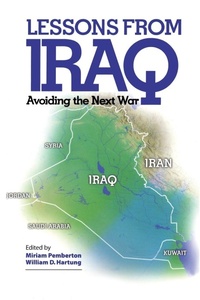
Lessons from Iraq
Avoiding the Next War
1st Edition
Published on 30. May 2008
Book
Paperback/Softback
160 pages
978-1-59451-499-9 (ISBN)
Description
If what is shaping up to be the worst foreign policy disaster in U.S. history has an upside, it is that the current war in Iraq should definitively, permanently settle a handful of critical questions about American conduct in the world. This book provides a list of those questions and even ventures some answers in the form of key lessons from Iraq. The idea of assembling lessons as tools for avoiding the next war is less of a stretch than it seems, given the group of writers represented here. They include a Nobel Prize-winning economist; the former chief UN weapons inspector; and an Iraqi American whose weekly conversations with his relatives have given him a grim education on what living through a war to spread democracy is like on the ground. Also here is a Pulitzer Prize and National Book Award winner who traces the recurring American bad habit of starting wars as tryouts for big ideas. All societies need a ready reference handbook that draws some lines around its conduct of war. The Bush administration has produced a radical overhaul of the U.S. manual. Given the Iraq experience, it is urgent that we reject this version and think again. This book is a manageably sized, accessibly written, affordable compilation of key points that most urgently need to be rethought.
Reviews / Votes
"America's future will be one of endless war unless we can come to grips with the deceptions, the lies, the reckless doctrines, the politicized intelligence, and the dishonest accounting that brought us the Iraq war. Read this compelling set of essays and join the movement to prevent the next war."-Barbara Ehrenreich, author of Blood Rites, This Land is Their Land, and Nickel and Dimed
"Assessing the wreckage caused by the Iraq War is an urgent national priority. This timely, immensely thoughtful, and justifiably angry collection gets that process off to an excellent start."
-Andrew J. Bacevich, author of The New American Militarism: How Americans Are Seduced by War
"If a main reason our government went to war in Iraq was to reassert American authority after 9/11 exposed our vulnerability, the actual consequence-as these incisive and important essays make clear-has been just the opposite. Not only have we paid dearly in blood, in treasure, and in damage to American liberties, the decline of our credibility and prestige has led to a sharp reduction in American power. We tried to show that we are strong and made ourselves seem weak."
-Aryeh Neier, President, Open Society Institute
More details
Language
English
Place of publication
New York
United States
Publishing group
Taylor & Francis Inc
Target group
College/higher education
Dimensions
Height: 229 mm
Width: 152 mm
Thickness: 9 mm
Weight
240 gr
ISBN-13
978-1-59451-499-9 (9781594514999)
Copyright in bibliographic data and cover images is held by Nielsen Book Services Limited or by the publishers or by their respective licensors: all rights reserved.
Schweitzer Classification
Other editions
Additional editions
E-Book
12/2015
Routledge
€64.49
Available for download
E-Book
12/2015
Routledge
€64.49
Available for download
Book
05/2008
1st Edition
Routledge
€231.10
Shipment within 3-4 weeks
Persons
Miriam Pemberton, William D. Hartung
Content
Introduction, Miriam Pemberton; prologue Prologue, Anas Shallal; Part 1 Purposes, Miriam Pemberton, William D. Hartung; Chapter 1 The Dangerous Leap, Neta C. Crawford; Chapter 2 American Imperialism, Chalmers Johnson; Chapter 3 Ideas Floating Free, Frances FitzGerald; Chapter 4 A Motive Hiding in Plain Sight, Michael T. Klare; Chapter 5 To Avoid Future Iraq-Style Quagmires, Reduce U.S. Global Military Presence, Ivan Eland; Part 2 Ways and Means, Miriam Pemberton, William D. Hartung; Chapter 6 Hidden Wounds and Accounting Tricks, Joseph Stiglitz, Linda Bilmes; Chapter 7 Lies, Spies, and Legends, John Prados; Chapter 8 Media Flagstones on the Path to War, Norman Solomon; Chapter 9 America's Slide, Jeffrey Laurenti; Chapter 10 Inspections or Invasion, Hans Blix; Chapter 11 Coalitions of the Coerced, Phyllis Bennis; Part 3 Collateral Damage, Miriam Pemberton, William D. Hartung; Chapter 12 Monarchic Pretensions, Fred Barbash; Chapter 13 Torture No More, Aziz Huq; Chapter 14 The Shadow Army, Janine R. Wedel; Chapter 15 Invitation to Steal, William D. Hartung; Chapter 16 The (Iraq) War on Civil Liberties, Jules Lobel; epilogue Epilogue, C. K. Williams;