

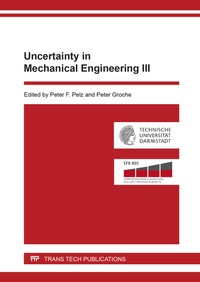
Uncertainty in Mechanical Engineering III
Published on 20. December 2018
Book
Paperback/Softback
326 pages
978-3-0357-1310-7 (ISBN)
Description
Collection of selected, peer-reviewed papers from the 3rd International Conference on Uncertainty in Mechanical Engineering (ICUME). The aim of ICUME is to discuss criteria, methods, and technologies to describe, evaluate and control uncertainty in mechanical engineering applications. International scholars and specialists come together and provide a broad discussion forum on the description, evaluation, avoidance, elimination of and adaptation to uncertainty. It is the aim to control uncertainty throughout the entire lifetime in planning, development, production, and usage of mechanical structures and systems. Engineers, mathematicians and other experts working in uncertainty evaluation exchange the latest research results and share their experiences in uncertainty control.
More details
Series
Language
English
Place of publication
Zurich
Switzerland
Target group
Professional and scholarly
Illustrations
Illustrations
Dimensions
Height: 240 mm
Width: 170 mm
Thickness: 16 mm
Weight
690 gr
ISBN-13
978-3-0357-1310-7 (9783035713107)
DOI
10.4028/b-VNtAN5
Copyright in bibliographic data and cover images is held by Nielsen Book Services Limited or by the publishers or by their respective licensors: all rights reserved.
Schweitzer Classification
Other editions
Additional editions
Peter F. Pelz | Peter Groche
Uncertainty in Mechanical Engineering III
Software
12/2018
Trans Tech Publications Ltd
€193.08
Shipment within 10-20 days
Peter F. Pelz | Peter Groche
Uncertainty in Mechanical Engineering III
E-Book
11/2018
Trans Tech Publications Ltd
€0.00
Available for download
Persons
Eds. Peter F. Pelz and Peter Groche
Content
Preface
Chapter 1: Adequate Prediction of Structural Dynamic System Behavior for Decision Making in Early Design Stage
Quantification of Uncertainty in the Mathematical Modelling of a Multivariable Suspension Strut Using Bayesian Interval Hypothesis-Based Approach
Sparse Gaussian Process Emulators for Surrogate Design Modelling
Chapter 2: Controlling Product Properties in Manufacturing Processes
Reducing Uncertainty in Shunt Damping by Model-Predictive Product Stiffness Control in a Single Point Incremental Forming Process
Cloudbased Production Optimization - Potential and Limits Today
Towards Damage Controlled Hot Forming
Numerical Comparison of Three Different Feedback Control Schemes Applied on a Forming Operation
Chapter 3: Contemporary Design - From Intelligent Components to Resilient Systems
Adaptivity as a Property to Achieve Resilience of Load-Carrying Systems
Resilient Product Development - A New Approach for Controlling Uncertainty
Optimal Booster Station Design and Operation under Uncertain Load
Chapter 4: Optimization under Uncertainty
Optimal Placement of Active Bars for Buckling Control in Truss Structures under Bar Failures
Robust Design of a Smart Structure under Manufacturing Uncertainty via Nonsmooth PDE-Constrained Optimization
Chapter 5: Mastering Uncertainty by Digitalization
Comparison of Inductive Inference Mechanisms and their Suitability for an Information Model for the Visualization of Uncertainty
Concept of a Resilient Process Chain to Control Uncertainty of a Hydraulic Actuator
Methods and Technologies for Research- and Metadata Management in Collaborative Experimental Research
Chapter 6: Resilient Technical Systems
Resilience in Mechanical Engineering - A Concept for Controlling Uncertainty during Design, Production and Usage Phase of Load-Carrying Structures
Towards Resilient Process Networks - Designing Booster Stations via Quantified Programming
Algorithmic Design and Resilience Assessment of Energy Efficient High-Rise Water Supply Systems
Chapter 7: Responsibility for Autonomous Systems
Autonomous Manufacturing Processes under Legal Uncertainty
On Obligations in the Development Process of Resilient Systems with Algorithmic Design Methods
Chapter 8: Uncertainty in High Precision Manufacturing Processes
Simulation of Multi-Stage Fine Machining Processes at the Example of Valve Guide and Valve Seat
Adjustment of Axis Offset Errors during Reaming
Cross-Domain Tolerance Analysis for Directional Control Valves Based on Imperfect Information
Chapter 9: Uncertainty Quantification
Estimation of Uncertainty in the Lateral Vibration Attenuation of a Beam with Piezo-Elastic Supports by Neural Networks
Inverse Interval Field Quantification via Digital Image Correlation
Chapter 1: Adequate Prediction of Structural Dynamic System Behavior for Decision Making in Early Design Stage
Quantification of Uncertainty in the Mathematical Modelling of a Multivariable Suspension Strut Using Bayesian Interval Hypothesis-Based Approach
Sparse Gaussian Process Emulators for Surrogate Design Modelling
Chapter 2: Controlling Product Properties in Manufacturing Processes
Reducing Uncertainty in Shunt Damping by Model-Predictive Product Stiffness Control in a Single Point Incremental Forming Process
Cloudbased Production Optimization - Potential and Limits Today
Towards Damage Controlled Hot Forming
Numerical Comparison of Three Different Feedback Control Schemes Applied on a Forming Operation
Chapter 3: Contemporary Design - From Intelligent Components to Resilient Systems
Adaptivity as a Property to Achieve Resilience of Load-Carrying Systems
Resilient Product Development - A New Approach for Controlling Uncertainty
Optimal Booster Station Design and Operation under Uncertain Load
Chapter 4: Optimization under Uncertainty
Optimal Placement of Active Bars for Buckling Control in Truss Structures under Bar Failures
Robust Design of a Smart Structure under Manufacturing Uncertainty via Nonsmooth PDE-Constrained Optimization
Chapter 5: Mastering Uncertainty by Digitalization
Comparison of Inductive Inference Mechanisms and their Suitability for an Information Model for the Visualization of Uncertainty
Concept of a Resilient Process Chain to Control Uncertainty of a Hydraulic Actuator
Methods and Technologies for Research- and Metadata Management in Collaborative Experimental Research
Chapter 6: Resilient Technical Systems
Resilience in Mechanical Engineering - A Concept for Controlling Uncertainty during Design, Production and Usage Phase of Load-Carrying Structures
Towards Resilient Process Networks - Designing Booster Stations via Quantified Programming
Algorithmic Design and Resilience Assessment of Energy Efficient High-Rise Water Supply Systems
Chapter 7: Responsibility for Autonomous Systems
Autonomous Manufacturing Processes under Legal Uncertainty
On Obligations in the Development Process of Resilient Systems with Algorithmic Design Methods
Chapter 8: Uncertainty in High Precision Manufacturing Processes
Simulation of Multi-Stage Fine Machining Processes at the Example of Valve Guide and Valve Seat
Adjustment of Axis Offset Errors during Reaming
Cross-Domain Tolerance Analysis for Directional Control Valves Based on Imperfect Information
Chapter 9: Uncertainty Quantification
Estimation of Uncertainty in the Lateral Vibration Attenuation of a Beam with Piezo-Elastic Supports by Neural Networks
Inverse Interval Field Quantification via Digital Image Correlation