

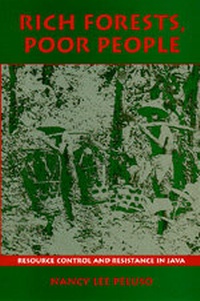
Rich Forests, Poor People
Resource Control and Resistance in Java
1st Edition
Will be published approx. on 2. November 1994
Book
Paperback/Softback
336 pages
978-0-520-08931-0 (ISBN)
Description
Millions of Javanese peasants live alongside state-controlled forest lands in one of the world's most densely populated agricultural regions. Because their legal access and customary rights to the forest have been severely limited, these peasants have been pushed toward illegal use of forest resources. Rich Forests, Poor People untangles the complex of peasant and state politics that has developed in Java over three centuries. Drawing on historical materials and intensive field research, including two contemporary case studies, Peluso presents the story of the forest and its people. Without major changes in forest policy, Peluso contends, the situation is portentous. Economic, social, and political costs to the government will increase. Development efforts will by stymied and forest destruction will continue. Mindful that a dramatic shift is unlikely, Peluso suggests how tension between foresters and villagers can be alleviated while giving peasants a greater stake in local forest management.
More details
Edition
First Edition
Language
English
Place of publication
Berkerley
United States
Target group
College/higher education
Professional and scholarly
Product notice
Paperback (trade)
Illustrations
19 b-w illustrations, 6 figures, 13 tables, 2 maps
Dimensions
Height: 229 mm
Width: 152 mm
Thickness: 20 mm
Weight
454 gr
ISBN-13
978-0-520-08931-0 (9780520089310)
Copyright in bibliographic data and cover images is held by Nielsen Book Services Limited or by the publishers or by their respective licensors: all rights reserved.
Schweitzer Classification
Other editions
Additional editions
E-Book
09/2023
1st Edition
Naval Institute Press
€32.99
Available for download
Person
Nancy Lee Peluso is Associate Professor in the Department of Environmental Science, Policy, and Management at the University of California, Berkeley.
Content
Acknowledgments Part I. INTRODUCTION 1. Structures of Access Control, Repetoires of Resistance Part II. TRADITIONS OF FOREST CONTROL IN JAVA 2. Gaining Access to People and Trees 3. The Emergence of "Scientific" Forestry in Colonial Java Part III. STATE FORESTS AND CHANGES IN STATE 4. Organized Forest Violence, Reorganized Forest Access, 1942-1966 5. State Power to Persist: Contemporary Forms of Forest Access Control Part IV. PEASANT POWER TO RESIST 6. A Forest without Trees 7. Teak and Temptation on the Extreme Periphery: Cultural Perspectives on Forest Crime Part V. CONCLUSION 8. Toward Integrated Social Forestry