

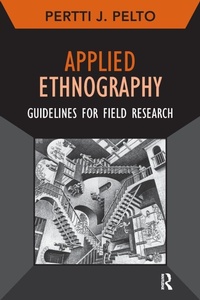
Applied Ethnography
Guidelines for Field Research
1st Edition
Published on 15. May 2013
Book
Paperback/Softback
352 pages
978-1-61132-208-8 (ISBN)
Description
This comprehensive, engaging guide to applied research distills the expertise of the distinguished ethnographer and methodologist Pertti Pelto over his acclaimed 50-year career. Having written the first major text promoting mixed qualitative and quantitative methods in applied ethnography in the 1970s, Pelto now synthesizes decades of innovation, including examples from around the world that illustrate how specific methods yield immediate results for addressing social problems. Ideal for researchers, students, training programs, and technical assistance projects, this thorough text covers the key topics and skills required: gaining entry, recording and organizing field data, a host of specialized techniques, integrating qualitative and quantitative methods, building and training research teams, rapid assessment and focused ethnographic studies, short- and long-term ethnography, writing up results, non-Western perspectives on research, and more.
More details
Series
Language
English
Place of publication
Walnut Creek
United States
Target group
College/higher education
Illustrations
black & white illustrations, black & white tables, figures
Dimensions
Height: 229 mm
Width: 152 mm
Thickness: 19 mm
Weight
513 gr
ISBN-13
978-1-61132-208-8 (9781611322088)
Copyright in bibliographic data and cover images is held by Nielsen Book Services Limited or by the publishers or by their respective licensors: all rights reserved.
Schweitzer Classification
Other editions
Additional editions
E-Book
06/2016
Routledge
€53.99
Available for download
E-Book
06/2016
Routledge
€53.99
Available for download
Book
05/2013
1st Edition
Left Coast Press Inc
€232.50
Shipment within 3-4 weeks
Person
Pertti J. (Bert) Pelto is Professor Emeritus of Anthropology at the University of Connecticut, USA where he founded the program in medical anthropology. During his career he also served on the faculty of Cornell University, the University of Minnesota, and Washington University. His foundational Anthropological Research: The Structure of Inquiry (1970), in which he argued for a comprehensive mix of qualitative and quantitative approaches, was the first methodology textbook in socio-cultural anthropology and among the first in qualitative research more generally. He is author or editor of many other major books and textbooks, some of which are The Snowmobile Revolution (1973), Technology and Social Change (ed., with H. R. Bernard, 1983), Research Methods in Nutritional Anthropology (with G. Pelto and E. Messer 1989), and Sexuality in the Time of AIDS (ed., with R. Verma, S. Schensul, and A. Joshi, 2004). Dr. Pelto has spent much of the past two decades time in India training and advising research groups and working with HIV/AIDS projects and other applied programmes.
Content
1: Introduction to Ethnographic Research; 2: Main Steps of Applied Ethnographic Field Research; 3: Gaining Entry to a Study Site: Getting Started; 4: Social Mapping and Sketch Mapping: Getting the Lay of the Land; 5: Early Phases of Research: Key Informants and Group Discussions; 6: Note Taking and Other Recording: Capturing and Managing the Data; 7: Participant Observation; 8: Sampling and Counting in Ethnographic Research; 9: In-Depth Interviewing: Case Interviews; 10: Free Lists: Getting an Inventory of Things in a Cultural Domain; 11: Pile Sorting and Other Structured Interviews; 12: Analysis of Qualitative Text Data: Basic Steps; 13: Structured Observation of Behaviors and Events; 14: Using Hypothetical Scenarios, Diaries, and Other Special Techniques; 15: Mapping: A Powerful Tool in Ethnographic Research; 16: Qualitative Research Guidelines: RAP, PRA, RRA, FES, and Others; 17: Research Teams and Training in Applied Ethnographic Research; 18: Writing Ethnography: Keeping it Grounded and Inductive; 19: Past, Present, Future: Notes on the History and Future of Applied Ethnography