

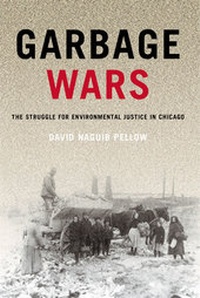
Garbage Wars
The Struggle for Environmental Justice in Chicago
Published on 2. August 2002
Book
Hardback
256 pages
978-0-262-16212-8 (ISBN)
Description
In Garbage Wars, the sociologist David Pellow describes the politics of
garbage in Chicago. He shows how garbage affects residents in vulnerable communities
and poses health risks to those who dispose of it. He follows the trash, the
pollution, the hazards, and the people who encountered them in the period 1880-2000.
What unfolds is a tug of war among social movements, government, and industry over
how we manage our waste, who benefits, and who pays the costs.Studies demonstrate
that minority and low-income communities bear a disproportionate burden of
environmental hazards. Pellow analyzes how and why environmental inequalities are
created. He also explains how class and racial politics have influenced the waste
industry throughout the history of Chicago and the United States. After examining
the roles of social movements and workers in defining, resisting, and shaping
garbage disposal in the United States, he concludes that some environmental groups
and people of color have actually contributed to environmental inequality.By
highlighting conflicts over waste dumping, incineration, landfills, and recycling,
Pellow provides a historical view of the garbage industry throughout the life cycle
of waste. Although his focus is on Chicago, he places the trends and conflicts in a
broader context, describing how communities throughout the United States have
resisted the waste industry's efforts to locate hazardous facilities in their
backyards. The book closes with suggestions for how communities can work more
effectively for environmental justice and safe, sustainable waste
management.
garbage in Chicago. He shows how garbage affects residents in vulnerable communities
and poses health risks to those who dispose of it. He follows the trash, the
pollution, the hazards, and the people who encountered them in the period 1880-2000.
What unfolds is a tug of war among social movements, government, and industry over
how we manage our waste, who benefits, and who pays the costs.Studies demonstrate
that minority and low-income communities bear a disproportionate burden of
environmental hazards. Pellow analyzes how and why environmental inequalities are
created. He also explains how class and racial politics have influenced the waste
industry throughout the history of Chicago and the United States. After examining
the roles of social movements and workers in defining, resisting, and shaping
garbage disposal in the United States, he concludes that some environmental groups
and people of color have actually contributed to environmental inequality.By
highlighting conflicts over waste dumping, incineration, landfills, and recycling,
Pellow provides a historical view of the garbage industry throughout the life cycle
of waste. Although his focus is on Chicago, he places the trends and conflicts in a
broader context, describing how communities throughout the United States have
resisted the waste industry's efforts to locate hazardous facilities in their
backyards. The book closes with suggestions for how communities can work more
effectively for environmental justice and safe, sustainable waste
management.
More details
Series
Language
English
Place of publication
Cambridge, Mass.
United States
Publishing group
MIT Press Ltd
Target group
College/higher education
Professional and scholarly
Illustrations
8 illus.
Dimensions
Height: 229 mm
Width: 152 mm
Thickness: 25 mm
Weight
490 gr
ISBN-13
978-0-262-16212-8 (9780262162128)
Copyright in bibliographic data and cover images is held by Nielsen Book Services Limited or by the publishers or by their respective licensors: all rights reserved.
Schweitzer Classification
Other editions
Additional editions
E-Book
09/2004
MIT Press
€24.49
Available for download
Person
David Naguib Pellow is Professor of Ethnic Studies and Director of California Cultures in Comparative Perspective at the University of California, San Diego. Among his books are the award-winning Garbage Wars: The Struggle for Environmental Justice in Chicago (MIT Press, 2002) and Power, Justice, and the Environment: A Critical Appraisal of the Environmental Justice Movement (coedited with Robert Brulle; MIT Press, 2005.)