

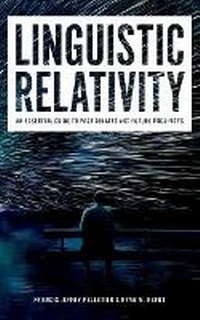
Linguistic Relativity
An essential guide to past debates and future prospects
Published on 17. September 2025
Book
Hardback
160 pages
978-0-19-779983-3 (ISBN)
Description
The concept of linguistic relativity (or Whorfianism) has its roots in the linguistic anthropology of Edward Sapir and his student Benjamin Whorf in the early twentieth century. However, questions over the relationship between natural language and human cognition go much further and deeper. Unfortunately, linguistic relativity has about as many misinterpretations as it does labels (linguistic relativity, linguistic relativism, linguistic determinism, Whorfianism, Sapir-Whorf hypothesis - weak and strong).
The idea that language determines thought through an environmentally constrained feedback system is at the heart of most concepts associated with linguistic relativity. The real philosophical questions, however, only seem to present themselves at a level beyond the trivial truism that linguistic structure has an effect on thought, i.e. different languages might encode environmental information differently resulting in variation in things like processing times, measured in psycholinguistic experiments.
These questions are important for a number of related disciplines, yet the concept itself is one of the most misunderstood in modern anthropology, sociology, philosophy of language, linguistics, and cognitive science. This book contributes much needed clarity to a theoretical landscape at the centre of insights into what makes us human, both linguistically and cognitively.
The idea that language determines thought through an environmentally constrained feedback system is at the heart of most concepts associated with linguistic relativity. The real philosophical questions, however, only seem to present themselves at a level beyond the trivial truism that linguistic structure has an effect on thought, i.e. different languages might encode environmental information differently resulting in variation in things like processing times, measured in psycholinguistic experiments.
These questions are important for a number of related disciplines, yet the concept itself is one of the most misunderstood in modern anthropology, sociology, philosophy of language, linguistics, and cognitive science. This book contributes much needed clarity to a theoretical landscape at the centre of insights into what makes us human, both linguistically and cognitively.
More details
Language
English
Place of publication
New York
United States
Target group
College/higher education
Dimensions
Height: 15 mm
Width: 140 mm
Thickness: 210 mm
Weight
267 gr
ISBN-13
978-0-19-779983-3 (9780197799833)
Copyright in bibliographic data and cover images is held by Nielsen Book Services Limited or by the publishers or by their respective licensors: all rights reserved.
Schweitzer Classification
Other editions
Additional editions
Francis Jeffry Pelletier | Ryan M. Nefdt
Linguistic Relativity
An essential guide to past debates and future prospects
Book
08/2025
Oxford University Press Inc
€25.50
Available immediately
Francis Jeffry Pelletier | Ryan M. Nefdt
Linguistic Relativity
An Essential Guide to Past Debates and Future Prospects
E-Book
05/2025
OUP eBook
€18.49
Available for download
Francis Jeffry Pelletier | Ryan M. Nefdt
Linguistic Relativity
An Essential Guide to Past Debates and Future Prospects
E-Book
05/2025
OUP eBook
€18.49
Available for download
Persons
Francis Jeffry Pelletier is a Professor Emeritus, Philosophy and Computing Science at the University of Alberta and Professor Emeritus, Philosophy and Linguistics and Simon Fraser University Canada Research Chair in Cognitive Science (2004-2010) at the Simon Fraser University. He is the author of countless journal articles and book chapters in linguistics, cognitive science, computer science, logic, and philosophy.
Ryan M. Nefdt is a Senior Research Fellow at the University of Bristol and a Professor of Philosophy who works on issues in linguistics, cognitive science, and AI at the University of Cape Town. He is the author of Language, Science and Structure (OUP 2023), as well as numerous articles and book chapters in linguistics and philosophy.
Ryan M. Nefdt is a Senior Research Fellow at the University of Bristol and a Professor of Philosophy who works on issues in linguistics, cognitive science, and AI at the University of Cape Town. He is the author of Language, Science and Structure (OUP 2023), as well as numerous articles and book chapters in linguistics and philosophy.
Content
Preface Acknowledgment 1: Basic Linguistic Relativity A Quick Sketch 2: Some Historical Antecedents of Linguistic Relativity 3: Edward Sapir and Benjamin Lee Whorf: Lives, Research, and Whorfianism 4: Three Interpretations of Linguistic Relativity 5: Linguistic Relativity and Cognitive Science 6: Conclusion: Whorf and Relativity-Yes? or No? 7: Afterword Bibliography Index