

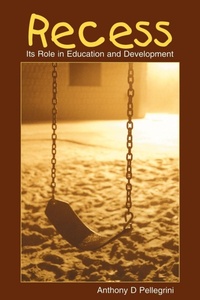
Recess
Its Role in Education and Development
1st Edition
Published on 10. June 2005
Book
Paperback/Softback
214 pages
978-0-8058-5544-9 (ISBN)
Description
Writing a book about recess could be a very questionable endeavor for a serious academic psychologist. At first blush it seems to be a pretty trivial topic. It's the time during the school day where there's a break from what's typically considered the most serious work of the day--reading, writing, and arithmetic. Reflecting this trivial tenor, it's also that time of the school day that kids--perhaps only half jokingly--say is their favorite part of school. This perception has lead many schools to question the role of recess in the school day. This book is an attempt to broach two views of recess--the perceived value of recess and the movement to eliminate or reduce the school recess period from the primary school day.
Due to tightened school budgets and the emphasis on testing, many elementary schools eliminate recess, gym classes, and play periods to the developmental detriment of the very children the schools are supposed to serve. Author Anthony Pellegrini has conducted a number of careful studies regarding student attentiveness and performance within programs that have recess periods, and those that don't. The data show that students need recess in order to blow off energy and interact with each other in the unstructured recess environment in order to grow socially. The goal of Recess is to help readers realize the importance of recess and counter the trend to eliminate it from schools.
This book appeals to academics, teachers, administrators, and parents.
Due to tightened school budgets and the emphasis on testing, many elementary schools eliminate recess, gym classes, and play periods to the developmental detriment of the very children the schools are supposed to serve. Author Anthony Pellegrini has conducted a number of careful studies regarding student attentiveness and performance within programs that have recess periods, and those that don't. The data show that students need recess in order to blow off energy and interact with each other in the unstructured recess environment in order to grow socially. The goal of Recess is to help readers realize the importance of recess and counter the trend to eliminate it from schools.
This book appeals to academics, teachers, administrators, and parents.
Reviews / Votes
"Well-organized and readable, the book's nine chapters outline the contours of the recess debate....Comprehensive author and subject indices enhance the book's referencing capacity. He builds a compelling case for how play and recess contribute to children's social competence and academic performance."-Education Review
"In this readable and informative account, the author notes the importance of recess for improving academic performance as well as providing an opportunity for children to develop social skills. Pellegrini marshals the available information to make a convincing argument for the continuation of recess as an aid to better academic and social performance in school. Highly recommended. General readers, upper-division undergraduates through practitioners."
-CHOICE
"This is a timely book with an urgent message. School recess is under threat. Pellegrini persuasively argues the case for the need to safeguard recess and play times in schools, on academic as well as social grounds. In the process we also get fascinating accounts of the history of recess, the nature of children's play, and gender differences. This is important reading for school personnel, play workers, and students in education and child development."
-Peter K. Smith
University of London, United Kingdom
"Recess, as it turns out, is serious business, and Tony Pellegrini takes us through the research on the topic, its importance to children's development, and why its disappearance from schools is a mistake. His conversational tone makes this informative and educationally important book a joy to read. Pellegrini has spent much of his career devoted to studying play and recess, and his book deserves to be widely read by researchers, educators, and social policy makers. It should be central in informing the debate about how to best educate our children."
-David F. Bjorklund
Florida Atlantic University
"...But the book also carries a powerful message. Paradoxically, recess or playtime is a serious and important business and current trends to cut back on it are likely to be damaging to students and society. Pellegrini is clear about the perils involved, and highlights implications for educational, psychological, and social policy."
-Peter Blatchford
University of London, United Kingdom
More details
Series
Language
English
Place of publication
Philadelphia
United States
Publishing group
Taylor & Francis Inc
Target group
College/higher education
Professional and scholarly
Dimensions
Height: 229 mm
Width: 152 mm
Thickness: 12 mm
Weight
321 gr
ISBN-13
978-0-8058-5544-9 (9780805855449)
Copyright in bibliographic data and cover images is held by Nielsen Book Services Limited or by the publishers or by their respective licensors: all rights reserved.
Schweitzer Classification
Other editions
Additional editions
E-Book
04/2006
Psychology Press Ltd
€59.49
Available for download
E-Book
04/2006
1st Edition
Psychology Press Ltd
€59.49
Available for download
Book
06/2005
1st Edition
Psychology Press
€205.40
Shipment within 10-20 days
Person
Anthony D. Pellegrini
Content
Contents: Preface. The Debate Over Recess: A Sad Tale of the Disjuncture Between Educational Policy and Scientific Research. A Brief History of the Place of Play and Recess in American Schools. The School Playground as a Venue for Children's Social Development. The Two Worlds of the Playground: Gender Segregation at Recess. Gender Differences in Preference for Outdoor Recess. Children's Play and Rough-and-Tumble Play on the Playground. Children's Games on the Playground at Recess. The Role of Recess in Children's Cognitive Performance in Classrooms. Summing Up: What Are the Implications of Recess for Children in School?