

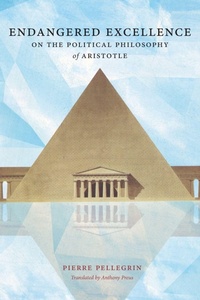
Endangered Excellence
On the Political Philosophy of Aristotle
Published on 2. July 2021
Book
Paperback/Softback
432 pages
978-1-4384-7956-9 (ISBN)
Description
A fresh look at Aristotle's political theory with attention to the resonance of his thought for contemporary concerns.
In Endangered Excellence, Pierre Pellegrin provides a fresh interpretation of Aristotle's Politics, revealing the extent to which Aristotle diverged from other ancient writers on politics, and the extent to which many of his positions resemble modern attitudes in political philosophy. Pellegrin highlights a number of strikingly original positions in his thought. Aristotle took humans to be inherently political, for example, even as he believed this characteristic developed more completely in men than in women, and in Greeks more than in barbarians. He maintained a nuanced and flexible conception of the way that cities ought to develop their constitutions, one that would be responsive to their particular social and historical contexts. Realist enough to recognize that virtuous men are rare and that class conflict is inevitable, Aristotle envisioned a political system that would be resilient in navigating the choppy waters of civic life. With this original approach to Aristotle's Politics, and incorporating key developments in European and English-language scholarship on the subject, Pellegrin demonstrates Aristotle's important and often unrecognized innovations in understanding political life.
In Endangered Excellence, Pierre Pellegrin provides a fresh interpretation of Aristotle's Politics, revealing the extent to which Aristotle diverged from other ancient writers on politics, and the extent to which many of his positions resemble modern attitudes in political philosophy. Pellegrin highlights a number of strikingly original positions in his thought. Aristotle took humans to be inherently political, for example, even as he believed this characteristic developed more completely in men than in women, and in Greeks more than in barbarians. He maintained a nuanced and flexible conception of the way that cities ought to develop their constitutions, one that would be responsive to their particular social and historical contexts. Realist enough to recognize that virtuous men are rare and that class conflict is inevitable, Aristotle envisioned a political system that would be resilient in navigating the choppy waters of civic life. With this original approach to Aristotle's Politics, and incorporating key developments in European and English-language scholarship on the subject, Pellegrin demonstrates Aristotle's important and often unrecognized innovations in understanding political life.
Reviews / Votes
"The result of Pellegrin's many decades of highly regarded scholarly work on Aristotle's philosophy, this book has much to offer the Aristotle specialist ... Particularly valuable is the way that he demonstrates how the seemingly disparate discussions of an idea or theme, when drawn together from various parts of the book, provide a comprehensive, subtle understanding of the concept being examined. Preus's translation is clear and very readable." - CHOICEMore details
Series
Language
English
Place of publication
Albany, NY
United States
Target group
Professional and scholarly
US School Grade: College Graduate Student and over
Product notice
Paperback (trade)
Dimensions
Height: 229 mm
Width: 152 mm
Thickness: 26 mm
Weight
697 gr
ISBN-13
978-1-4384-7956-9 (9781438479569)
Copyright in bibliographic data and cover images is held by Nielsen Book Services Limited or by the publishers or by their respective licensors: all rights reserved.
Schweitzer Classification
Other editions
Additional editions
E-Book
09/2020
1st Edition
De Gruyter
from
€91.99
Available for download
Persons
Pierre Pellegrin is Director of the National Center for Scientific Research in Paris, France. His books include Aristotle's Classification of Animals: Biology and the Conceptual Unity of the Aristotelian Corpus (translated by Anthony Preus) and A Companion to Ancient Philosophy (coedited with Mary Louise Gill). Anthony Preus is Distinguished Teaching Professor in Philosophy at Binghamton University, State University of New York. He is the author and editor of many books, including Historical Dictionary of Ancient Greek Philosophy.
Content
Translator's Note
Abbreviations
Introduction: "Our Ancestors the Greeks"
1. The Philosopher in Politics
2. A Biological Politics?
3. The Endangered Happiness of the City
4. Citizen, City, Constitution
5. On the Positive Use of Deviance
6. The Legislator
7. The Theoretical Tools of the Legislator
8. Political Matter
Conclusion
Bibliography
Index
Abbreviations
Introduction: "Our Ancestors the Greeks"
1. The Philosopher in Politics
2. A Biological Politics?
3. The Endangered Happiness of the City
4. Citizen, City, Constitution
5. On the Positive Use of Deviance
6. The Legislator
7. The Theoretical Tools of the Legislator
8. Political Matter
Conclusion
Bibliography
Index