

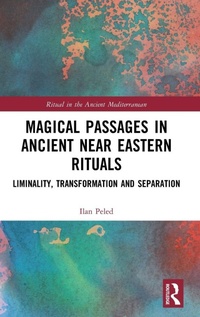
Magical Passages in Ancient Near Eastern Rituals
Liminality, Transformation and Separation
1st Edition
Published on 24. September 2025
Book
Hardback
254 pages
978-1-041-06632-3 (ISBN)
Description
This book focuses on the element of thresholds - makeshift gates, makeshift structures and house doors - as concepts of liminality in ancient Near Eastern magical rituals, and the idea of transformation they reflect.
Readers gain an in-depth understanding of theories of liminality and rites of passage, and how they illuminate fascinating aspects of social behavior and religious and cultic practices in ancient Near Eastern societies, specifically those of Hatti and Mesopotamia. Ritual liminality, manifested in the use of makeshift and permanent architectural elements, was meant to facilitate two different aims: transformation from one category to the other (using makeshift gates and structures) and separation between categories (using house doors). The book presents the pertinent ritual texts in their original languages, analyzes these texts in detail and offers comparative discussions of the different cultures that practiced these rituals.
Magical Passages in Ancient Near Eastern Rituals is suitable for students and scholars interested in ancient religions, rituals and cults, particularly in the ancient Near East, as well as those working on ancient history, philology, anthropology and religious studies more broadly.
Readers gain an in-depth understanding of theories of liminality and rites of passage, and how they illuminate fascinating aspects of social behavior and religious and cultic practices in ancient Near Eastern societies, specifically those of Hatti and Mesopotamia. Ritual liminality, manifested in the use of makeshift and permanent architectural elements, was meant to facilitate two different aims: transformation from one category to the other (using makeshift gates and structures) and separation between categories (using house doors). The book presents the pertinent ritual texts in their original languages, analyzes these texts in detail and offers comparative discussions of the different cultures that practiced these rituals.
Magical Passages in Ancient Near Eastern Rituals is suitable for students and scholars interested in ancient religions, rituals and cults, particularly in the ancient Near East, as well as those working on ancient history, philology, anthropology and religious studies more broadly.
More details
Series
Language
English
Place of publication
London
United Kingdom
Publishing group
Taylor & Francis Ltd
Target group
College/higher education
Postgraduate and Undergraduate Advanced
Illustrations
5 s/w Abbildungen, 5 s/w Photographien bzw. Rasterbilder, 1 s/w Tabelle
1 Tables, black and white; 5 Halftones, black and white; 5 Illustrations, black and white
Dimensions
Height: 240 mm
Width: 161 mm
Thickness: 19 mm
Weight
564 gr
ISBN-13
978-1-041-06632-3 (9781041066323)
Copyright in bibliographic data and cover images is held by Nielsen Book Services Limited or by the publishers or by their respective licensors: all rights reserved.
Schweitzer Classification
Other editions
Additional editions
Ilan Peled
Magical Passages in Ancient Near Eastern Rituals
Liminality, Transformation and Separation
E-Book
09/2025
Routledge
€60.99
Available for download
Ilan Peled
Magical Passages in Ancient Near Eastern Rituals
Liminality, Transformation and Separation
E-Book
09/2025
Routledge
€60.99
Available for download
Person
Ilan Peled is a historian working at the Leiden University Institute for Area Studies, Netherlands. He is the author of Masculinities and Third Gender (2016), Law and Gender in the Ancient Near East (2020) and Magic in the Ancient Near East (2026), and the editor of Structures of Power (2017).
Content
Introduction; Part 1: Hatti; Chapter 1: Hittite Rituals Using Makeshift Gates in the Public Domain; Chapter 2: Hittite Rituals Using Makeshift Gates in the Private Domain; Chapter 3: Hittite Rituals Using Makeshift Structures in the Public Domain; Chapter 4: Hittite Rituals Using Makeshift Structures in the Private Domain; Chapter 5: Hittite Rituals Using the House Door; Part 2: Mesopotamia; Chapter 6: Mesopotamian Rituals Using Makeshift Structures in the Public Domain; Chapter 7: Mesopotamian Rituals Using Makeshift Structures in the Private Domain; Chapter 8: Mesopotamian Rituals Using Makeshift Gates in the Private Domain; Chapter 9: Mesopotamian Rituals Using the House Door; Part 3: Interpretation and Discussion; Conclusions.