

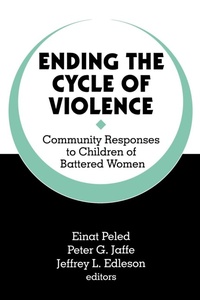
Ending the Cycle of Violence
Community Responses to Children of Battered Women
1st Edition
Published on 27. October 1994
Book
Paperback/Softback
320 pages
978-0-8039-5369-7 (ISBN)
Description
Canadian and American contributors to this book describe a wide range of programs offered to deal with the direct and indirect victims of men who batter. These include individual treatment options for children who witness the violence, parenting programs for men who batter, and prevention programs targeting high school students. For those involved in providing family services, the book is guaranteed to be both informative and thought-provoking. --John Hunsley in The Canadian Family Psychologist "There is a great deal to reflect upon in every section of the book. The chapters on assessment of children exposed to family violence, and on providing individual and group therapy for children of abused women, take up some very important issues. . . . This book is to be highly commended for its unequivocal espousal of the tenet that a child who witnesses the abuse of his or her mother is an abused child." --Chris Goddard in Child Abuse Review "This is an invaluable collection of papers that both raises awareness regarding the growing body of research that indicates the negative psychological effects domestic violence has on children even if they themselves are not the target of the violence, as well as offering practical suggestions for clinicians. It is a useful resource book for anyone working with the issue of family violence." --G. Smith in European Child & Adolescent Psychiatry Although there is a growing body of research on children of battered women, there has been little practical information available on intervention with these children. Ending the Cycle of Violence is the first volume to cover the varied and complex arena of intervention with children of battered women. It provides an overview of current practices including strategies and program models. The expert contributors present a concise and accessible look into four major areas: living in a violent culture, shelters and domestic violence counseling, child protection services and the criminal justice system, and prevention and education in schools and communities. Practitioners who work with battered women and their children--shelter and domestic violence program staff, battered women's advocates, and counselors--will find this book most useful. It will also be helpful to all professionals working with children in schools, child protective services, youth programs, health and mental health agencies, institutions, group homes, and foster care settings. Ending the Cycle of Violence also provides and overview of innovations in this field that can enhance policymakers' ability to further develop services for this at-risk population.
More details
Language
English
Place of publication
Thousand Oaks
United States
Target group
Professional and scholarly
Dimensions
Height: 229 mm
Width: 152 mm
Thickness: 19 mm
Weight
522 gr
ISBN-13
978-0-8039-5369-7 (9780803953697)
Copyright in bibliographic data and cover images is held by Nielsen Book Services Limited or by the publishers or by their respective licensors: all rights reserved.
Schweitzer Classification
Other editions
Additional editions

Einat Peled | Peter G. Jaffe | Jeffrey L. Edleson
Ending the Cycle of Violence
Community Responses to Children of Battered Women
Book
04/1995
1st Edition
SAGE Publications Inc
€88.09
Article exhausted; check different version
Persons
Peter Jaffe is the Founding Director (1975-2001) and Special Advisor on Violence Prevention of the Centre for Children and Families in the Justice System of the London Family Court Clinic; member of the Clinical Adjunct Faculty for the Departments of Psychology and Psychiatry at the University of Western Ontario; former chair of the Board of Directors of the Battered Women's Advocacy Centre; and past Chairperson and a founding board member of the Board of Directors for the Centre for Research on Violence Against Women and Children. He gives presentations on violence and facilitates over 50 workshops a year for teachers, students, lawyers, judges, police, doctors, clergy and various community groups. Dr. Jaffe is the recipient of many awards and grants, author of numerous research articles, and co-author of four books dealing with children exposed to domestic violence.
Jeffrey L. Edleson, PhD, is Dean and Professor at the University of California, Berkeley, School of Social Welfare. He is Professor Emeritus in the University of Minnesota School of Social Work and founding director of the Minnesota Center Against Violence and Abuse. He has published more than 130 articles and 12 books on domestic violence, group work, and program evaluation. Edleson recently served on the US National Advisory Council on Violence Against Women and is a Fellow of the American Academy of Social Work and Social Welfare.
Jeffrey L. Edleson, PhD, is Dean and Professor at the University of California, Berkeley, School of Social Welfare. He is Professor Emeritus in the University of Minnesota School of Social Work and founding director of the Minnesota Center Against Violence and Abuse. He has published more than 130 articles and 12 books on domestic violence, group work, and program evaluation. Edleson recently served on the US National Advisory Council on Violence Against Women and is a Fellow of the American Academy of Social Work and Social Welfare.
Content
PART ONE: LIVING IN A VIOLENT CULTURE
Introduction - Einat Peled, Peter G Jaffe and Jeffrey L Edleson
Learning to be Violent - Myriam Miedzian
PART TWO: SHELTERS AND DOMESTIC VIOLENCE PROGRAMS
Assessment Following Violence-Witnessing Trauma - William Arroyo and Spencer Eth
Individual Psychotherapy for the Traumatized Children of Abused Women - Louise Silvern, Jane Karyl and Toby Y Landis
Process and Outcome in Small Groups for Children of Battered Women - Einat Peled and Jeffrey L Edleson
Empowering Battered Women as Mothers - Joan Bilinkoff
Parenting Groups for Men Who Batter - David J Mathews
Advocacy for Children of Battered Women - Honore M Hughes and Michele Marshall
PART THREE: CHILD PROTECTION AND THE CRIMINAL JUSTICE SYSTEM
How Abused Women Can Use the Law To Help Protect Their Children - Joan Zorza
Child Protection Services for Children of Battered Women - Carole Echlin and Larry Marshall
Practice and Controversy
Doing More Harm Than Good? Some Cautions on Visitation Centers - Martha McMahon and Ellen Pence
PART FOUR: PREVENTION AND EDUCATION IN SCHOOLS AND COMMUNITIES
Teach Your Children Well - Denise Gamache and Sarah Snapp
Elementary Schools and Violence Prevention
Violence Prevention Programs in Secondary (High) Schools - Marlies Sudermann, Peter G Jaffe and Elaine Hastings
Strategies To Address Violence in the Lives of High Risk Youth - David A Wolfe et al
Aboriginal Canadian Children Who Witness and Live with Violence - Claudette Dumont-Smith
Conclusion - Einat Peled, Peter G Jaffe and Jeffrey L Edleson
Introduction - Einat Peled, Peter G Jaffe and Jeffrey L Edleson
Learning to be Violent - Myriam Miedzian
PART TWO: SHELTERS AND DOMESTIC VIOLENCE PROGRAMS
Assessment Following Violence-Witnessing Trauma - William Arroyo and Spencer Eth
Individual Psychotherapy for the Traumatized Children of Abused Women - Louise Silvern, Jane Karyl and Toby Y Landis
Process and Outcome in Small Groups for Children of Battered Women - Einat Peled and Jeffrey L Edleson
Empowering Battered Women as Mothers - Joan Bilinkoff
Parenting Groups for Men Who Batter - David J Mathews
Advocacy for Children of Battered Women - Honore M Hughes and Michele Marshall
PART THREE: CHILD PROTECTION AND THE CRIMINAL JUSTICE SYSTEM
How Abused Women Can Use the Law To Help Protect Their Children - Joan Zorza
Child Protection Services for Children of Battered Women - Carole Echlin and Larry Marshall
Practice and Controversy
Doing More Harm Than Good? Some Cautions on Visitation Centers - Martha McMahon and Ellen Pence
PART FOUR: PREVENTION AND EDUCATION IN SCHOOLS AND COMMUNITIES
Teach Your Children Well - Denise Gamache and Sarah Snapp
Elementary Schools and Violence Prevention
Violence Prevention Programs in Secondary (High) Schools - Marlies Sudermann, Peter G Jaffe and Elaine Hastings
Strategies To Address Violence in the Lives of High Risk Youth - David A Wolfe et al
Aboriginal Canadian Children Who Witness and Live with Violence - Claudette Dumont-Smith
Conclusion - Einat Peled, Peter G Jaffe and Jeffrey L Edleson