

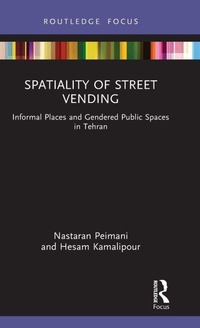
Spatiality of Street Vending
Informal Places and Gendered Public Spaces in Tehran
1st Edition
Published on 4. June 2026
Book
Hardback
124 pages
978-1-032-56414-2 (ISBN)
Description
This book reframes street vending beyond depictions of marginality or disorder, exploring how informal street vending works as a situated, negotiated, diverse, relational, and gendered practice within contested public spaces. Bringing together a critical review of scholarship with an assemblage-informed methodological framework, it positions informality as relational and spatially embedded, emerging through interactions among mobility, public space edges, pedestrian flows, governance, street life, and everyday survival.
Focusing on Tehran as a critical case, this book presents two detailed case studies. Through field observation, photographic survey, urban mapping, and archival research, it investigates how different types of street vending unfold in relation to mixed-use corridors and transit nodes. A typology grounded in mobility and proximity to public/private interfaces shows how certain forms of street vending enable economic resilience while contributing to street-level sociability and urban intensity.
The concluding discussion situates these findings within broader governance, political economy, and gender dynamics, addressing selective enforcement, institutional opacity, and women's uneven access to public space and the informal economy. This book will appeal to scholars and practitioners in urban design, planning, geography, and Middle Eastern studies seeking empirically grounded, critically reflexive insights into informality, public space, and the everyday politics of the city.
Focusing on Tehran as a critical case, this book presents two detailed case studies. Through field observation, photographic survey, urban mapping, and archival research, it investigates how different types of street vending unfold in relation to mixed-use corridors and transit nodes. A typology grounded in mobility and proximity to public/private interfaces shows how certain forms of street vending enable economic resilience while contributing to street-level sociability and urban intensity.
The concluding discussion situates these findings within broader governance, political economy, and gender dynamics, addressing selective enforcement, institutional opacity, and women's uneven access to public space and the informal economy. This book will appeal to scholars and practitioners in urban design, planning, geography, and Middle Eastern studies seeking empirically grounded, critically reflexive insights into informality, public space, and the everyday politics of the city.
More details
Language
English
Place of publication
London
United Kingdom
Publishing group
Taylor & Francis Ltd
Target group
College/higher education
Professional and scholarly
Postgraduate and Undergraduate Advanced
Product notice
Laminated cover
Illustrations
8 s/w Photographien bzw. Rasterbilder, 7 s/w Zeichnungen, 3 s/w Tabellen, 15 s/w Abbildungen
3 Tables, black and white; 7 Line drawings, black and white; 8 Halftones, black and white; 15 Illustrations, black and white
Dimensions
Height: 216 mm
Width: 140 mm
Thickness: 10 mm
Weight
308 gr
ISBN-13
978-1-032-56414-2 (9781032564142)
Copyright in bibliographic data and cover images is held by Nielsen Book Services Limited or by the publishers or by their respective licensors: all rights reserved.
Schweitzer Classification
Other editions
Additional editions
Nastaran Peimani | Hesam Kamalipour
Spatiality of Street Vending
Informal Places and Gendered Public Spaces in Tehran
E-Book
06/2026
Routledge
€31.49
Available for download
Nastaran Peimani | Hesam Kamalipour
Spatiality of Street Vending
Informal Places and Gendered Public Spaces in Tehran
E-Book
06/2026
Routledge
€31.49
Available for download
Persons
Nastaran Peimani is a Reader (Associate Professor) in Urban Design, the Leader of the Urbanism Research Group, and the Co-Founding Director of the Public Space Observatory Research Centre at Cardiff University. Since 2021, she has served as the Co-Director of the MA Urban Design programme at the Welsh School of Architecture, Cardiff University. Her research primarily focuses on the intersections of urban design, the built environment, urban mobilities, and forms of informality. Her current research interests include the spatiality of street vending, public space and urbanity, transit-oriented urbanism, urban morphology, urban mapping, and urban design education and pedagogy. She is the Associate Editor of International Planning Studies and an editorial board member of Urban Design and Planning and Sage Open. She is the co-editor of The Routledge Handbook of Urban Design Research Methods (Routledge, 2023) and co-author of Urban Design Education (Edward Elgar, 2025).
Hesam Kamalipour is a Reader (Associate Professor) in Urban Design and Co-Founding Director of the Public Space Observatory Research Centre at Cardiff University, where he previously served as Co-Director of the MA Urban Design programme. His work lies at the intersections of urban design, informal urbanism, public space, urban morphology, and comparative urbanism. He is the lead co-editor of The Routledge Handbook of Urban Design Research Methods (Routledge, 2023) and lead co-author of Urban Design Education (Edward Elgar, 2025). He is currently authoring a forthcoming monograph titled Informal Design (Routledge) and a further book titled Framing Urbanism (Palgrave Macmillan). He serves as Associate Editor of Frontiers in Sustainable Cities - Cities in the Global South and is an editorial board member of Cities, Habitat International, Journal of Urban Management, Urban Design and Planning, The Journal of Public Space, Planning Practice & Research, International Journal of Architectural Research, and Urban Planning.
Hesam Kamalipour is a Reader (Associate Professor) in Urban Design and Co-Founding Director of the Public Space Observatory Research Centre at Cardiff University, where he previously served as Co-Director of the MA Urban Design programme. His work lies at the intersections of urban design, informal urbanism, public space, urban morphology, and comparative urbanism. He is the lead co-editor of The Routledge Handbook of Urban Design Research Methods (Routledge, 2023) and lead co-author of Urban Design Education (Edward Elgar, 2025). He is currently authoring a forthcoming monograph titled Informal Design (Routledge) and a further book titled Framing Urbanism (Palgrave Macmillan). He serves as Associate Editor of Frontiers in Sustainable Cities - Cities in the Global South and is an editorial board member of Cities, Habitat International, Journal of Urban Management, Urban Design and Planning, The Journal of Public Space, Planning Practice & Research, International Journal of Architectural Research, and Urban Planning.
Content
Chapter 1. Introduction Chapter 2. Street Vending: How Far Have We Come? Chapter 3. Methodological Framework Chapter 4: Tehran Chapter 5. Appropriating Public Space in the Urban Core: The Case of Saadi Station Area Chapter 6. Negotiating Public Space in Eastern Tehran: The Case of Sarsabz Station Area Chapter 7. Discussion and Conclusion