

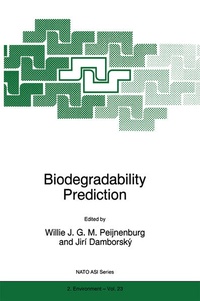
Biodegradability Prediction
Published on 13. October 2012
Book
Paperback/Softback
IX, 143 pages
978-94-010-6398-2 (ISBN)
Description
Biodegradation is the dominant pathway for the environmental transformation of most chemicals and information on a chemical's biodegradability is essential for proper risk assessment. But there are few methods for predicting whether or not a chemical is biodegradable, since this depends on the chemical's structure as well as on the environmental conditions that it encounters.
The present book deals with quantitative structure-biodegradability relationship models (QSBRs), emphasizing the biological and ecological part of the biodegradation process. Surveys are given of the microbial aspects of biodegradation and the methods available for testing biodegradability. New trends and methods in biodegradation modelling are reviewed, including contributions on computerized biodegradability prediction systems. Some of the newly developed models for assessing risk and ecological impact in aquatic and terrestrial environments have been validated, and this process is discussed.
Audience: Scientists active in microbiology, the environmental sciences, biotechnology and bioremediation. Policy makers will find the book indispensable in assessing the present state of the art on the biodegradability of substances.
The present book deals with quantitative structure-biodegradability relationship models (QSBRs), emphasizing the biological and ecological part of the biodegradation process. Surveys are given of the microbial aspects of biodegradation and the methods available for testing biodegradability. New trends and methods in biodegradation modelling are reviewed, including contributions on computerized biodegradability prediction systems. Some of the newly developed models for assessing risk and ecological impact in aquatic and terrestrial environments have been validated, and this process is discussed.
Audience: Scientists active in microbiology, the environmental sciences, biotechnology and bioremediation. Policy makers will find the book indispensable in assessing the present state of the art on the biodegradability of substances.
More details
Series
Edition
Softcover reprint of the original 1st ed. 1996
Language
English
Place of publication
Dordrecht
Netherlands
Target group
Professional and scholarly
Research
Illustrations
IX, 143 p.
Dimensions
Height: 240 mm
Width: 160 mm
Thickness: 9 mm
Weight
261 gr
ISBN-13
978-94-010-6398-2 (9789401063982)
DOI
10.1007/978-94-011-5686-8
Schweitzer Classification
Other editions
Additional editions
W.J. Peijnenburg | Jirí Damborský
Biodegradability Prediction
Proceedings of the NATO Advanced Research Workshop on QSAR Biodegradation II - QSARs for Biotransformation and Biodegradation, Luhacovice, Czech Republic, May 2-3 1996
Book
11/1996
1st Edition
Kluwer Academic Publishers
€96.00
Article exhausted; check different version
Content
Introduction, Main Conclusions and Recommendations of the Workshop "QSAR Biodegradation II".- I. Biodegradability (foundations, testing).- Biodegradability of Xenobiotic Organic Compounds Depends on their Chemical Structure and Efficiently Controlled, and Productive Biochemical Reaction Mechanisms.- Biodegradability Testing of Xenobiotics.- II. Biodegradability Modelling (trends, methods).- The META-CASETOX System for the Prediction of the Toxic Hazard of Chemicals Deposited in the Environment.- Application of Artificial Intelligence in Biodegradation Modelling.- Polychlorinated Dibenzo-p-Dioxins in Anaerobic Soils and Sediments. A Quest for Dechlorination Pattern-Microbial Community Relationships.- A Biodegradability Evaluation and Simulation System (BESS) Based on Knowledge of Biodegradation Pathways.- A Mechanistic Approach to Deriving Quantitative Structure Biodegradability Relationships. A Case Study: Dehalogenation of Haloaliphatic Compounds.- III. Biodegradability Prediction (applications).- Quantitative Structure-Biodegradability Studies: An Investigation of the MITI Aromatic Compound Data-Base.- Prediction of Biodegradability from Chemical Structure: Use of MITI Data, Structural Fragments and Multivariate Analysis for the Estimation of Ready and Not Ready Biodegradability.- Development of Structure-Biodegradability Relationships (SBRs) for Estimating Half-Lifes of Organic Contaminants in Soil Systems.- Author Index.