

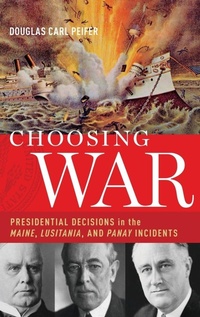
Choosing War
Presidential Decisions in the Maine, Lusitania, and Panay Incidents
Published on 28. July 2016
Book
Hardback
344 pages
978-0-19-026868-8 (ISBN)
Description
China's expanding air and naval capabilities, coupled with the proliferation of long-range anti-ship and anti-air missile systems, are making US naval diplomacy an increasingly risky enterprise. It is surprising therefore how little attention has been devoted to comparing the way in which different administrations have reacted in dissimilar manners to major naval incidents. This book provides the first comparative analysis of multiple cases. In particular, it examines three incidents: the Maine incident (1898), which led to war in the short term; the Lusitania crisis (1915), which set the trajectory for intervention; and the Panay incident (1937), which was settled diplomatically.
After scrutinizing these incidents and the domestic and international factors shaping the subsequent crisis, Douglas Carl Peifer analyses the presidential decision making in terms of options considered and policies selected. The book draws upon international relations and coercion theory but emphasizes the importance of context, complexity, and contingency when assessing presidential decision making. The contemporary tensions in East Asia, the Persian Gulf, the Baltic, and the Black Sea are increasingly vexing US naval diplomacy. By analyzing how Presidents William McKinley, Woodrow Wilson, and Franklin Delano Roosevelt responded to the Maine, Lusitania, and Panay incidents, this book provides an essential instrument to deal with the growing threats of a new naval crisis.
After scrutinizing these incidents and the domestic and international factors shaping the subsequent crisis, Douglas Carl Peifer analyses the presidential decision making in terms of options considered and policies selected. The book draws upon international relations and coercion theory but emphasizes the importance of context, complexity, and contingency when assessing presidential decision making. The contemporary tensions in East Asia, the Persian Gulf, the Baltic, and the Black Sea are increasingly vexing US naval diplomacy. By analyzing how Presidents William McKinley, Woodrow Wilson, and Franklin Delano Roosevelt responded to the Maine, Lusitania, and Panay incidents, this book provides an essential instrument to deal with the growing threats of a new naval crisis.
Reviews / Votes
[A]n excellent example of how historically informed comparative analysis can create a framework for our understanding of the uses of force and war-making... The gripping prose style and narrative detail in each episode are impressive.[O]ne can only hope--likely in vain--that current policymakers will read this excellent study. * Stephen R. Ortiz, Passport * This work is very valuable to aspiring historians in its discussion of the uses of history... With at-sea incidents between U.S. and Iranian and Chinese ships on the rise, this book should be required reading for policymakers and national security professionals alike. * Robert M. Brown, Military Review * Choosing War is an excellent dissection of the decisions made by American presidents in the wake of the Maine, Lusitania, and Panay incidents. Choosing War, in great detail, shows that naval incidents are very often a precursor to greater conflicts on land, on sea, and in the air.... It is a unique book that is written clearly enough to serve as popular history, yet Choosing War will also serve as a great reference to American military figures, geopolitical strategists, and their publicly elected leaders. * Larry Provost, MCU Journal * Peifer's insightful analysis in Choosing War is as useful as it is timely.... Peifer makes a unique contribution to our understanding of how an American administration makes that most important of decisions--whether or not to go to war. Students of diplomatic, naval, and military history and those interested in the national security decision-making process will find Choosing War a valuable endeavor and a worthwhile addition to their professional libraries. Well researched and with extensive notes, Choosing War hits the mark. * Mark Montesclaros, H-War *More details
Language
English
Place of publication
New York
United States
Target group
College/higher education
Illustrations
24 illus.
Dimensions
Height: 240 mm
Width: 161 mm
Thickness: 23 mm
Weight
678 gr
ISBN-13
978-0-19-026868-8 (9780190268688)
Copyright in bibliographic data and cover images is held by Nielsen Book Services Limited or by the publishers or by their respective licensors: all rights reserved.
Schweitzer Classification
Other editions
Additional editions
Book
11/2018
Oxford University Press Inc
€43.40
Shipment within 15-20 days
E-Book
06/2016
1st Edition
OUP eBook
€9.99
Available for download
E-Book
06/2016
1st Edition
OUP eBook
€9.99
Available for download
Person
Douglas C. Peifer is department chair and professor of strategy in the US Air War College's Department of Strategy in Montgomery, Alabama. He holds a Ph.D. in modern history from the University of North Carolina at Chapel Hill. His primary field of research is modern diplomatic and military history, with a special interest in the nexus between strategy, history, international politics, and culture.
Content
Introduction: Naval Incidents and the Decision for War
Part 1: The Maine Incident
Part 2: The Lusitania Crisis
Part 3: The Panay Incident
Conclusion: Naval Incidents and the Primacy of Context. Typologies, Theories, and the Historical Mindset
Bibliography
Index
Part 1: The Maine Incident
Part 2: The Lusitania Crisis
Part 3: The Panay Incident
Conclusion: Naval Incidents and the Primacy of Context. Typologies, Theories, and the Historical Mindset
Bibliography
Index