

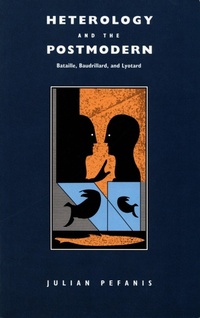
Heterology and the Postmodern
Bataille, Baudrillard, and Lyotard
Will be published approx. on 30. November 1990
Book
Hardback
180 pages
978-0-8223-1075-4 (ISBN)
Description
In Heterology and the Postmodern, Julian Pefanis presents a new view of the history of poststructuralism (heterology) and the origins of postmodernism by analyzing three important French theorists, Georges Bataille, Jean Baudrillard, and Jean-FranCois Lyotard.
Beginning with the introduction of Hegel in French postmodernist thought-largely but not exclusively through the thought of Georges Bataille-Pefanis argues that the core problematics of postmodern aesthetics-history, exchange, representation, and writing-are related to Bataille's reconceptualization of the Hegelian framework. Pefanis explores how Bataille was influenced by Hegel, Marcel Mauss, Freud, and Nietzsche, and traces the effects of this influence on the analyses and critiques of later postmodernists, most notably Lyotard and Baudrillard. Finally, employing these postmodernists along with Freud and Jacques Lacan, Pefanis discusses discourse on postmodernism and its relation to Freud's concept of the death drive.
This intellectual history makes valuable contributions to the debates over what the "postmodern" may mean for intellectual and political activity.
Beginning with the introduction of Hegel in French postmodernist thought-largely but not exclusively through the thought of Georges Bataille-Pefanis argues that the core problematics of postmodern aesthetics-history, exchange, representation, and writing-are related to Bataille's reconceptualization of the Hegelian framework. Pefanis explores how Bataille was influenced by Hegel, Marcel Mauss, Freud, and Nietzsche, and traces the effects of this influence on the analyses and critiques of later postmodernists, most notably Lyotard and Baudrillard. Finally, employing these postmodernists along with Freud and Jacques Lacan, Pefanis discusses discourse on postmodernism and its relation to Freud's concept of the death drive.
This intellectual history makes valuable contributions to the debates over what the "postmodern" may mean for intellectual and political activity.
More details
Series
Language
English
Place of publication
North Carolina
United States
Target group
Professional and scholarly
Product notice
Cloth over boards
Dimensions
Height: 244 mm
Width: 152 mm
Thickness: 23 mm
Weight
454 gr
ISBN-13
978-0-8223-1075-4 (9780822310754)
Copyright in bibliographic data and cover images is held by Nielsen Book Services Limited or by the publishers or by their respective licensors: all rights reserved.
Schweitzer Classification
Person
Julian Pefanis