

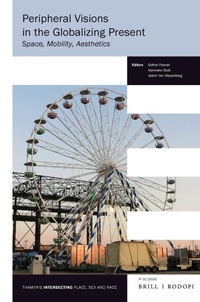
Peripheral Visions in the Globalizing Present
Space, Mobility, Aesthetics
Published on 19. August 2016
Book
Paperback/Softback
280 pages
978-90-04-32144-1 (ISBN)
Description
This volume sheds new light on how today's peripheries are made, lived, imagined and mobilized in a context of rapidly advancing globalization. Focusing on peripheral spaces, mobilities and aesthetics, it presents critical readings of, among others, Indian caste quarters, the Sahara, the South African backyard and European migration, as well as films, novels and artworks about marginalized communities and repressed histories. Together, these readings insist that the peripheral not only needs more visibility in political, economic and cultural terms, but is also invaluable for creating alternative perspectives on the globalizing present. Peripheral Visions combines sociological, cultural, literary and philosophical perspectives on the periphery, and highlights peripheral innovation and futurity to counter the lingering association of the peripheral with stagnation and backwardness.
More details
Series
Language
English
Place of publication
Leiden
Netherlands
Target group
Professional and scholarly
Product notice
Paperback (trade)
Unsewn / adhesive bound
Dimensions
Height: 234 mm
Width: 155 mm
Thickness: 13 mm
Weight
386 gr
ISBN-13
978-90-04-32144-1 (9789004321441)
Copyright in bibliographic data and cover images is held by Nielsen Book Services Limited or by the publishers or by their respective licensors: all rights reserved.
Schweitzer Classification
Persons
Esther Peeren is Associate Professor of Globalization Studies at the University of Amsterdam. Her publications include Intersubjectivity and Popular Culture: Bakhtin and Beyond (Stanford, 2008) and The Spectral Metaphor: Living Ghosts and the Agency of Invisibility (Palgrave, 2014). Hanneke Stuit is Assistant Professor of Literary and Cultural Analysis at the University of Amsterdam. Her recent publications deal with community and ubuntu, including Ubuntu Strategies: Constructing Spaces of Belonging in Contemporary South African Culture (Palgrave, 2016). Astrid Van Weyenberg is Lecturer of Film and Literary Studies at Leiden University and a member of the Leiden University Centre for the Arts (LUCAS). She is the author of The Politics of Adaptation: Contemporary African Drama and Greek Tragedy (Rodopi, 2013).
Content
Contents
Introduction: Peripheral Visions in the Globalizing Present, Esther Peeren, Hanneke Stuit and Astrid Van Weyenberg
Part 1: Theorizing the Peripheral
A Grammar of Peripheralization: Neill Blomkamp's District 9, Mireille Rosello
The Infra-Periphery and Global Circuits of Symbolic Capital Accumulation, Paulina Aroch-Fugellie
Fragments in Relation: Trajectories of/for an Unbound Europe, Sudeep Dasgupta
Peripheral Worldscapes in Circulation: Towards a Productive Understanding of Untranslatability, Doro Wiese
Part II: Peripheral Spaces
The Center of All Concerns at the Periphery of the World: The Sahara Desert from a Nomadic Perspective, Luca Raineri
Cast(e)ing Life: The Experience of Living in Peripheral Caste Quarters, Durgesh Solanki
The South African Backyard as a Very Local Peripheral Space, Ena Jansen
Part III: Peripheral Mobilities
Mobile Peripheries? Contesting and Negotiating Peripheries in the Global Era of Mobility, Magdalena Slusarczyk and Paula Pustulka
"Repairing Europe": A Critical Reading of Storytelling in European Cultural Projects, Astrid Van Weyenberg
The Rise of the Peripheral Subject: Questions of Cultural Hybridity in the Greek "Crisis", Evangelia Mademli
Part IV: Peripheral Aesthetics
Remains to be Un/Seen: Envisioning the Disappeared in Willie Doherty's Ancient Ground and Patricio Guzman's Nostalgia for the Light, Paula Blair
Shaping "Common Places": Post-Soviet Narratives beyond Anti-Utopia in Ksenia Buksha's The Freedom Factory and Igor Saveljev's Tereshkova is Flying to Mars, Ksenia Robbe
The Heterotopic Closet: Spectral Presences and Otherworlds in La Revue Monstre and Michael James O'Brien's Interiors, Matthieu Foucher
Contributors
Name Index
Introduction: Peripheral Visions in the Globalizing Present, Esther Peeren, Hanneke Stuit and Astrid Van Weyenberg
Part 1: Theorizing the Peripheral
A Grammar of Peripheralization: Neill Blomkamp's District 9, Mireille Rosello
The Infra-Periphery and Global Circuits of Symbolic Capital Accumulation, Paulina Aroch-Fugellie
Fragments in Relation: Trajectories of/for an Unbound Europe, Sudeep Dasgupta
Peripheral Worldscapes in Circulation: Towards a Productive Understanding of Untranslatability, Doro Wiese
Part II: Peripheral Spaces
The Center of All Concerns at the Periphery of the World: The Sahara Desert from a Nomadic Perspective, Luca Raineri
Cast(e)ing Life: The Experience of Living in Peripheral Caste Quarters, Durgesh Solanki
The South African Backyard as a Very Local Peripheral Space, Ena Jansen
Part III: Peripheral Mobilities
Mobile Peripheries? Contesting and Negotiating Peripheries in the Global Era of Mobility, Magdalena Slusarczyk and Paula Pustulka
"Repairing Europe": A Critical Reading of Storytelling in European Cultural Projects, Astrid Van Weyenberg
The Rise of the Peripheral Subject: Questions of Cultural Hybridity in the Greek "Crisis", Evangelia Mademli
Part IV: Peripheral Aesthetics
Remains to be Un/Seen: Envisioning the Disappeared in Willie Doherty's Ancient Ground and Patricio Guzman's Nostalgia for the Light, Paula Blair
Shaping "Common Places": Post-Soviet Narratives beyond Anti-Utopia in Ksenia Buksha's The Freedom Factory and Igor Saveljev's Tereshkova is Flying to Mars, Ksenia Robbe
The Heterotopic Closet: Spectral Presences and Otherworlds in La Revue Monstre and Michael James O'Brien's Interiors, Matthieu Foucher
Contributors
Name Index