

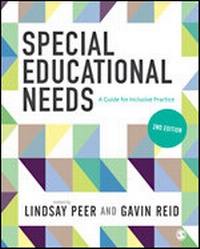
Special Educational Needs
A Guide for Inclusive Practice
2nd Edition
Published on 28. January 2016
Book
Paperback/Softback
416 pages
978-1-4739-0454-5 (ISBN)
Description
Covering contemporary policy issues, perspectives from practice and a range of common syndromes and barriers Special Educational Needs presents a wealth of information and guidance for students and professionals on how to achieve effective, inclusive practice.
Second edition features include:
? fully revised annotated further readings and links to useful websites;
? a new chapter on Autism and Applied Behaviour Analysis (ABA)
? a new chapter on Down Syndrome
? updated reference to legislation, including the SEND Code of Practice (2014)
? updated case studies covering 0-18 age range
This comprehensive course text is ideal for students, teachers, practitioners and specialists, and provides a solid foundation for understanding and supporting learners with additional needs.
Second edition features include:
? fully revised annotated further readings and links to useful websites;
? a new chapter on Autism and Applied Behaviour Analysis (ABA)
? a new chapter on Down Syndrome
? updated reference to legislation, including the SEND Code of Practice (2014)
? updated case studies covering 0-18 age range
This comprehensive course text is ideal for students, teachers, practitioners and specialists, and provides a solid foundation for understanding and supporting learners with additional needs.
Reviews / Votes
It will provide both a solid foundation of knowledge and understanding, and a vehicle for instigating debate, reflection and professional development moving forward. This edition is something that should be read by all who work in the early years, given that understanding of both special educational needs and the policy requirements that surround it can always be enhanced among staff teams. -- Neil HentyMore details
Edition
2nd Revised edition
Language
English
Place of publication
London
United Kingdom
Target group
College/higher education
Edition type
Revised edition
Dimensions
Height: 232 mm
Width: 186 mm
Weight
742 gr
ISBN-13
978-1-4739-0454-5 (9781473904545)
Copyright in bibliographic data and cover images is held by Nielsen Book Services Limited or by the publishers or by their respective licensors: all rights reserved.
Schweitzer Classification
Other editions
New editions
Book
11/2020
3rd Edition
SAGE Publications Ltd
€66.10
Shipment within 15-20 days
Persons
Dr Lindsay Peer CBE, practitioner psychologist, international speaker, author and expert witness, and is widely recognised as an expert in the range of Specific Learning Difficulties, special educational needs and mainstream education. In 2002, she was appointed CBE for services to Education and Dyslexia. She is a Patron of GroOops, a charity dedicated to creating an emotionally healthy, dyslexia aware world. In 2011, she was presented with an Outstanding Lifetime Academic Achievement Award by the British Dyslexia Association. In 2017, she won a Science Council Chartered Scientist CPD Commendation. She is an Associate Fellow and Chartered Scientist of the British Psychological Society, and Fellow of both the International Academy of Research in Learning Disabilities and the Royal Society of Arts. She is a member of the Association of Child Psychologists in Private Practice and of the Association for Child and Adolescent Mental Health. She is registered to practice with the Health and Care Professions Council.
?
She held the posts of Education Director and Deputy CEO of the BDA. She has had many years' experience as a teacher, teacher trainer and SENCo. Lindsay has been a keynote speaker in the UK, USA, India, Sweden, Belgium, Finland, Israel, Iceland, Norway, Italy, Spain, Majorca, Greece, South Africa, Botswana, Swaziland, Cyprus, the Czech Republic and the Netherlands. She has further advised governments, policy makers, lawyers, adults, schools, psychologists, therapists and parents. She has published a considerable body of material both theoretical and practical, and published the first ground-breaking book linking Glue Ear with Dyslexia.
Her email address is: lindsay@peergordonassociates.co.uk and her website is: www.peergordonassociates.co.uk.
Dr. Gavin Reid is an international consultant and psychologist with consultancies in Canada, UK, Europe, Middle East, Asia and Australasia. He was Visiting Professor at the University of British Columbia in Vancouver, Canada, in the Department of Education and Counseling Psychology and Special Education in 2007 and 2010.
?
He is chair of the British Dyslexia Association Accreditation Board and an ambassador for the Helen Arkell Dyslexia Centre in the UK and is a Consultant/Psychologist for the Centre for Child Evaluation and Teaching (CCET) in Kuwait and the Lighthouse Learning Centre in Cairo. He is also a director of the Red Rose School for children with specific learning difficulties in St Annes on Sea, Lancashire, UK.
He was formerly senior lecturer in the Department of Educational Studies (formally Department of Special Education), Moray House School of Education, University of Edinburgh, from 1991 to 2007. He has written 34 books on learning, motivation and dyslexia and lectured to thousands of professionals and parents in 75 countries. Some of his books have been published in Polish, Italian, Greek, Arabic, Hebrew, French, Latvian and Slovak. He is an experienced teacher with over ten years' experience in the classroom and has held external examiner appointments at 20 universities worldwide for PhD and masters' courses. He resides in Vancouver and Edinburgh.
His email is gavinreid66@gmail.com and his website is: www.drgavinreid.com
?
She held the posts of Education Director and Deputy CEO of the BDA. She has had many years' experience as a teacher, teacher trainer and SENCo. Lindsay has been a keynote speaker in the UK, USA, India, Sweden, Belgium, Finland, Israel, Iceland, Norway, Italy, Spain, Majorca, Greece, South Africa, Botswana, Swaziland, Cyprus, the Czech Republic and the Netherlands. She has further advised governments, policy makers, lawyers, adults, schools, psychologists, therapists and parents. She has published a considerable body of material both theoretical and practical, and published the first ground-breaking book linking Glue Ear with Dyslexia.
Her email address is: lindsay@peergordonassociates.co.uk and her website is: www.peergordonassociates.co.uk.
Dr. Gavin Reid is an international consultant and psychologist with consultancies in Canada, UK, Europe, Middle East, Asia and Australasia. He was Visiting Professor at the University of British Columbia in Vancouver, Canada, in the Department of Education and Counseling Psychology and Special Education in 2007 and 2010.
?
He is chair of the British Dyslexia Association Accreditation Board and an ambassador for the Helen Arkell Dyslexia Centre in the UK and is a Consultant/Psychologist for the Centre for Child Evaluation and Teaching (CCET) in Kuwait and the Lighthouse Learning Centre in Cairo. He is also a director of the Red Rose School for children with specific learning difficulties in St Annes on Sea, Lancashire, UK.
He was formerly senior lecturer in the Department of Educational Studies (formally Department of Special Education), Moray House School of Education, University of Edinburgh, from 1991 to 2007. He has written 34 books on learning, motivation and dyslexia and lectured to thousands of professionals and parents in 75 countries. Some of his books have been published in Polish, Italian, Greek, Arabic, Hebrew, French, Latvian and Slovak. He is an experienced teacher with over ten years' experience in the classroom and has held external examiner appointments at 20 universities worldwide for PhD and masters' courses. He resides in Vancouver and Edinburgh.
His email is gavinreid66@gmail.com and his website is: www.drgavinreid.com
Content
1. Introduction - Gavin Reid and Lindsay Peer
PART I: Policy, Practice and Provision
2. Special and additional support needs in England and Scotland -current dilemmas and solutions - Sheila Riddell, Elisabet Weedon and Neville Harris
3. The state of the research - compromise, consensus or disarray? - Elias Avramidis and Brahm Norwich
4. Inclusion and special educational needs - a dialogic inquiry into controversial issues - Artemi Sakellariadis
5. The potential impact and influence of the social model of disability - Charles Weedon
PART II: Perspectives from Practice
6. Speech and language - Janet O'Keefe and Janet Farrugia
7. Auditory processing disorder - Tony Sirimanna
8. Developmental co-ordination disorder and dyspraxia from an occupational therapist's perspective - Jane Abdullah
9. Vision and learning - Keith Holland and Clare Holland
10. Good practice in training specialist teachers and assessors of people with dyslexia - Sheena Bell and Bernadette McLean
11. Literacy - Margaret Crombie
12. Mathematics learning difficulties and dyscalculia - Steve Chinn
PART III: Syndromes and Barriers
13. Students with Down syndrome in inclusive classrooms: Using evidence-based practices - Iva Strnadova and David Evans
14. Attention deficit hyperactivity disorder (or hyperkinetic disorder) - Richard Soppitt
15. Visual impairment and mainstream education: beyond mere awareness raising - John Ravenscroft
16. Students with hearing loss - Jill Duncan
17. Autistic spectrum disorder: challenges, issues and responses - Gavin Reid, Sionah Lannen and Colin Lannen
18. Autism Spectrum Disorders (ASD): Applied Behavioural Analysis (ABA) Treatment and Research - Jo-Ann Page
19 Understanding Tourette syndrome - Judy Barrow
PART IV: Working Together
20. The role and perspectives of practitioner educational psychologists - Kevin Woods
21. Expert Evidence: Changes in the Law - John Friel
22. Parents' perspectives - Gavin Reid, Lindsay Peer, Susan Strachan and Jo-Ann Page
PART I: Policy, Practice and Provision
2. Special and additional support needs in England and Scotland -current dilemmas and solutions - Sheila Riddell, Elisabet Weedon and Neville Harris
3. The state of the research - compromise, consensus or disarray? - Elias Avramidis and Brahm Norwich
4. Inclusion and special educational needs - a dialogic inquiry into controversial issues - Artemi Sakellariadis
5. The potential impact and influence of the social model of disability - Charles Weedon
PART II: Perspectives from Practice
6. Speech and language - Janet O'Keefe and Janet Farrugia
7. Auditory processing disorder - Tony Sirimanna
8. Developmental co-ordination disorder and dyspraxia from an occupational therapist's perspective - Jane Abdullah
9. Vision and learning - Keith Holland and Clare Holland
10. Good practice in training specialist teachers and assessors of people with dyslexia - Sheena Bell and Bernadette McLean
11. Literacy - Margaret Crombie
12. Mathematics learning difficulties and dyscalculia - Steve Chinn
PART III: Syndromes and Barriers
13. Students with Down syndrome in inclusive classrooms: Using evidence-based practices - Iva Strnadova and David Evans
14. Attention deficit hyperactivity disorder (or hyperkinetic disorder) - Richard Soppitt
15. Visual impairment and mainstream education: beyond mere awareness raising - John Ravenscroft
16. Students with hearing loss - Jill Duncan
17. Autistic spectrum disorder: challenges, issues and responses - Gavin Reid, Sionah Lannen and Colin Lannen
18. Autism Spectrum Disorders (ASD): Applied Behavioural Analysis (ABA) Treatment and Research - Jo-Ann Page
19 Understanding Tourette syndrome - Judy Barrow
PART IV: Working Together
20. The role and perspectives of practitioner educational psychologists - Kevin Woods
21. Expert Evidence: Changes in the Law - John Friel
22. Parents' perspectives - Gavin Reid, Lindsay Peer, Susan Strachan and Jo-Ann Page