

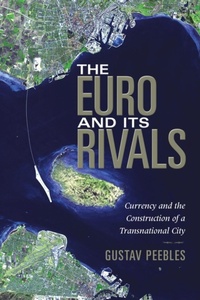
The Euro and Its Rivals
Currency and the Construction of a Transnational City
Published on 14. June 2011
Book
Paperback/Softback
232 pages
978-0-253-22320-3 (ISBN)
Description
Gustav Peebles takes an anthropological look at two seemingly separate developments in Europe at the turn of the millennium: the rollout of the euro and the building of new transnational regions such as the Oresund Region, envisioned as a melding of Copenhagen, Denmark, with Malmoe, Sweden. Peebles argues that the drive to create such transnational spaces is inseparable from the drive to create a pan-national currency. He studies the practices and rhetoric surrounding the national currencies of Denmark and Sweden, the euro, and several new "local currencies" struggling to come into being. The Euro and Its Rivals provides a deep historical study of the welfare state and the monetary policies and utopian visions that helped to ground it, at the same time shedding new light on the contemporary movement of goods, people, credit, and debt.
Reviews / Votes
"[This book] . . . is an ethnographic study arguing that a bridge connecting Malmoe, Sweden, and Copenhagen, Denmark, has similar cultural effects as a common European currency. Peebles (anthropology, The New School), who lived in Malmoe during the construction of the Oresund Bridge, is primarily concerned with boundaries of inclusion and exclusion. He simplifies the world by defining several visions of the ideal, or what he calls utopian visions, and argues that proponents of the bridge had similar utopian visions as those who favored the euro. Both wanted to alter people's sense of identity from being part of a nation to being part of a transnational group. He draws similar parallels between those who opposed the bridge and those who advocated local currency rings, which he treats with more respect than most economists would give them. Along the way he ties in attitudes toward debt and bankruptcy, vagrancy, and immigration. Issues central to Peebles's discussion are ignored by economists, while issues that interest economists are not addressed in this work. Summing Up: Recommended. Upper-division undergraduate through faculty and research collections. - Choice"-R. E. Schenk, emeritus, Saint Joseph's College (IN)"Peebles adopts an anthropological approach to the question of how the roll-out of the euro has influenced the emergence of transnational regions in Europe, such as the Oresund region encompassing Copenhagen, Denmark, and Malmo, Sweden."-Survival
"A fascinating and nicely documented account of the creation of, and resistances to, a transnational social formation in one of the so-called 'Regions' of the new Europe."-Bill Maurer, author of Mutual Life, Limited: Islamic Banking, Alternative Currencies, Lateral Reason
"A highly original and creative contribution to literature on the anthropology of Europe . . . . A sophisticated account and a considerable achievement."-Eve Darian-Smith, author of Bridging Divides: The Channel Tunnel and English Legal Identity in the New Europe
More details
Series
Language
English
Place of publication
Bloomington, IN
United States
Target group
College/higher education
Product notice
Paperback (trade)
Illustrations
1 map
Dimensions
Height: 231 mm
Width: 154 mm
Thickness: 23 mm
Weight
362 gr
ISBN-13
978-0-253-22320-3 (9780253223203)
Copyright in bibliographic data and cover images is held by Nielsen Book Services Limited or by the publishers or by their respective licensors: all rights reserved.
Schweitzer Classification
Person
Gustav Peebles is Assistant Professor of Anthropology and Chair of Social Sciences in the Bachelor's Program at The New School in New York City. His work has appeared in Harper's Magazine and other publications.
Content
Contents
Introduction
1. Imagining Utopia, Constructing Oresund: From the Nation-State to the Region
2. The Arts of 'Scientific' Money: Monetary Policy as Moral Policy
3. Receipts and Deceits: Currency Regulation, Black Markets and Borders
4. The Mark of Money: Regulating the Flow of Subjects
5. Indebted Communities
Notes
Bibliography
Index
Introduction
1. Imagining Utopia, Constructing Oresund: From the Nation-State to the Region
2. The Arts of 'Scientific' Money: Monetary Policy as Moral Policy
3. Receipts and Deceits: Currency Regulation, Black Markets and Borders
4. The Mark of Money: Regulating the Flow of Subjects
5. Indebted Communities
Notes
Bibliography
Index