

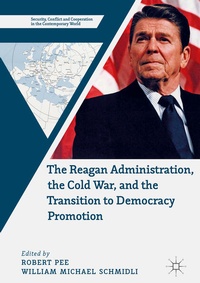
The Reagan Administration, the Cold War, and the Transition to Democracy Promotion
Description
This book posits that democracy promotion played a key role in the Reagan administration's Cold War foreign policy. It analyzes the democracy initiatives launched under Reagan and the role of administration officials, neoconservatives and non-state actors, such as the National Endowment for Democracy (NED), in shaping a new model of democracy promotion, characterized by aid to foreign political movements and the spread of neoliberal economics. The book discusses the ideological, strategic and organizational aspects of U.S. democracy promotion in the 1980s, then analyzes case studies of democracy promotion in the Soviet bloc and in U.S.-allied dictatorships in Latin America and East Asia, and, finally, reflects on the legacy of Reagan's democracy promotion and its influence on Clinton, Bush and Obama. Based on new research and archival documents, this book shows that the development of democracy promotion under Reagan laid the foundations for US post-Cold War foreign policy.
Reviews / Votes
"A fascinating exploration of 'democracy promotion' during the Reagan administration, this volume does not take the term at face value; it avoids falling into the ' semantic trap' which assumes a benevolent intent. Instead, the chapters advance stories of the complexity and inconsistency of practice in a variety of well-chosen cases. The volume provides a sober antidote to the positive turn in Reagan historiography. It draws more broadly from the archives and the literature integrating non-US voices, non-state actors and provides a transnational investigation to the ideologically driven agenda, seemingly set in a neutral or natural setting. The studies in this volume provide an excellent appraisal of the 'soft' intervention the US inconsistently practices. The irony, of course, Washington would be deeply offended if these practices were aimed at US elections." (David Ryan, University College Cork, Ireland)
"Boldly taking the study of U.S. foreign relations into the 1980s, the authors in this pathbreaking collection examine democracy promotion on the premise that it was anything but a "technical" agenda. Instead, each shows in different ways, this signature program of Ronald Reagan's presidency and sometimes since was freighted with ideological choices and intersected the realities of great power politics. All told, the book is a major contribution." (Samuel Moyn, Yale University, USA)
More details
Other editions
Additional editions
Persons
Robert Pee is a Teaching Fellow at the University of Birmingham, UK. He is the author of Democracy Promotion, National Security and Strategy: Foreign Policy under the Reagan Administration . His research focuses on U.S. democracy promotion during the Cold War and the War on Terror.
William Michael Schmidli is University Lecturer at the Institute for History at Leiden University, The Netherlands. He is a U.S. foreign relations historian, and his research focuses on the evolving significance of human rights, democracy promotion, and transnational advocacy networks from the Cold War to the present.