

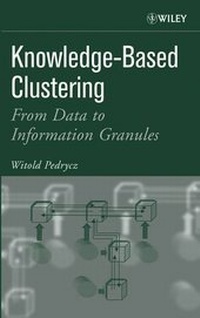
Knowledge-Based Clustering
From Data to Information Granules
1st Edition
Published on 18. February 2005
Book
Hardback
336 pages
978-0-471-46966-7 (ISBN)
Description
* A comprehensive coverage of emerging and current technology dealing with heterogeneous sources of information, including data, design hints, reinforcement signals from external datasets, and related topics
* Covers all necessary prerequisites, and if necessary,additional explanations of more advanced topics, to make abstract concepts more tangible
* Includes illustrative material andwell-known experimentsto offer hands-on experience
Reviews / Votes
"I agree with Zadeh's opinion (mentioned at the end of book's foreword): 'The author and the publisher deserve our loud applause and congratulations.'" (Computing Reviews.com, May 19, 2005)More details
Product info
GB
Edition
1., Auflage
Language
English
Place of publication
United States
Publishing group
John Wiley & Sons Inc
Target group
Professional and scholarly
Product notice
sewn/stitched
Paper over boards
Illustrations
Drawings: 0 B&W, 0 Color; Screen captures: 0 B&W, 0 Color
Dimensions
Height: 240 mm
Width: 161 mm
Thickness: 23 mm
Weight
671 gr
ISBN-13
978-0-471-46966-7 (9780471469667)
Schweitzer Classification
Other editions
Additional editions
E-Book
04/2005
Wiley
€124.99
Available for download
Person
WITOLD PEDRYCZ, PHD, is a Professor and Canada Research Chair at the University of Alberta, Canada. He is also with the Systems Research Institute of The Polish Academy of Sciences, Warsaw, Poland. Dr. Pedrycz is a Fellow of the IEEE, has authored nine research monographs, edited six volumes, and has written numerous papers in computational intelligence, granular computing, pattern recognition, quantitative software engineering, and data mining.
Content
Foreword.
Preface.
1. Clustering and Fuzzy Clustering.
2. Computing with Granular Information: Fuzzy Sets and Fuzzy Relations.
3. Logic-Oriented Neurocomputing.
4. Conditional Fuzzy Clustering.
5. Clustering with Partial Supervision.
6. Principles of Knowledge-Based Guidance in Fuzzy Clustering.
7. Collaborative Clustering.
8. Directional Clustering.
9. Fuzzy Relational Clustering.
10. Fuzzy Clustering of Heterogeneous Patterns.
11. Hyperbox Models of Granular Data: The Tchebyschev FCM.
12. Genetic Tolerance Fuzzy Neural Networks.
13. Granular Prototyping.
14. Granular Mappings.
15. Linguistic Modeling.
Bibliography.
Index.