

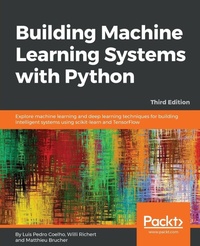
Building Machine Learning Systems with Python
Explore machine learning and deep learning techniques for building intelligent systems using scikit-learn and TensorFlow, 3rd Edition
3rd Edition
Published on 26. July 2018
Book
Paperback/Softback
406 pages
978-1-78862-322-3 (ISBN)
Description
Get more from your data by creating practical machine learning systems with Python
Key Features
Develop your own Python-based machine learning system
Discover how Python offers multiple algorithms for modern machine learning systems
Explore key Python machine learning libraries to implement in your projects
Book DescriptionMachine learning allows systems to learn things without being explicitly programmed to do so. Python is one of the most popular languages used to develop machine learning applications, which take advantage of its extensive library support. This third edition of Building Machine Learning Systems with Python addresses recent developments in the field by covering the most-used datasets and libraries to help you build practical machine learning systems.
Using machine learning to gain deeper insights from data is a key skill required by modern application developers and analysts alike. Python, being a dynamic language, allows for fast exploration and experimentation. This book shows you exactly how to find patterns in your raw data. You will start by brushing up on your Python machine learning knowledge and being introduced to libraries. You'll quickly get to grips with serious, real-world projects on datasets, using modeling and creating recommendation systems. With Building Machine Learning Systems with Python, you'll gain the tools and understanding required to build your own systems, all tailored to solve real-world data analysis problems.
By the end of this book, you will be able to build machine learning systems using techniques and methodologies such as classification, sentiment analysis, computer vision, reinforcement learning, and neural networks.
What you will learn
Build a classification system that can be applied to text, images, and sound
Employ Amazon Web Services (AWS) to run analysis on the cloud
Solve problems related to regression using scikit-learn and TensorFlow
Recommend products to users based on their past purchases
Understand different ways to apply deep neural networks on structured data
Address recent developments in the field of computer vision and reinforcement learning
Who this book is forBuilding Machine Learning Systems with Python is for data scientists, machine learning developers, and Python developers who want to learn how to build increasingly complex machine learning systems. You will use Python's machine learning capabilities to develop effective solutions. Prior knowledge of Python programming is expected.
Key Features
Develop your own Python-based machine learning system
Discover how Python offers multiple algorithms for modern machine learning systems
Explore key Python machine learning libraries to implement in your projects
Book DescriptionMachine learning allows systems to learn things without being explicitly programmed to do so. Python is one of the most popular languages used to develop machine learning applications, which take advantage of its extensive library support. This third edition of Building Machine Learning Systems with Python addresses recent developments in the field by covering the most-used datasets and libraries to help you build practical machine learning systems.
Using machine learning to gain deeper insights from data is a key skill required by modern application developers and analysts alike. Python, being a dynamic language, allows for fast exploration and experimentation. This book shows you exactly how to find patterns in your raw data. You will start by brushing up on your Python machine learning knowledge and being introduced to libraries. You'll quickly get to grips with serious, real-world projects on datasets, using modeling and creating recommendation systems. With Building Machine Learning Systems with Python, you'll gain the tools and understanding required to build your own systems, all tailored to solve real-world data analysis problems.
By the end of this book, you will be able to build machine learning systems using techniques and methodologies such as classification, sentiment analysis, computer vision, reinforcement learning, and neural networks.
What you will learn
Build a classification system that can be applied to text, images, and sound
Employ Amazon Web Services (AWS) to run analysis on the cloud
Solve problems related to regression using scikit-learn and TensorFlow
Recommend products to users based on their past purchases
Understand different ways to apply deep neural networks on structured data
Address recent developments in the field of computer vision and reinforcement learning
Who this book is forBuilding Machine Learning Systems with Python is for data scientists, machine learning developers, and Python developers who want to learn how to build increasingly complex machine learning systems. You will use Python's machine learning capabilities to develop effective solutions. Prior knowledge of Python programming is expected.
More details
Edition
3rd Revised edition
Language
English
Place of publication
Birmingham
United Kingdom
Target group
Professional and scholarly
Edition type
Revised edition
Dimensions
Height: 235 mm
Width: 191 mm
Thickness: 22 mm
Weight
755 gr
ISBN-13
978-1-78862-322-3 (9781788623223)
Copyright in bibliographic data and cover images is held by Nielsen Book Services Limited or by the publishers or by their respective licensors: all rights reserved.
Schweitzer Classification
Other editions
Additional editions
Luis Pedro Coelho | Matthieu Brucher
Building Machine Learning Systems with Python
Explore machine learning and deep learning techniques for building intelligent systems using scikit-learn and TensorFlow
E-Book
07/2018
3rd Edition
De Gruyter
€31.49
Available for download
Persons
Luis Pedro Coelho is a computational biologist who analyzes DNA from microbial communities to characterize their behavior. He has also worked extensively in bioimage informatics-the application of machine learning techniques for the analysis of images of biological specimens. His main focus is on the processing and integration of large-scale datasets. He has a PhD from Carnegie Mellon University and has authored several scientific publications. In 2004, he began developing in Python and has contributed to several open source libraries. He is currently a faculty member at Fudan University in Shanghai. Willi Richert has a PhD in machine learning/robotics, where he has used reinforcement learning, hidden Markov models, and Bayesian networks to let heterogeneous robots learn by imitation. Now at Microsoft, he is involved in various machine learning areas, such as deep learning, active learning, or statistical machine translation. Willi started as a child with BASIC on his Commodore 128. Later, he discovered Turbo Pascal, then Java, then C++-only to finally arrive at his true love: Python. Matthieu Brucher is a computer scientist who specializes in high-performance computing and computational modeling and currently works for JPMorgan in their quantitative research branch. He is also the lead developer of Audio ToolKit, a library for real-time audio signal processing. He has a PhD in machine learning and signals processing from the University of Strasbourg, two Master of Science degrees-one in digital electronics and signal processing and another in automation - from the University of Paris XI and Supelec, as well as a Master of Music degree from Bath Spa University.
Content
Table of Contents
Getting Started with Python Machine Learning
Classifying with Real-world Examples
Regression
Classification I - Detecting Poor Answers
Dimensionality Reduction
Clustering - Finding Related Posts
Recommendations
Artificial neural Networks & Deep Learning
Classification II - Sentiment Analysis
Topic Modeling
Classification III - Music Genre Classification
Computer Vision
Reinforcement Learning
Bigger Data
Getting Started with Python Machine Learning
Classifying with Real-world Examples
Regression
Classification I - Detecting Poor Answers
Dimensionality Reduction
Clustering - Finding Related Posts
Recommendations
Artificial neural Networks & Deep Learning
Classification II - Sentiment Analysis
Topic Modeling
Classification III - Music Genre Classification
Computer Vision
Reinforcement Learning
Bigger Data