

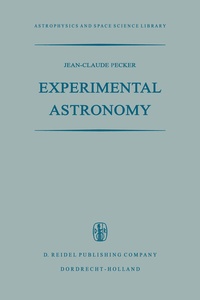
Experimental Astronomy
Published on 5. November 2011
Book
Paperback/Softback
X, 105 pages
978-94-010-3304-6 (ISBN)
Description
Socrates knew all that was known by his contemporaries. But already in the Middle Ages it was becoming difficult for a single man to have a truly encyclopedic view of all human knowledge. It is true that Pico della Mirandola, Pius II, Leonardo da Vinci, and several other great minds were thoroughly in possession of considerable know ledge, and knew all that one could know, except no doubt for some techniques. The encyclopedists of the 18th century had to be content with an admirable survey: they could not go into details, and their work is a collective one, the specialized science of each collaborator compensating for the insufficiencies of the others. We know very well that our science of today is a science of specialists. Not only is it impossible for anyone person to assimilate the totality of human knowledge, it is impossible even to know ones own discipline perfectly thoroughly. Each year the presses of science pro duce a frightening quantity of printed paper. Even in very limited fields, new journals are created every day, devoted to extremely specialized, often very narrowly defined subjects. It is indeed evident that in a field whose scope extends well beyond astronomical or astrophysical research, it is materially impossible to be informed of everything, even with the richest of libraries at hand.
More details
Series
Edition
Softcover reprint of the original 1st ed. 1970
Language
English
Place of publication
Dordrecht
Netherlands
Target group
Professional and scholarly
Research
Illustrations
X, 105 p.
Dimensions
Height: 240 mm
Width: 160 mm
Thickness: 7 mm
Weight
206 gr
ISBN-13
978-94-010-3304-6 (9789401033046)
DOI
10.1007/978-94-010-3302-2
Schweitzer Classification
Other editions
Additional editions
Book
07/1970
Kluwer Academic Publishers
€96.00
No shipping information available
Persons
Content
I / Astronomy - An Experimental Science?.- 1. Auguste Comte and Astronomy.- 2. An Observer is also an Experimentalist.- 3. Numerical Experimentation.- 4. Conclusion; Space Astronomy Enters the Scene.- II / Artificial Satellites as Celestial Bodies, or the Introduction of 'Experimental Celestial Mechanics'.- 1. Universal Gravitation.- 2. Potential of a Spherical Mass.- 3. Numerical Study of the Simple Case of Circular Orbits.- 4. Non-Circular Keplerian Orbits of Artificial Satellites.- 5. Perturbations of Keplerian Orbits.- 6. Detailed Examination of Gravitational Perturbations.- 7. Non-Gravitational Perturbing Forces.- 8. Satellite Observation and Analysis of the Measurements.- III / Initiation in Astronautics.- 1. Transfer Orbits.- 2. Toward Venus and Mars.- 3. Employment of Double Maneuvers.- 4. Complex Orbits.- 5. Effects of Firing Errors.- 6. Conclusion.- IV / What of Experimental Astrophysics?.- V / The Direct Exploration of the Extraterrestrial World.- 1. The Direct Exploration of the Moon.- 2. The Exploration of Mars.- 3. The Exploration of Venus.- 4. Meteoroidal Particles and Dust.- VI / The Plurality of Inhabited Worlds.- 1. With Fontenelle and his Marquise.- 2. Life and the Biosphere.- 3. The Solar System.- 4. Other Planetary Systems in the Universe.- 5. Project Ozma.- 6. The Improbable, The Probable, The Possible and Nonsense....- Conclusion / After Ten Years of Space Research.- Appendix / Tables V-VII.- Bibliographic Orientation.- Index of Names.- Index of Subjects.