

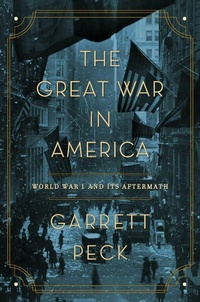
The Great War in America
World War I and Its Aftermath
Published on 3. September 2020
Book
Paperback/Softback
448 pages
978-1-64313-481-9 (ISBN)
Description
A chronicle of the American experience during World War I and the unexpected changes that rocked the country in its immediate aftermath.
The Great War's bitter outcome left the experience largely overlooked and forgotten in American history. This timely book is a reexamination of America's first global experience as we commemorate World War I's centennial. The U.S. had steered clear of the European conflagration known as the Great War for more than two years, but President Woodrow Wilson reluctantly led the divided country into the conflict with the goal of making the world "safe for democracy." The country assumed a global role for the first time and attempted to build the foundations for world peace, only to witness the experience go badly awry and it retreated into isolationism.
Though overshadowed by the tens of millions of deaths and catastrophic destruction of World War II, the Great War was the most important war of the twentieth century. It was the first continent-wide conflagration in a century, and it drew much of the world into its fire. By the end of it, four empires and their royal houses had fallen, communism was unleashed, the map of the Middle East was redrawn, and the United States emerged as a global power - only to withdraw from the world's stage.
The Great War is often overlooked, especially compared to World War II, which is considered the "last good war." The United States was disillusioned with what it achieved in the earlier war and withdrew into itself. Americans have tried to forget about it ever since. The Great War in America presents an opportunity to reexamine the country's role on the global stage and the tremendous political and social changes that overtook the nation because of the war.
The Great War's bitter outcome left the experience largely overlooked and forgotten in American history. This timely book is a reexamination of America's first global experience as we commemorate World War I's centennial. The U.S. had steered clear of the European conflagration known as the Great War for more than two years, but President Woodrow Wilson reluctantly led the divided country into the conflict with the goal of making the world "safe for democracy." The country assumed a global role for the first time and attempted to build the foundations for world peace, only to witness the experience go badly awry and it retreated into isolationism.
Though overshadowed by the tens of millions of deaths and catastrophic destruction of World War II, the Great War was the most important war of the twentieth century. It was the first continent-wide conflagration in a century, and it drew much of the world into its fire. By the end of it, four empires and their royal houses had fallen, communism was unleashed, the map of the Middle East was redrawn, and the United States emerged as a global power - only to withdraw from the world's stage.
The Great War is often overlooked, especially compared to World War II, which is considered the "last good war." The United States was disillusioned with what it achieved in the earlier war and withdrew into itself. Americans have tried to forget about it ever since. The Great War in America presents an opportunity to reexamine the country's role on the global stage and the tremendous political and social changes that overtook the nation because of the war.
More details
Language
English
Place of publication
New York
United States
Product notice
Paperback (trade)
Dimensions
Height: 221 mm
Width: 141 mm
Thickness: 38 mm
Weight
456 gr
ISBN-13
978-1-64313-481-9 (9781643134819)
Copyright in bibliographic data and cover images is held by Nielsen Book Services Limited or by the publishers or by their respective licensors: all rights reserved.
Schweitzer Classification
Person
Garrett Peck, author of The Great War in America, is a historian who serves on the advisory council of the Woodrow Wilson House in Washington, D.C. He has lectured at the Library of Congress, the National Archives, the National Museum of American History, and the Smithsonian Institution. He lives in Arlington, Virginia.