

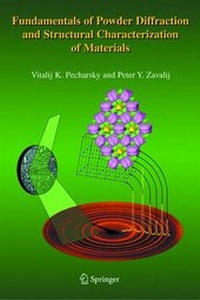
Fundamentals of Powder Diffraction and Structural Characterization of Materials
Published on 3. March 2005
Book
Mixed media product
XXIII, 713 pages
978-0-387-24147-0 (ISBN)
Description
Requires no prior knowledge of the subject, but is comprehensive and detailed making it useful for both the novice and experienced user of the powder diffraction method. Useful for any scientific or engineering background, where precise structural information is required. Comprehensively describes the state-of-the-art in structure determination from powder diffraction data both theoretically and practically using multiple examples of varying complexity. Pays particular attention to the utilization of Internet resources, especially the well-tested and freely available computer codes designed for processing of powder diffraction data.
More details
Other editions
New editions
Vitalij Pecharsky | Peter Zavalij
Fundamentals of Powder Diffraction and Structural Characterization of Materials, Second Edition
Book
11/2008
2nd Edition
Springer
€117.69
Shipment within 5-7 days
Additional editions
Vitalij Pecharsky | Peter Zavalij
Fundamentals of Powder Diffraction and Structural Characterization of Materials
E-Book
12/2005
1st Edition
Springer
€84.99
Available for download
Content
Preface. 1: Fundamentals of Crystalline State. 1.1. Introduction. 1.2. Crystalline state. 1.3. Crystal lattice and crystal structure. 1.4. Symmetry operations and symmetry elements. 1.5. Finite symmetry elements. 1.6. Interaction of symmetry elements. 1.7. Fundamentals of group theory. 1.8. Crystal systems. 1.9. Stereographic projections. 1.10. Crystallographic point groups. 1.11. Laue classes. 1.12. Selection of a unit cell and Bravais lattices. 1.13. Infinite symmetry elements. 1.14. Crystallographic planes, directions and indices. 1.15. Reciprocal lattice. 1.16. Crystallographic space groups. 1.17. International Tables for Crystallography. 1.18. Equivalent positions. 1.19. Symbolic description of symmetry operations. 1.20. Algebraic treatment of symmetry operations. 1.21. Non-conventional symmetry. 1.22. Additional reading. 1.23. Problems. 2: Fundamentals of Diffraction. 2.1. Introduction. 2.2. Properties and sources of radiation. 2.3. Collimation and monochromatization. 2.4. Detection of x-rays. 2.5. Scattering by electrons, atoms and lattices. 2.6. Geometry of diffraction by lattices. 2.7. Origin of the powder diffraction pattern. 2.8. Positions of powder diffraction peaks. 2.9. Shapes of powder diffraction peaks. 2.10. Intensity of powder diffraction peaks. 2.11. Structure factor. 2.12. Effects of symmetry on the structure amplitude. 2.13. Fourier transformation. 2.14. Phase problem. 2.15. Additional reading. 2.16. Problems. 3: Experimental Techniques. 3.1. Introduction. 3.2. Brief history of the powder diffraction method. 3.3. Powder diffractometers. 3.4. Safety. 3.5. Sample preparation. 3.6. Data acquisition. 3.7. Quality of experimental data. 3.8. Additional reading. 3.9. Problems. 4: Preliminary Data Processing and Phase Analysis. 4.1. Introduction. 4.2. Interpretation of powder diffraction data. 4.3. Preliminary data processing. 4.4. Phase identification and analysis. 4.5. Additional reading. 4.6. Problems. 5: Unit Cell Determination and Refinement. 5.1. Introduction. 5.2. The indexing problem. 5.3. Known versus unknown unit cell dimensions. 5.4. Indexing: known unit cell. 5.5. Reliability of indexing. 5.6. Introduction to ab initio indexing. 5.7. Cubic crystal system. 5.8. Tetragonal and hexagonal crystal systems. 5.9. Automatic ab initio indexing algorithms. 5.10. Unit cell reduction algorithms. 5.11. Automatic ab initio indexing: computer codes. 5.12. Ab initio indexing examples. 5.13. Precise lattice parameters and linear least squares. 5.14. Epilogue. 5.15. Additional reading. 5.16. Problems. 6: Crystal Structure Determination. 6.1. Introduction. 6.2. A