

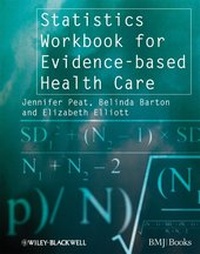
Statistics Workbook for Evidence-based Health Care
Published on 29. August 2008
Book
Paperback/Softback
190 pages
978-1-4051-4644-9 (ISBN)
Description
Evidence-based Statistical Workbook is a brand new workbook, providing a hands-on guide for individual and group exercises, teaching students how to understand statistical methods when reading journals, and how to use them in clinical research.
Emphasizing the use of statistics in evidence-based research, each chapter covers one aspect of the methods used in the journal examples provided to explain the principles, with a worked example, followed by a series of exercises.
This book is an ideal resource for anyone needing to use statistics in their work and a perfect resource for medical students.
More details
Product info
Paperback
Series
Edition
1. Auflage
Language
English
Place of publication
United Kingdom
Publishing group
John Wiley and Sons Ltd
Target group
Professional and scholarly
health care professionals, medical researchers and medical students
Product notice
Paperback (trade)
Unsewn / adhesive bound
Dimensions
Height: 280 mm
Width: 216 mm
Thickness: 11 mm
Weight
499 gr
ISBN-13
978-1-4051-4644-9 (9781405146449)
Schweitzer Classification
Other editions
Additional editions
Jennifer Peat | Belinda Barton | Elizabeth Elliott
Statistics Workbook for Evidence-based Health Care
E-Book
01/2009
BMJ Books
€47.99
Available for download
Persons
Jennifer Peat is Associate Professor in the Department of Paediatrics and Child Health and Senior Hospital Statistician, Clinical Epidemiology Unit at the Children's Hospital at Westmead, NSW Australia
Belinda Barton also from the Children's Hospital at Westmead is Head of the Education Research Institute and Psychologist in the Neurogenetics Research Unit
Professor Elizabeth Elliott, Discipline of Paediatrics and Child Health, University of Sydney, The Children's Hospital at Westmead
Content
Chapter 1: types of study designs.
Chapter 2: Tests of significance and confidence intervals.
Chapter 3: Incidence and prevalence.
Chapter 4: Comparing proportions.
Chapter 5: Odds ratio and relative risk.
Chapter 6: Comparing mean values.
Chapter 7: Paired and one sample tests.
Chapter 8: Correlation and regression.
Chapter 9: Statistics for clinical trials.
Chapter 10 Survival tests.
Chapter 11 Diagnostic tests.
Chapter 12 Tests of agreement.