

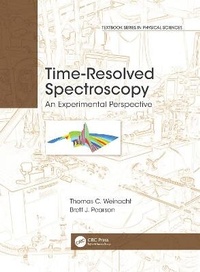
Time-Resolved Spectroscopy
An Experimental Perspective
1st Edition
Published on 31. March 2021
Book
Paperback/Softback
372 pages
978-0-367-78040-1 (ISBN)
Description
This concise and carefully developed text offers a reader friendly guide to the basics of time-resolved spectroscopy with an emphasis on experimental implementation. The authors carefully explain and relate for the reader how measurements are connected to the core physical principles. They use the time-dependent wave packet as a building block for understanding quantum dynamics, progressively advancing to more complex topics. The topics are discussed in paired sections, one discussing the theory and the next presenting the related experimental methods.
A wide range of readers including students and newcomers to the field will gain a clear and practical understanding of how to measure aspects of molecular dynamics such as wave packet motion, intramolecular vibrational relaxation, and electron-electron coupling, and how to describe such measurements mathematically.
A wide range of readers including students and newcomers to the field will gain a clear and practical understanding of how to measure aspects of molecular dynamics such as wave packet motion, intramolecular vibrational relaxation, and electron-electron coupling, and how to describe such measurements mathematically.
Reviews / Votes
"Weinacht and Pearson have produced a simple and direct introduction to the modern methods and motivations of ultrafast science, intended as a first text for students and scholars interested in this field. The chapter sections interleave physical concepts such as wave packets, correlated motion, or quantum tunneling with clear descriptions of the techniques that ultrafast optical scientists have developed in the last two decades, including the sources and tools of the trade. The result is an excellent introduction and practical guide to time resolved measurements."--Philip H. Bucksbaum, Marguerite Blake Wilbur Chair and Professor of Photon Science, Applied Physics, and Physics, Stanford University
"How do I measure a 'molecular movie'? Which observables do I obtain and how can they be interpreted? To answer these questions, a deeper understanding of the physics and the underlying models and assumptions, as well as the experimental techniques is essential. This is exactly the aim of this clearly written textbook. So far, no textbook exists that focuses on a time-dependent perspective accessible for both theoreticians and experimentalists. It succeeds in improving the common level of basic understanding of (quantum) dynamical models and experimental techniques...an excellent textbook"
--Prof. Dr. Stefanie Graefe, Institute of Physical Chemistry, Abbe Center for Photonics, Jena University
"An excellent, well-written and easy to read text. The approach is insightful, nicely blending intuitive physical pictures with sufficient mathematical formalism to enable calculations of real quantities of interest. The authors explain what information can be extracted from a variety of standard measurement techniques, including strengths and weaknesses of the various methods. I do not see a comparable book out there. I recommend it highly, not only for lecture courses on ultrafast spectroscopy and/or molecular dynamics, but as a primer for undergraduate and graduate students as they begin research projects in these areas. I intend to make it standard reading for students joining my group." --Robert R. Jones, Department Chair and Francis H. Smith Professor of Physics, University of Virginia "Weinacht and Pearson have produced a simple and direct introduction to the modern methods and motivations of ultrafast science, intended as a first text for students and scholars interested in this field. The chapter sections interleave physical concepts such as wave packets, correlated motion, or quantum tunneling with clear descriptions of the techniques that ultrafast optical scientists have developed in the last two decades, including the sources and tools of the trade. The result is an excellent introduction and practical guide to time resolved measurements."
--Philip H. Bucksbaum, Marguerite Blake Wilbur Chair and Professor of Photon Science, Applied Physics, and Physics, Stanford University
"How do I measure a 'molecular movie'? Which observables do I obtain and how can they be interpreted? To answer these questions, a deeper understanding of the physics and the underlying models and assumptions, as well as the experimental techniques is essential. This is exactly the aim of this clearly written textbook. So far, no textbook exists that focuses on a time-dependent perspective accessible for both theoreticians and experimentalists. It succeeds in improving the common level of basic understanding of (quantum) dynamical models and experimental techniques...an excellent textbook"
--Prof. Dr. Stefanie Graefe, Institute of Physical Chemistry, Abbe Center for Photonics, Jena University
"An excellent, well-written and easy to read text. The approach is insightful, nicely blending intuitive physical pictures with sufficient mathematical formalism to enable calculations of real quantities of interest. The authors explain what information can be extracted from a variety of standard measurement techniques, including strengths and weaknesses of the various methods. I do not see a comparable book out there. I recommend it highly, not only for lecture courses on ultrafast spectroscopy and/or molecular dynamics, but as a primer for undergraduate and graduate students as they begin research projects in these areas. I intend to make it standard reading for students joining my group." --Robert R. Jones, Department Chair and Francis H. Smith Professor of Physics, University of Virginia
More details
Series
Language
English
Place of publication
London
United Kingdom
Publishing group
Taylor & Francis Ltd
Target group
College/higher education
Postgraduate and Undergraduate
Dimensions
Height: 254 mm
Width: 203 mm
Weight
453 gr
ISBN-13
978-0-367-78040-1 (9780367780401)
Copyright in bibliographic data and cover images is held by Nielsen Book Services Limited or by the publishers or by their respective licensors: all rights reserved.
Schweitzer Classification
Other editions
Additional editions
Book
01/2019
1st Edition
CRC Press
€193.31
Shipment within 15-20 days
E-Book
12/2018
CRC Press
€67.49
Available for download
E-Book
12/2018
1st Edition
CRC Press
€67.49
Available for download
Persons
Thomas Weinacht is a Professor of Physics at Stony Brook University in New York.
He received his B.S. in physics from the University of Toronto 1995 and a Ph.D. in
physics from the University of Michigan in 2000. He started his position at Stony
Brook University in 2002. His research focuses on controlling and following molecular
dynamics with strong-field ultrafast laser pulses. He has published extensively
in both physics and chemistry journals, with an emphasis on interpreting experimental
measurements. His research group has developed a number of experimental techniques,
and he has organized multiple international conferences and workshops in the
field of time-resolved spectroscopy. He is a fellow of the American Physical Society.
Brett Pearson is an Associate Professor of Physics and Astronomy at Dickinson College
in Carlisle, PA. He obtained a B.A. in physics in 1997 from Grinnell College and
then a Ph.D. in physics from the University of Michigan in 2004. He was a postdoctoral
fellow at Stony Brook University before moving to his current position. At Dickinson,
Brett teaches across the curriculum and works with undergraduate students on
research related to both ultrafast pulse shaping and single-photon quantum mechanics.
He received his B.S. in physics from the University of Toronto 1995 and a Ph.D. in
physics from the University of Michigan in 2000. He started his position at Stony
Brook University in 2002. His research focuses on controlling and following molecular
dynamics with strong-field ultrafast laser pulses. He has published extensively
in both physics and chemistry journals, with an emphasis on interpreting experimental
measurements. His research group has developed a number of experimental techniques,
and he has organized multiple international conferences and workshops in the
field of time-resolved spectroscopy. He is a fellow of the American Physical Society.
Brett Pearson is an Associate Professor of Physics and Astronomy at Dickinson College
in Carlisle, PA. He obtained a B.A. in physics in 1997 from Grinnell College and
then a Ph.D. in physics from the University of Michigan in 2004. He was a postdoctoral
fellow at Stony Brook University before moving to his current position. At Dickinson,
Brett teaches across the curriculum and works with undergraduate students on
research related to both ultrafast pulse shaping and single-photon quantum mechanics.
Content
Contents
Preface ix
Authors xi
Part I Introduction and Background 1
Chapter 1 Introduction 3
Chapter 2 Molecular Structure 11
Chapter 3 Light-Matter Interaction 41
Chapter 4 Introduction to Experimental Techniques 63
Part II Quantum Dynamics in One Dimension 73
Chapter 5 Field-Free Dynamics 75
Chapter 6 Field-Driven Dynamics 93
Part III Measurements of One Dimensional Dynamics 113
Chapter 7 Incoherent Measurements in 1D 115
Chapter 8 Coherent Optical Measurements in 1D 141
Chapter 9 Coherent Diffractive Measurements in 1D 165
Part IV Quantum Dynamics in Multiple Dimensions 183
Chapter 10 Explicit Approach to N-D Dynamics 185
Chapter 11 Implicit Approaches to N-D Dynamics 205
Part V Measurements of Multidimensional Dynamics 215
Chapter 12 Incoherent Measurements in ND 217
Chapter 13 Coherent Optical Measurements in ND 241
Chapter 14 Coherent Diffractive Measurements in ND 275
Chapter 15 One System, Multiple Approaches 283
Appendix A Quantum Mechanics Essentials 297
Appendix B Experimental Considerations 317
Appendix C Additional Problems 325
Bibliography 327
Index 337
Preface ix
Authors xi
Part I Introduction and Background 1
Chapter 1 Introduction 3
Chapter 2 Molecular Structure 11
Chapter 3 Light-Matter Interaction 41
Chapter 4 Introduction to Experimental Techniques 63
Part II Quantum Dynamics in One Dimension 73
Chapter 5 Field-Free Dynamics 75
Chapter 6 Field-Driven Dynamics 93
Part III Measurements of One Dimensional Dynamics 113
Chapter 7 Incoherent Measurements in 1D 115
Chapter 8 Coherent Optical Measurements in 1D 141
Chapter 9 Coherent Diffractive Measurements in 1D 165
Part IV Quantum Dynamics in Multiple Dimensions 183
Chapter 10 Explicit Approach to N-D Dynamics 185
Chapter 11 Implicit Approaches to N-D Dynamics 205
Part V Measurements of Multidimensional Dynamics 215
Chapter 12 Incoherent Measurements in ND 217
Chapter 13 Coherent Optical Measurements in ND 241
Chapter 14 Coherent Diffractive Measurements in ND 275
Chapter 15 One System, Multiple Approaches 283
Appendix A Quantum Mechanics Essentials 297
Appendix B Experimental Considerations 317
Appendix C Additional Problems 325
Bibliography 327
Index 337