

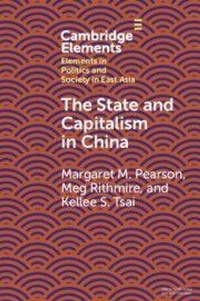
The State and Capitalism in China
Published on 29. June 2023
Book
Paperback/Softback
96 pages
978-1-009-35674-9 (ISBN)
Description
China's contemporary political economy features an emboldened role for the state as owner and regulator, and with markets expected to act in the service of party-state goals. How has the relationship between the state and different types of firms evolved? This Element situates China's reform-era political economy in comparative analytic perspective with attention to adaptations of its model over time. Just as other types of economies have generated internal dynamics and external reactions that undermine initial arrangements, so too has China's political economy. While China's state has always played a core role in development, over time prioritization of growth has shifted to a variant of state capitalism best described as, "party-state capitalism," which emphasizes risk management and leadership by the Chinese Communist Party (CCP). Rather than reflecting long-held intentions of the CCP, the transition to party-state capitalism emerged from reactions to perceived threats and problems, some domestic and some external. These adaptations are refracted in the contemporary crises of global capitalism.This title is also available as open access on Cambridge Core.
More details
Series
Language
English
Place of publication
Cambridge
United Kingdom
Product notice
Paperback (trade)
Illustrations
Worked examples or Exercises
Dimensions
Height: 229 mm
Width: 152 mm
Thickness: 5 mm
Weight
141 gr
ISBN-13
978-1-009-35674-9 (9781009356749)
Copyright in bibliographic data and cover images is held by Nielsen Book Services Limited or by the publishers or by their respective licensors: all rights reserved.
Schweitzer Classification
Other editions
Additional editions
Margaret M. Pearson | Meg Rithmire | Kellee Tsai
The State and Capitalism in China
E-Book
06/2023
Cambridge University Press
€20.99
Available for download
Persons
Content
1. Situating China's Political Economy; 2. Classic Conceptions and Models; 3. Evolution of China's Political Economy; 4. A New Model: Party-State Capitalism; 5. Explaining the Shifting Model; 6. External Backlash Against China's Model; 7. Conclusion: China's Development Model and Crises of Global Capitalism; References.