

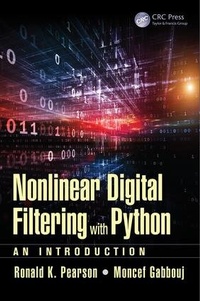
Nonlinear Digital Filtering with Python
An Introduction
1st Edition
Published on 25. September 2015
Book
Hardback
308 pages
978-1-4987-1411-2 (ISBN)
Description
Nonlinear Digital Filtering with Python: An Introduction discusses important structural filter classes including the median filter and a number of its extensions (e.g., weighted and recursive median filters), and Volterra filters based on polynomial nonlinearities. Adopting both structural and behavioral approaches in characterizing and designing nonlinear digital filters, this book:
Begins with an expedient introduction to programming in the free, open-source computing environment of Python
Uses results from algebra and the theory of functional equations to construct and characterize behaviorally defined nonlinear filter classes
Analyzes the impact of a range of useful interconnection strategies on filter behavior, providing Python implementations of the presented filters and interconnection strategies
Proposes practical, bottom-up strategies for designing more complex and capable filters from simpler components in a way that preserves the key properties of these components
Illustrates the behavioral consequences of allowing recursive (i.e., feedback) interconnections in nonlinear digital filters while highlighting a challenging but promising research frontier
Nonlinear Digital Filtering with Python: An Introduction supplies essential knowledge useful for developing and implementing data cleaning filters for dynamic data analysis and time-series modeling.
Begins with an expedient introduction to programming in the free, open-source computing environment of Python
Uses results from algebra and the theory of functional equations to construct and characterize behaviorally defined nonlinear filter classes
Analyzes the impact of a range of useful interconnection strategies on filter behavior, providing Python implementations of the presented filters and interconnection strategies
Proposes practical, bottom-up strategies for designing more complex and capable filters from simpler components in a way that preserves the key properties of these components
Illustrates the behavioral consequences of allowing recursive (i.e., feedback) interconnections in nonlinear digital filters while highlighting a challenging but promising research frontier
Nonlinear Digital Filtering with Python: An Introduction supplies essential knowledge useful for developing and implementing data cleaning filters for dynamic data analysis and time-series modeling.
Reviews / Votes
"The authors bring the reader from the consolidated world of linear filters into the variegate universe of nonlinear filters, and show how the main subclasses of digital nonlinear filters can be described on the basis of their structural and/or behavioral characteristics. This approach is complemented by the use of a free, open-source computing environment-Python-for the implementation of the nonlinear digital filters presented in each chapter."-Giovanni L. Sicuranza, University of Trieste, Italy
More details
Language
English
Place of publication
Bosa Roca
United States
Publishing group
Taylor & Francis Inc
Target group
College/higher education
Illustrations
2 s/w Tabellen, 39 s/w Abbildungen
2 Tables, black and white; 39 Illustrations, black and white
Dimensions
Height: 234 mm
Width: 156 mm
Weight
566 gr
ISBN-13
978-1-4987-1411-2 (9781498714112)
Copyright in bibliographic data and cover images is held by Nielsen Book Services Limited or by the publishers or by their respective licensors: all rights reserved.
Schweitzer Classification
Other editions
Additional editions
E-Book
09/2018
CRC Press
€73.49
Available for download
E-Book
09/2018
1st Edition
CRC Press
€73.99
Available for download
Persons
Ronald K. Pearson is a data scientist with DataRobot. He previously held industrial, business, and academic positions at organizations including the DuPont Company, Swiss Federal Institute of Technology (ETH Zurich), Tampere University of Technology, and Travelers Companies. He holds a Ph.D in electrical engineering and computer science from the Massachusetts Institute of Technology, and has published conference and journal papers on topics ranging from nonlinear dynamic model structure selection to the problems of disguised missing data in predictive modeling. Dr. Pearson has authored or co-authored four previous books, the most recent being Exploring Data in Engineering, the Sciences, and Medicine.
Moncef Gabbouj is an Academy of Finland professor of signal processing at Tampere University of Technology. He holds a B.Sc in electrical engineering from Oklahoma State University, and an M.Sc and Ph.D in electrical engineering from Purdue University. Dr. Gabbouj is internationally recognized for his research in nonlinear signal and image processing and analysis. His research also includes multimedia analysis, indexing and retrieval, machine learning, voice conversion, and video processing and coding. Previously, Dr. Gabbouj held visiting professorships at institutions including the Hong Kong University of Science and Technology, Purdue University, University of Southern California, and American University of Sharjah.
Moncef Gabbouj is an Academy of Finland professor of signal processing at Tampere University of Technology. He holds a B.Sc in electrical engineering from Oklahoma State University, and an M.Sc and Ph.D in electrical engineering from Purdue University. Dr. Gabbouj is internationally recognized for his research in nonlinear signal and image processing and analysis. His research also includes multimedia analysis, indexing and retrieval, machine learning, voice conversion, and video processing and coding. Previously, Dr. Gabbouj held visiting professorships at institutions including the Hong Kong University of Science and Technology, Purdue University, University of Southern California, and American University of Sharjah.
Content
Introduction. Python. Linear and Volterra Filters. Median Filters and Some Extensions. Forms of Nonlinear Behavior. Composite Structures: Bottom-Up Design. Recursive Structures and Stability.