

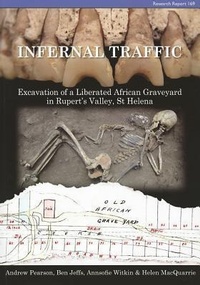
Infernal Traffic
Excavation of a Liberated African Graveyard in Rupert's Valley, St Helena
Published on 31. December 2011
Book
Paperback/Softback
204 pages
978-1-902771-89-2 (ISBN)
Description
Britain's abolition of the slave trade in 1807 did not end the traffic of human beings across the Atlantic. Indeed, for many decades to come, hundreds of thousands of enslaved Africans continued to be shipped into slavery. From 1840 to 1872 the remote South Atlantic island of St Helena played a pivotal role in Britain's efforts to suppress the slave trade, and over this time it received over 25,000 'liberated Africans', taken from slave ships by Royal Navy patrols. Conditions aboard the slavers were appalling, and many did not survive the journey. Rupert's Valley therefore became a graveyard to many thousands of Africans - 'a valley of dry bones' in the words of a visiting missionary. In 2008 archaeological excavations uncovered a small part of that graveyard, revealing the burials of over 300 victims of the slave trade. It was disposal on a massive scale, with the dead interred in a combination of single, multiple and mass graves. This book presents the finding of the archaeological and osteological study, and in so doing brings the inhumanity of the slave trade into vivid focus. It tells the story of a group of children and young adults who had lived in Africa only a few weeks prior to their death on St Helena, and whose remains bear witness to the cruelty of their transportation. However, the archaeology also shows them as more than just victims, but also as individuals with a sense of their own identity and culture. The slave trade continues to this day, and although this book is a study of the past it also serves as a reminder of evils that persist into the modern day.
Reviews / Votes
This is a timely and important work, essential reading for cultural historians of the nineteenth century, historical archaeologists, human remains specialists, those with an interest in funerary archaeology and indeed those like the current reviewer with an interest in the archaeology of the African Diaspora. Away from the undoubted value of this report as an archaeological research document, it retains a rare capacity among archaeological literature to provoke shocking and strong human emotions. The impact of this work is impressive on many levels. -- Archaeological Journal Archaeological JournalMore details
Language
English
Place of publication
York
United Kingdom
Target group
College/higher education
Product notice
Paperback (trade)
Unsewn / adhesive bound
Dimensions
Height: 295 mm
Width: 208 mm
Thickness: 15 mm
Weight
771 gr
ISBN-13
978-1-902771-89-2 (9781902771892)
Copyright in bibliographic data and cover images is held by Nielsen Book Services Limited or by the publishers or by their respective licensors: all rights reserved.
Schweitzer Classification
Persons
The Rupert's Valley project has been undertaken by a group of professional archaeologists from both the academic and commercial sectors. The project director, Dr Andrew Pearson, is an archaeologist and historian in the department of Archaeology and Anthropology at the University of Bristol. He is also a private consultant with over ten years' experience of archaeological projects in the UK and abroad. Mr Ben Jeffs is director of Blackfreighter Archaeology and Conservation, a company which carries out archaeological and built heritage projects on a world-wide basis. Dr Annsofie Witkin is an osteologist with over twenty years' experience in her field: formerly a Project Officer with Oxford Archaeology she has recently completed a PhD in the Archaeology and Anthropology department of Bristol University. Miss Helen MacQuarrie is a professional field archaeologist, currently working as a Project Officer for AOC Archaeology. Her ongoing academic research focuses on the artefactual remains of the slave trade.