

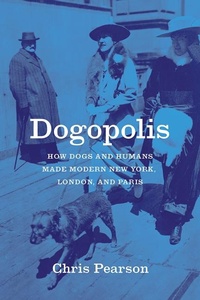
Dogopolis
How Dogs and Humans Made Modern New York, London, and Paris
Published on 31. August 2021
Book
Paperback/Softback
256 pages
978-0-226-79816-5 (ISBN)
Description
Stroll through any American or European city today and you probably won't get far before seeing a dog being taken for a walk. It's expected that these domesticated animals can easily navigate sidewalks, streets, and other foundational elements of our built environment. But what if our cities were actually shaped in response to dogs more than we ever realized?
Chris Pearson's Dogopolis boldly and convincingly asserts that human-canine relations were a crucial factor in the formation of modern urban living. Focusing on New York, London, and Paris from the early nineteenth century into the 1930s, Pearson shows that human reactions to dogs significantly remolded them and other contemporary western cities. It's an unalterable fact that dogs-often filthy, bellicose, and sometimes off-putting-run away, spread rabies, defecate, and breed wherever they like, so as dogs became a more and more common in nineteenth-century middle-class life, cities had to respond to people's fear of them and revulsion at their least desirable traits. The gradual integration of dogs into city life centered on disgust at dirt, fear of crime and vagrancy, and the promotion of humanitarian sentiments. On the other hand, dogs are some people's most beloved animal companions, and human compassion and affection for pets and strays were equally powerful forces in shaping urban modernity. Dogopolis details the complex interrelations among emotions, sentiment, and the ways we manifest our feelings toward what we love-showing that together they can actually reshape society.
Chris Pearson's Dogopolis boldly and convincingly asserts that human-canine relations were a crucial factor in the formation of modern urban living. Focusing on New York, London, and Paris from the early nineteenth century into the 1930s, Pearson shows that human reactions to dogs significantly remolded them and other contemporary western cities. It's an unalterable fact that dogs-often filthy, bellicose, and sometimes off-putting-run away, spread rabies, defecate, and breed wherever they like, so as dogs became a more and more common in nineteenth-century middle-class life, cities had to respond to people's fear of them and revulsion at their least desirable traits. The gradual integration of dogs into city life centered on disgust at dirt, fear of crime and vagrancy, and the promotion of humanitarian sentiments. On the other hand, dogs are some people's most beloved animal companions, and human compassion and affection for pets and strays were equally powerful forces in shaping urban modernity. Dogopolis details the complex interrelations among emotions, sentiment, and the ways we manifest our feelings toward what we love-showing that together they can actually reshape society.
Reviews / Votes
"Dogopolis is a beautifully presented book with an evocative historical voice and great confidence and flair. It is also a lot of fun to read. Pearson offers a treasure trove of details about the shared lives of humans and dogs across three rapidly urbanizing cities that epitomized urban modernity, and deals with themes at the heart of urban history in his examination of the public and private spaces; class, gender, and race relationships; and public health and disease."-- "Neil Pemberton, Manchester University"More details
Series
Language
English
Place of publication
Chicago
United States
Publishing group
The University of Chicago Press
Product notice
Paperback (trade)
Unsewn / adhesive bound
Dimensions
Height: 229 mm
Width: 152 mm
Thickness: 14 mm
Weight
358 gr
ISBN-13
978-0-226-79816-5 (9780226798165)
Copyright in bibliographic data and cover images is held by Nielsen Book Services Limited or by the publishers or by their respective licensors: all rights reserved.
Schweitzer Classification
Other editions
Additional editions
E-Book
08/2021
1st Edition
University of Chicago Press
€29.49
Available for download
Person
Chris Pearson is a senior lecturer in twentieth-century history at the University of Liverpool
Content
Introduction
1 Straying
2 Biting
3 Suffering
4 Thinking
5 Defecating
Coda
Acknowledgments
Appendix: Reflections on Animals, History, and Emotions
Chronology
Notes
Index
1 Straying
2 Biting
3 Suffering
4 Thinking
5 Defecating
Coda
Acknowledgments
Appendix: Reflections on Animals, History, and Emotions
Chronology
Notes
Index