

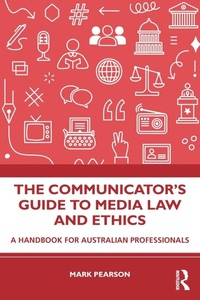
The Communicator's Guide to Media Law and Ethics
A Handbook for Australian Professionals
1st Edition
Published on 23. November 2023
Book
Paperback/Softback
392 pages
978-1-032-44557-1 (ISBN)
Description
This book offers an introduction to the key legal and ethical topics confronting Australian journalists and strategic communicators both at home and internationally and offers a suite of reflective techniques for navigating them. It starts by positioning morals, ethics, and the law in their historical and philosophical frameworks by tracing the evolution of free expression and professional media ethics. Media law and ethics are then contextualized in their modern international human rights framework.
Readers are equipped with a skill set for reflecting on the law and ethics of professional media dilemmas - including mindful reflection, the Potter Box, journaling, concept mapping, and discussion. Such approaches are then applied to key topic areas, including free expression; reputation; confidentiality; privacy; justice; intellectual property; national security; discrimination and harassment; and conflicted interests. Each is examined in terms of its philosophical underpinnings, relationship to human rights, professional ethical context, international examples, legal principles, key Australian laws, legal cases, and strategies for applying reflective practice techniques. It concludes on a confident note - imploring communicators to engage in constructive and mindful strategic communication with the authority and confidence that results from a working knowledge of media law and ethics.
This handbook is for professional communicators and students in all fields, but particularly in journalism, public relations, corporate communication, media relations, and marketing.
Readers are equipped with a skill set for reflecting on the law and ethics of professional media dilemmas - including mindful reflection, the Potter Box, journaling, concept mapping, and discussion. Such approaches are then applied to key topic areas, including free expression; reputation; confidentiality; privacy; justice; intellectual property; national security; discrimination and harassment; and conflicted interests. Each is examined in terms of its philosophical underpinnings, relationship to human rights, professional ethical context, international examples, legal principles, key Australian laws, legal cases, and strategies for applying reflective practice techniques. It concludes on a confident note - imploring communicators to engage in constructive and mindful strategic communication with the authority and confidence that results from a working knowledge of media law and ethics.
This handbook is for professional communicators and students in all fields, but particularly in journalism, public relations, corporate communication, media relations, and marketing.
Reviews / Votes
"Up to date, forward thinking, and highly accessible for students seeking careers in the fast-changing world of communications. A book students will keep well past their graduation."-Alexandra Wake, Program Manager Journalism at RMIT University and President, Journalism Education and Research Association of Australia
"For those navigating the increasingly complex landscape of media law and ethics, there is no better guide than Mark Pearson. Essential reading for all Australian communicators, whether you're an educator, student, or established professional."
-Dr Steinar Ellingsen, Senior Lecturer in Journalism, Communication and Media, School of the Arts, English, University of Wollongong, Australia
More details
Language
English
Place of publication
London
United Kingdom
Publishing group
Taylor & Francis Ltd
Target group
College/higher education
Postgraduate, Undergraduate Advanced, and Undergraduate Core
Illustrations
3 s/w Abbildungen, 3 s/w Photographien bzw. Rasterbilder, 9 s/w Tabellen
9 Tables, black and white; 3 Halftones, black and white; 3 Illustrations, black and white
Dimensions
Height: 234 mm
Width: 156 mm
Thickness: 22 mm
Weight
626 gr
ISBN-13
978-1-032-44557-1 (9781032445571)
Copyright in bibliographic data and cover images is held by Nielsen Book Services Limited or by the publishers or by their respective licensors: all rights reserved.
Schweitzer Classification
Other editions
Additional editions
Mark Pearson
The Communicator's Guide to Media Law and Ethics
A Handbook for Australian Professionals
E-Book
11/2023
1st Edition
Routledge
€53.99
Available for download
Mark Pearson
The Communicator's Guide to Media Law and Ethics
A Handbook for Australian Professionals
E-Book
11/2023
1st Edition
Routledge
€53.99
Available for download
Mark Pearson
The Communicator's Guide to Media Law and Ethics
A Handbook for Australian Professionals
Book
11/2023
1st Edition
Routledge
€207.60
Shipment within 10-20 days
Person
Mark Pearson is Professor of Journalism and Social Media at Griffith University in Queensland, Australia, where he is a member of the Griffith Centre for Social and Cultural Research. He is co-author of Social Media Risk and the Law: A Guide for Global Communicators (Routledge, 2022), lead author of The Journalist's Guide to Media Law: A Handbook for Communicators in a Digital World (6th ed, Routledge, 2020), author of Blogging and Tweeting Without Getting Sued (Allen & Unwin, 2012), and co-editor of Mindful Journalism and News Ethics in the Digital Era: A Buddhist Approach (Routledge, 2015). He has worked as a journalist and trainer with several media organisations and as a press secretary to a federal member of parliament. He was Australian correspondent for Reporters Without Borders for a decade and is a life member of the Journalism Education and Research Association of Australia.
Content
Part 1 Foundational Approaches 1. Applied Ethics 101 2. Human rights, ethics and laws 3. Tools for reflection in a communication context 4. Law and ethics across communication careers: truth and deception in action Part 2 Key Topics in Media Law and Ethics 5. Reputation and defamation 6. Confidentiality, sources, secrets, and disclosure 7. Privacy and data protection 8. Communicating crime and justice Part 3 Challenges in the Digital Era 9. Law and ethics of intellectual property 10. Defence, national security, cyber security and anti-terrorism 11. Discrimination and harassment 12. Integrity, conflicted interests and the business of communication