

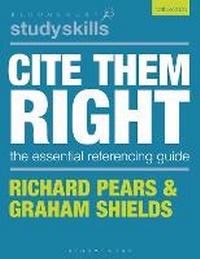
Cite Them Right
12th Edition
Published on 19. May 2022
Book
Hardback
312 pages
978-1-350-93344-6 (ISBN)
Description
Cite them right is renowned as the most comprehensive yet easy-to-use guide to referencing text available to students and authors. Academics and teachers rely on the advice in Cite them right to guide their students in the skills of identifying and referencing information sources and avoiding plagiarism.
Comprehensive and accessible, it provides readers with detailed examples of print and electronic sources, business, government, technical and legal publications, works of art, images and much more. Packed with practical tips and example sources in both citations and reference lists, it makes referencing manageable and easy to follow for everyone.
The fully revised and updated 12th edition contains:
- Expanded guidance on the key principles of referencing and avoiding plagiarism, including new sections on collecting evidence to use in your work; reading, listening and taking notes; and using other people's work in your writing.
- New reference examples for Tik Tok, blog posts, Zoom and Teams, recorded lectures and online seminars.
Comprehensive and accessible, it provides readers with detailed examples of print and electronic sources, business, government, technical and legal publications, works of art, images and much more. Packed with practical tips and example sources in both citations and reference lists, it makes referencing manageable and easy to follow for everyone.
The fully revised and updated 12th edition contains:
- Expanded guidance on the key principles of referencing and avoiding plagiarism, including new sections on collecting evidence to use in your work; reading, listening and taking notes; and using other people's work in your writing.
- New reference examples for Tik Tok, blog posts, Zoom and Teams, recorded lectures and online seminars.
Reviews / Votes
Every source you can think of is in the book with a clear example. * praise from students * The standard for referencing and citations at our university, and I can see why... useful for people at all levels of writing, from those still at school to the very top of academia. * praise from students * A text that just keeps getting better and better -- Nigel Chaffey, Bath Spa University, UK A comprehensive yet easy-to-follow guide to referencing all kinds of sources in any subject area. -- Livia Sz. Olah, Stockholm University, Sweden This has been a complete lifesaver for my university work. * praise from students *More details
Series
Edition
12th edition
Language
English
Place of publication
London
United Kingdom
Publishing group
Bloomsbury Publishing PLC
Target group
College/higher education
Illustrations
full-colour photos (approx 20)
Dimensions
Height: 246 mm
Width: 189 mm
ISBN-13
978-1-350-93344-6 (9781350933446)
Copyright in bibliographic data and cover images is held by Nielsen Book Services Limited or by the publishers or by their respective licensors: all rights reserved.
Schweitzer Classification
Persons
Richard Pears is a Faculty Librarian at Durham University Library, UK. He has worked in academic and public libraries for over twenty-five years, delivering research skills training to students in all academic stages.
Graham Shields is a retired university librarian, with over thirty years' experience. Working closely with academics and students, he has built up an extensive knowledge and understanding of the problems students face in relation to referencing.
Graham Shields is a retired university librarian, with over thirty years' experience. Working closely with academics and students, he has built up an extensive knowledge and understanding of the problems students face in relation to referencing.
Content
Foreword
Acknowledgements
Section A: What is Referencing?
Section B: Collecting Evidence to Use in Your Work
Section C: Reading, Listening and Taking Notes
Section D: How to Cite Sources
Section E: Using Other People's Work in Your Writing: Quoting, Paraphrasing and Summarizing
Section F: How to Reference
Section G. Harvard Referencing Style
Section H: American Psychological Association (APA) Referencing Style
Section I: Chicago Referencing Style
Section J: IEEE Referencing Style
Section K: Modern Humanities Research Association (MHRA) Referencing Style
Section L: Modern Language Association (MLA) Referencing Style
Section M: Oxford University Standard for the Citation of Legal Authorities (OSCOLA)
Section N: Vancouver Referencing Style
Glossary
Further Reading
Index
Acknowledgements
Section A: What is Referencing?
Section B: Collecting Evidence to Use in Your Work
Section C: Reading, Listening and Taking Notes
Section D: How to Cite Sources
Section E: Using Other People's Work in Your Writing: Quoting, Paraphrasing and Summarizing
Section F: How to Reference
Section G. Harvard Referencing Style
Section H: American Psychological Association (APA) Referencing Style
Section I: Chicago Referencing Style
Section J: IEEE Referencing Style
Section K: Modern Humanities Research Association (MHRA) Referencing Style
Section L: Modern Language Association (MLA) Referencing Style
Section M: Oxford University Standard for the Citation of Legal Authorities (OSCOLA)
Section N: Vancouver Referencing Style
Glossary
Further Reading
Index