

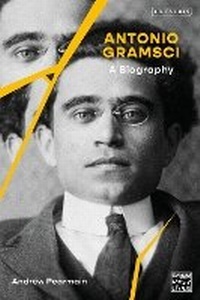
Antonio Gramsci
A Biography
Published on 20. August 2020
Book
Hardback
248 pages
978-1-83860-160-7 (ISBN)
Description
A historical biography of the Italian philosopher/politician Antonio Gramsci (1891-1973), considered one of the most important Marxist philosophers of the twentieth-century. As part of the Communist Lives series, Andrew Pearmain explores the life of Gramsci from his childhood, to his role in the newly formed Communist Party of Italy, and to his imprisonment and death in Turi di Bari, using recent archival research including material released by the Gramsci and Schucht family.
Reviews / Votes
A compelling narrative of Gramsci's life and times with a lucid exposition of his intellectual achievements ... It is beautifully and sensitively written, sober in tone, wise in judgment and full of striking apercus. * Perspectives * Gramsci is probably the most brilliant of all Marx's intellectual followers. He was also a real historical actor, secret leader of the Italian Communist Party under Fascism. Pearmain's biography places the first fact in the context of the second: he has written a book that, just as he aimed to do, re-places Gramsci from merely academic treatments back into "politics and history". This biography enables one to understand how this extraordinary organic intellectual can have so much to say that speaks to us still today. His difficult existence - in ill-health, as beleaguered political prisoner, and in a world that gradually seemed to forget all that he holds dear - casts real light on how his thought became increasingly 'revisionist' during the course of his (too-short) life, and on how the Gramscian net of concepts such as 'subaltern' and 'hegemony' is far more relevant to our times than most more-dogmatically Marxian theory. Pearmain's account is simultaneously humble and authoritative, grounded sharply in Gramsci's time and yet dripping with relevances to our own. It is faithful and therefore poignant. It deserves to be read. * Professor Rupert Read, University of East Anglia. *More details
Series
Language
English
Place of publication
United Kingdom
Publishing group
Bloomsbury Publishing PLC
Target group
College/higher education
Dimensions
Height: 234 mm
Width: 156 mm
Weight
526 gr
ISBN-13
978-1-83860-160-7 (9781838601607)
Copyright in bibliographic data and cover images is held by Nielsen Book Services Limited or by the publishers or by their respective licensors: all rights reserved.
Schweitzer Classification
Other editions
Additional editions
E-Book
07/2020
1st Edition
I.B. Tauris
€28.49
Available for download
Person
Andrew Pearmain has a PhD in History from the University of East Anglia, UK. Andrew has previously published several articles and a book on Gramsci. Andrew was a member of the Labour Party, serving as a Norwich City Councillor for four years from 1999-2003, and is now associated with the Green Party though the think-tank Greenhouse. Now semi-retired, Andrew is a contributing editor to the art/fashion magazine Arena Homme Plus.
Content
A. Infancy and Childhood in Rural Sardinia, effects of Gramsci's father's prosecution and imprisonment.
B. School study at home and in Cagliari.
C. Scholarship and study at the University of Turin, and early involvement in radical politics.
D. Early journalism and activism in the Socialist Party.
E. Italian responses to the First World War and the Soviet revolution, and schisms within the Socialist Party.
F. The journal Ordine Nuovo and the Turin Factory Councils movement.
G. The foundation of the Italian Communist Party, and the reaction of Fascism.
H. The early life of the PCd'I, Gramsci's then minor role, and his time in Russia at the Communist International, including his acquaintance with the Schucht family, his complicated courtship of Julia and the birth of their sons.
I. Return to Italy as a Communist MP, then (with the arrest of most of the party leadership) as Party Secretary, culminating in arrest in November 1926.
J. Early prison years, with court appearances and frequent relocations, with growing reliance on Tatiana and estrangement from Julia and the rest of the Schucht family.
K. Settlement at the penitentiary in Turi di Bari, and a serious start on the prison notebooks.
L. The inner-party feuds of the early 1930s and their ramifications for Gramsci.
M. The onset of serious ill health, and death in 1937.
N. The several 'after-lives' of Antonio Gramsci, and the continuing relevance of his thought.
B. School study at home and in Cagliari.
C. Scholarship and study at the University of Turin, and early involvement in radical politics.
D. Early journalism and activism in the Socialist Party.
E. Italian responses to the First World War and the Soviet revolution, and schisms within the Socialist Party.
F. The journal Ordine Nuovo and the Turin Factory Councils movement.
G. The foundation of the Italian Communist Party, and the reaction of Fascism.
H. The early life of the PCd'I, Gramsci's then minor role, and his time in Russia at the Communist International, including his acquaintance with the Schucht family, his complicated courtship of Julia and the birth of their sons.
I. Return to Italy as a Communist MP, then (with the arrest of most of the party leadership) as Party Secretary, culminating in arrest in November 1926.
J. Early prison years, with court appearances and frequent relocations, with growing reliance on Tatiana and estrangement from Julia and the rest of the Schucht family.
K. Settlement at the penitentiary in Turi di Bari, and a serious start on the prison notebooks.
L. The inner-party feuds of the early 1930s and their ramifications for Gramsci.
M. The onset of serious ill health, and death in 1937.
N. The several 'after-lives' of Antonio Gramsci, and the continuing relevance of his thought.