

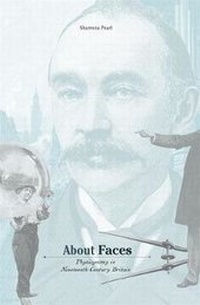
About Faces
Physiognomy in Nineteenth-Century Britain
Published on 15. February 2010
Book
Hardback
302 pages
978-0-674-03604-8 (ISBN)
Description
When nineteenth-century Londoners looked at each other, what did they see, and how did they want to be seen? Sharrona Pearl reveals the way that physiognomy, the study of facial features and their relationship to character, shaped the way that people understood one another and presented themselves.
Physiognomy was initially a practice used to get information about others, but soon became a way to self-consciously give information-on stage, in print, in images, in research, and especially on the street. Moving through a wide range of media, Pearl shows how physiognomical notions rested on instinct and honed a kind of shared subjectivity. She looks at the stakes for framing physiognomy-a practice with a long history-as a science in the nineteenth century.
By showing how physiognomy gave people permission to judge others, Pearl holds up a mirror both to Victorian times and our own.
Physiognomy was initially a practice used to get information about others, but soon became a way to self-consciously give information-on stage, in print, in images, in research, and especially on the street. Moving through a wide range of media, Pearl shows how physiognomical notions rested on instinct and honed a kind of shared subjectivity. She looks at the stakes for framing physiognomy-a practice with a long history-as a science in the nineteenth century.
By showing how physiognomy gave people permission to judge others, Pearl holds up a mirror both to Victorian times and our own.
Reviews / Votes
Although this book is clearly a cultural history of Victorian Britain, the resonances of physiognomy with current preoccupations and events are poignant. With pervasive concerns about the alleged invisible threats in our midst, any technology or idea, old or new, that promises to reveal those threats tends to carry weight. As Pearl rightly concludes, the promise of establishing reliable links between appearance and underlying reality was played for high stakes--and still is. -- Alan Collins * Times Higher Education Supplement * Pearl's book is a brilliant and original contribution to the history of visual culture. It bodes well for the career of a young scholar whose questions are difficult and whose answers are compelling. -- Sander L. Gilman * Bulletin of the History of Medicine * In this smart, engaging book, Sharrona Pearl shows that we can see Victorian culture through new eyes if we learn to look, as the Victorians did, with a physiognomic sensibility. Actors, criminals, the insane, rushed Londoners, Irish, Jews: all came to be categorized in this new form of gaze. Pearl's inventive and expansive About Faces recreates for us this most protean of nineteenth-century sciences. -- Peter Galison, Harvard University This is a masterful study of how the Victorians came to see each other and themselves. Sharrona Pearl's witty, incisive, and pathbreaking book uses 'physiognomy'--the scientific study of faces--to tell us about the ways that the nineteenth-century British understood their rapidly changing social world, one face and glance at a time. -- Alison Winter, author of <i>Mesmerized: Powers of Mind in Victorian Britain</i>More details
Language
English
Place of publication
Cambridge, Mass
United States
Target group
Professional and scholarly
Illustrations
41 halftones, 35 numbered figures
Dimensions
Height: 235 mm
Width: 156 mm
ISBN-13
978-0-674-03604-8 (9780674036048)
Copyright in bibliographic data and cover images is held by Nielsen Book Services Limited or by the publishers or by their respective licensors: all rights reserved.
Schweitzer Classification
Person
Sharrona Pearl is Assistant Professor of Communication at the Annenberg School for Communication of the University of Pennsylvania.
Content
* List of Figures * Acknowledgments * Introduction: Face Facts * Pocket Physiognomy: Sense in the City * Performing Physiognomy: Imitating Art and Life * Portrait Physiognomy: Communicating Character * Caricature Physiognomy: Imaging Communities * Photographic Physiognomy: Through a Mediated Mirror * Diagnostic Physiognomy: From Phrenology to Fingerprints * Conclusion: Seeing Ourselves * Notes * Index