

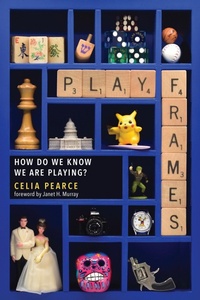
Playframes
How Do We Know We Are Playing?
Published on 17. December 2024
Book
Paperback/Softback
320 pages
978-0-262-55081-9 (ISBN)
Description
"Pearce explores a new theory of play, to help us get at the question: How do we know we are playing? The book is broken into three parts: the first explores a variety of concepts derived from social theory, the second shows how we can apply these frames in practice, and the third part then focuses on a series of specific case studies and examples"--
More details
Language
English
Place of publication
Cambridge (Massachusetts)
United States
Publishing group
MIT Press Ltd
Illustrations
4 BLACK AND WHITE ILLUS.
Dimensions
Height: 153 mm
Width: 229 mm
Thickness: 28 mm
Weight
414 gr
ISBN-13
978-0-262-55081-9 (9780262550819)
Copyright in bibliographic data and cover images is held by Nielsen Book Services Limited or by the publishers or by their respective licensors: all rights reserved.
Schweitzer Classification
Other editions
Additional editions

E-Book
12/2024
MIT Press
€63.49
Available for download
Persons
Celia Pearce is the author of Communities of Play (MIT Press) and IndieCade: A History. Her award-winning game designs include Virtual Adventures and eBee, an electronic quilt game, which won the 2017 award for Most Innovative Board Game at the Boston Festival of Independent Games. She is also a cofounder of IndieCade and Co-Executive Director of the Playable Theatre Project.
Content
Foreword
Janet H. Murray
Acknowledgments
Introduction: The How of Play
Part I: Framing This Research
Introduction to Part I
1 The Social Construction of Playframes
2 Principles and Terms
Part II: The Metacommunication of Play: Keying Mechanisms
Introduction to Part II
3 Four Types of Rule Conveyance
4 Inter-Rule Dynamics
5 The How of Play
6 Gestalt Redux—Putting It All Together
Part III: Topical Studies
Introduction to Part III
7 A Trip to Dragon Con with Erving Goffman
8 “Playing with Fire”: Weddings, Real and Virtual
9 Play Money
10 “This Is Not a Game”: Alternate Reality, Alternative Facts, and the January 6 Insurrection
11 Beyond Bateson’s Monkeys: The Present and Future of Playframes
Notes
References
Index
Janet H. Murray
Acknowledgments
Introduction: The How of Play
Part I: Framing This Research
Introduction to Part I
1 The Social Construction of Playframes
2 Principles and Terms
Part II: The Metacommunication of Play: Keying Mechanisms
Introduction to Part II
3 Four Types of Rule Conveyance
4 Inter-Rule Dynamics
5 The How of Play
6 Gestalt Redux—Putting It All Together
Part III: Topical Studies
Introduction to Part III
7 A Trip to Dragon Con with Erving Goffman
8 “Playing with Fire”: Weddings, Real and Virtual
9 Play Money
10 “This Is Not a Game”: Alternate Reality, Alternative Facts, and the January 6 Insurrection
11 Beyond Bateson’s Monkeys: The Present and Future of Playframes
Notes
References
Index