

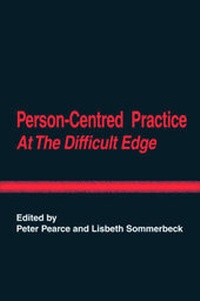
Person-Centred Practice at the Difficult Edge
Published on 2. July 2014
Book
Paperback/Softback
236 pages
978-1-906254-69-8 (ISBN)
Description
This book presents accounts of the practice of the person-centred approach (PCA) with people suffering from a range of severe and enduring conditions. Comprehensively refuting the notion that person-centred therapy is suitable only for the 'worried well', it backs up contemporary practice with appropriate theory. For students, academic and professional audiences. Contributions include: Person-centred therapy with post-traumatic stress (Stephen Joseph and David Murphy); Tenuous contact - Person-centred therapy with adolescent process (Peter Pearce and Ros Sewell); Pre-Therapy with psychotic clients (Dion van Werde); Refutation of myths of inappropriateness of person-centered therapy at the difficult edge (Lisbeth Sommerbeck); Difficult processes (Margaret Warner) and several other chapters from leading theorists and practitioners.
Reviews / Votes
Intelligent, skilled, inspiring therapists offer chapters that teach us not only how to be therapists working with those at the 'difficult edge' but how to be better therapists with all our clients. This book gives us deep understanding of often misunderstood clients and the therapist's inner dialogue in connecting with them. Charles O'Leary, author of The Practice of Person-Centred Couple and Family Therapy;This book identifies the challenges of contact with certain client groups and particular 'difficult edges'. Throughout, the contributors hold the notion of empathy as a guiding light; both explicitly and implicitly documenting the profound impact of understanding and acceptance on others and self. Sheila Haugh, Associate Lecturer, Prague College of Psychosocial Studies, Czech Republic; Lecturer, Metanoia Institute, London, UK;... I feel this book has much to offer both the experienced person-centred practitioner, the student exploring a wider application of person-centred therapy, as well as practitioners from other modalities wishing to find out more... I strongly recommend you read it ofr yourself in its entirely! Reviewed in BAPCA's Person-Centred Quarterly, November 2014 by Claire Thomas;This is for me a joyful book, in that it recognisis and celebrates the effectiveness of person-centred practice in areas that may traditionally have been the preserve of psychiatry, or focused on stabilisation and support rather than the facilitation of growth. Mike Gallant, Senior Teaching Fellow (Counselling & Psychotherapy), Warwick University. Reviewed in Therapy Today, December 2014More details
Edition
1st
Language
English
Place of publication
Manchester
United Kingdom
Target group
Professional and scholarly
Dimensions
Height: 240 mm
Width: 172 mm
Thickness: 17 mm
Weight
427 gr
ISBN-13
978-1-906254-69-8 (9781906254698)
Copyright in bibliographic data and cover images is held by Nielsen Book Services Limited or by the publishers or by their respective licensors: all rights reserved.
Schweitzer Classification
Other editions
Additional editions
Peter Pearce | Lisbeth Sommerbeck
Person-Centred Practice at the Difficult Edge
E-Book
07/2014
PCCS Books
€29.49
Available for download
Persons
Peter is Head of the Person-Centred Department at Metanoia Institute where, amongst other trainings, he runs an MSc in Contemporary Person-Centred Psychotherapy, BA in Counselling, and the Practitioner Certificate in Person-Centred Practice at the Difficult Edge. He has provided person-centred counselling for nearly twenty five years, predominantly in 'difficult edge' situations within UK National Health Service, multi-disciplinary community teams for adults with mental health issues and adults with learning disabilities, and with young people in inner London school settings. Lisbeth Sommerbeck is a clinical psychologist, accredited as a specialist in psychotherapy and supervision by the Danish Psychological Association. Since 1974 she has been employed in Dianalund Psychiatric Hospital in Denmark, where the bulk of her work has been, and still is, psychotherapy, supervision, consultation and teaching. She therefore has solid personal experience with the ups and downs of being dedicated to the person-centred approach in psychiatric contexts and practising client-centred therapy with psychiatric clients. She is the initiator of the recently created Danish Carl Rogers Forum.
Content
Part 1: Practice1 Understanding posttraumatic stress and facilitating posttraumatic growth David Murphy and Stephen Joseph2 Person-centred therapy with adult survivors of childhood sexual abuse Jan Hawkins3 Person-centred therapy with people with learning disabilities: Happy people wear hats Jan Hawkins4 'Tenuous contact': New theory about adolescent process Peter Pearce and Ros Sewell 5 Pre-Therapy at its edges: From palliative care to exercising newly recoveredcontact functioning Dion Van Werde 6 Combining person-centred therapy and Pre-Therapy with clients at the difficult edge Lisbeth Sommerbeck 7 A person-centred approach to counselling clients with autistic process Anja Rutten 8 Person-centred therapy for people with dementia Danuta Lipinska 9 Pre-Therapy and dementia - the opportunity to put Person-Centred theory into everyday practice Penny Dodds, Pamela Bruce-Hay and Sally Stapleton Part 2: Conceptualisations that support practice 10 Client processes at the difficult edge Margaret Warner 11 The relation between intersubjectivity, imitation, mirror neurons, empathy and Pre-Therapy Hans Peters 12 Refutation of myths of inappropriateness of person-centred therapy at the difficult edge Lisbeth SommerbeckPart 3: Research that supports practice 14 An investigation of the effectiveness of person-centred therapy for 'psychotic' processes in adult clients Wendy Traynor 15 Pre-Therapy process and outcome: A review of research instruments and findings Mathias Dekeyser, Garry Prouty and Robert Elliott