

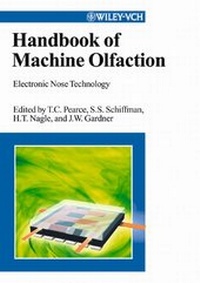
Handbook of Machine Olfaction
Electronic Nose Technology
1st Edition
Published on 3. January 2003
Book
Hardback
XXXII, 592 pages
978-3-527-30358-8 (ISBN)
Description
Electronic noses: that means instruments which mimic the sense of smell. They are very useful for a remarkably variety of applications, e. g. in food and pharmaceutical industry, in environmental control or clinical diagnostics.
The book covers biological and technical fundamentals, up-to-date research, contributed by renowned international scientists, as well as application-oriented news from successful E-nose manufacturers. It is a unique standard work for scientists in research and development and for users of electronic noses.
Reviews / Votes
"...a well rounded account of the topic..." (Insight, April 2003) "...This book is a valuable information source ...This reviewer was captivated that he ended up with enough notes for a book review of several thousand words!..." (Measurement & Control, July 2003More details
Edition
1., Aufl.
Language
English
Place of publication
Weinheim
Germany
Target group
Professional and scholarly
Sensorindustrie, Hersteller von Sensoren, Industriebibliotheken, Institutsbibliotheken, Analytiker
Illustrations
238 s/w Abbildungen, 29 farbige Abbildungen, 46 s/w Tabellen
Illustrations (some col.)
Dimensions
Height: 24 cm
Width: 17 cm
Weight
1350 gr
ISBN-13
978-3-527-30358-8 (9783527303588)
Schweitzer Classification
Other editions
Additional editions
Tim C. Pearce | Susan S. Schiffman | H. Troy Nagle
Handbook of Machine Olfaction
Electronic Nose Technology
E-Book
01/2006
1st Edition
Wiley-VCH
€237.99
Available for download
Content
PART 1: INTRODUCTION TO OLFACTION: PERCEPTION, ANATOMY, PHYSIOLOGY AND MOLECULAR BIOLOGY.Introduction to Olfaction.Odor Classification Schemes Based on Adjective Descriptors.Odor Classification Based on Chemical Properties.Physiology and Anatomy of Olfaction.Molecular Biology of Olfaction.Taste.Final Comment.PART 2: CHEMICAL SENSING IN HUMANS AND MACHINES.Human Chemosensory Perception of Airborne Chemicals.Nasal Chemosensory Detection.Olfactory and Nasal Chemesthetic Detection of Mixtures of Chemicals.Physicochemical Determinants of Odor and Nasal Pungency.Human Chemical Sensing: Olfactometry.Instruments for Chemical Sensing: Gas Chromatography-Olfactometry.PART 3: ODOR HANDLING AND DELIVERY SYSTEMS.Introduction.Physics of Evaporation.Sample Flow System.Static System.Preconcentrator.Measurement of Sensor Directly Exposed to Ambient Vapor.Summary.PART 4: INTRODUCTION TO CHEMOSENSORS.Introduction.Survey and Classification of Chemosensors.Chemoresistors.Chemocapcitors.Potentiometric Odor Sensors.Gravimetric Odor Sensors.Optical Odor Sensors.Thermal (Calorimetric) Sensors.Amperometric Sensors.Summary of Chemical Sensors.PART 5: SIGNAL CONDITIONING AND PREPROCESSING.Introduction.Interface Circuits.Signal Conditioning.Signal Preprocessing.Noise in Sensors and Circuits.Outlook.Conclusions.Acknowledgements.PART 6: PATTERN ANALYSIS FOR ELECTRONIC NOSES.Introduction.Statistical Pattern Analysis Techniques.'Intelligent' Pattern Analysis Techniques.Outlook and Conclusions.PART 7: COMMERCIAL ELECTRONIC NOSE INSTRUMENTS.Introduction.Commercial Availability.Some Market Considerations.PART 8: OPTICAL ELECTRONIC NOSES.Introduction.Optical Vapor Sensing.The Tufts Artificial Nose.Conclusion.PART 9: HAND-HELD AND PALM-TOP MICROSENSOR SYSTEMS FOR GAS ANALYSIS.Introduction.Conventional Hand-Held Systems.Silicon-Based Microsensors.Summary and Outlook.PART 10: INTEGRATED ELECTRONIC NOSES AND MICROSYSTEMS FOR CHEMCIAL ANALYSIS.Introduction.Microcomponents for Fluid Handling.Integrated E-Nose Systems.Microsystems for Chemical Analysis.Future Outlook.PART 11: ELECTRONIC TONGUES AND COMBINATIONS OF ARTIFICIAL SENSES.Introduction.Electronic Tongues.The Combination or Fusion of Artificial Senses.Conclusions.PART 12: DYNAMIC PATTERN RECOGNITION METHODS AND SYSTEM IDENTIFICATION.Introduction.Dynamic Models and System Identification.Identifying a Model.Dynamic Models and Intelligent Sensor Systems.Outlook.PART 13: DRIFT COMPENSATION, STANDARDS, AND CALIBRATION METHODS.Physical Reasons for Drift and Sensor Poisoning.Examples of Sensor Drift.Comparison of Drift and Noise.Model Building Strategies.Calibration Transfer.Drift Compensation.Conclusions.PART 14: CHEMICAL SENSOR ARRAY OPTIMIZATION: GEOMETRIC AND INFORMATION THEORETIC APPROACHES.The Need for Array Performance Definition and Optimization.Historical Perspective.Geometric Interpretation.Noise Considerations.Non-linear Transformations.Array Performance as a Statistical Estimation Problem.Fisher Information Matrix and the Best Unbiased Estimator.Performance Optimization.Conclusions.PART 15: CORRELATING ELECTRONIC NOSE AND SENSORY PANEL DATA.Sensory Panel Methods.Applications of Electronic Noses for Correlating Sensory Data.Algorithms for Correlating Sensor Array Data with Sensory Panels.Correlations of Electronic Nose Data with Sensory Panel Data.Conclusions.PART 16: MACHINE OLFACTION FOR MOBILE ROBOTS.Introduction.Olfactory-Guided Behavior of Animals.Sensors and Signal Processing in Mobile Robots.Trail Following Robots.Plume Tracking Robots.Other Technologies in Developing Plume Tracking Systems.Concluding Remarks.PART 17: ENVIRONMENTAL MONITORING.Introduction.Special Considerations for Environmental Monitoring.Case Study 1: Livestock Odor Classification.Case Study 2: Swine Odor Detection Thresholds.Case Study 3: Biofilter Evaluation.Case Study 4: Mold Detection.Future Directions.PART 18: MEDICAL DIAGNOSTICS AND HEALTH MONITORING.Introduction.Special Considerations in Medical/Healthcare Applications.Monitoring Metabolic Defects in Humans Using a Conducting Polymer Sensor Array to Measure Odor.The Use of Electronic Nose for the Detection of Bacterial Vaginosis.Conclusion.PART 19: RECOGNITION OF NATURAL PRODUCTS.Introduction.Recent Literature Review.Sampling Techniques.Case-Study: The Rapid Detection of Natural Products as a Means of Identifying Plant Species.Case Study: Differentiation of Essential Oil-Bearing Plants.Conclusion and Future Outlook.PART 20: PROCESS MONITORING.Introduction.Previous Work.Special Considerations.Selected Process Monitoring Examples.Future ProspectsPART 21: FOOD AND BEVERAGE QUALITY ASSURANCE.Introduction.Literature Survey.Methodological Issues in Food Measurement with Electronic Nose.Selected Case.Conclusions.Future Outlook.PART 22: AUTOMOTIVE AND AEROSPACE APPLICATIONS.Introduction.Automotive Applications.Aerospace Applications.Polymer Composite Films.Electronic Nose Operation in Spacecraft.Method Development.Future Directions.Conclusion.PART 23: DETECTION OF EXPLOSIVES.Introduction.Previous Work.State-of-the-Art of Various Explosive Vapor Sensors.Case Study.Conclusions.Future Directions.PART 24: COSMETICS AND FRAGRANCES.Introduction.The Case for an Electronic Nose in Perfumery.Current Challenges and Limitations of Electronic Noses.Literature Review of Electronic Noses in Perfumery and Cosmetics.Special Considerations for using Electronic Noses to Classify and Judge Quality of Perfumes, PRMs, and Products.Case Study 1: Use in Classification of PRMs with Different Odor Character but of Similar Composition.Case Study 2: Use in Judging the Odor Quality of a Sunscreen Product.Conclusions.Future Directions.Index.