

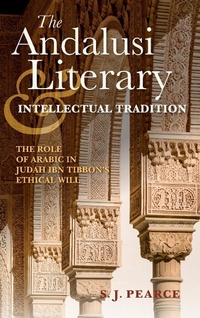
The Andalusi Literary and Intellectual Tradition
The Role of Arabic in Judah Ibn Tibbon's Ethical Will
Published on 6. March 2017
Book
Hardback
276 pages
978-0-253-02596-8 (ISBN)
Description
Beginning in 1172, Judah ibn Tibbon, who was called the father of Hebrew translators, wrote a letter to his son that was full of personal and professional guidance. The detailed letter, described as an ethical will, was revised through the years and offered a vivid picture of intellectual life among Andalusi elites exiled in the south of France after 1148. S. J. Pearce sets this letter into broader context and reads it as a document of literary practice and intellectual values. She reveals how ibn Tibbon, as a translator of philosophical and religious texts, explains how his son should make his way in the family business and how to operate, textually, within Arabic literary models even when writing for a non-Arabic audience. While the letter is also full of personal criticism and admonitions, Pearce shows ibn Tibbon making a powerful argument in favor of the continuation of Arabic as a prestige language for Andalusi Jewish readers and writers, even in exile outside of the Islamic world.
Reviews / Votes
Throughout the book, Pearce never fails to adequately situate the reader within the proper context, striking the correct balance that makes this book accessible and enjoyable to specialists and non-specialists alike.(Readng Religion)
Highly recommended for academic and research institutions.
(AJL Reviews)
As the first full-length study on Judah ibn Tibbon, Pearce's book fills a lacuna in the historiography of Hebrew literature and philosophy.
(Medieval Encounters)
More details
Series
Language
English
Place of publication
Bloomington, IN
United States
Target group
Professional and scholarly
Product notice
Paper over boards
Illustrations
12 b&w illus. - 12 Illustrations, black and white
Dimensions
Height: 235 mm
Width: 157 mm
Thickness: 19 mm
Weight
559 gr
ISBN-13
978-0-253-02596-8 (9780253025968)
Copyright in bibliographic data and cover images is held by Nielsen Book Services Limited or by the publishers or by their respective licensors: all rights reserved.
Schweitzer Classification
Other editions
Additional editions
Sarah J. Pearce
The Andalusi Literary and Intellectual Tradition
The Role of Arabic in Judah Ibn Tibbon's Ethical Will
E-Book
03/2017
1st Edition
Indiana University Press
from
€60.09
Available for download
Person
S. J. Pearce earned her PhD in Near Eastern Studies at Cornell University in 2011 and is now assistant professor in the Department of Spanish and Portuguese at New York University, where her teaching and research focus on the intellectual history and literature of Jews, Christians, and Muslims in medieval Spain. She was awarded the John K. Walsh Prize from La Coronica/MLA Division of Medieval Hispanic Literature in 2016.
Content
Acknowledgements
A Note on Translations and Transliterations
Introduction: 'The Preface of Every Book Is Its First Part': A Brief Overview of Materials and Methodology
1. 'Pen, I Recount Your Favor': Reading, Writing and Translating in Memory of al-Andalus
2. 'Examine your Hebrew Books Monthly and Arabic Books Bimonthly': Autobiography and Bibliography in the Islamic West
3. 'On Every Sabbath, Read from the Bible in Arabic': Reading the Hebrew Bible as Arabic Literature
4. 'The Words of the Ancient Poets': Poetics Between Jewish and Islamic Scripture
5. 'The Arab Sage Said': Transmitting Arabic Wisdom in Translation
6. 'From Vessel to Vessel': The Reception and Reimagining of the Tibbonid Corpus
Conclusion: "This Book Has Been Completed:" Looking Back and Ahead at al-Andalus in Translation
Appendix: Judah ibn Tibbon's Ethical Will: A New Translation
Bibliography
Index
A Note on Translations and Transliterations
Introduction: 'The Preface of Every Book Is Its First Part': A Brief Overview of Materials and Methodology
1. 'Pen, I Recount Your Favor': Reading, Writing and Translating in Memory of al-Andalus
2. 'Examine your Hebrew Books Monthly and Arabic Books Bimonthly': Autobiography and Bibliography in the Islamic West
3. 'On Every Sabbath, Read from the Bible in Arabic': Reading the Hebrew Bible as Arabic Literature
4. 'The Words of the Ancient Poets': Poetics Between Jewish and Islamic Scripture
5. 'The Arab Sage Said': Transmitting Arabic Wisdom in Translation
6. 'From Vessel to Vessel': The Reception and Reimagining of the Tibbonid Corpus
Conclusion: "This Book Has Been Completed:" Looking Back and Ahead at al-Andalus in Translation
Appendix: Judah ibn Tibbon's Ethical Will: A New Translation
Bibliography
Index