

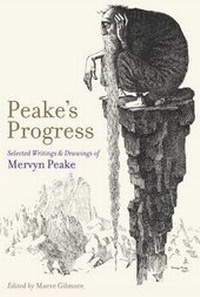
Peake's Progress
Published on 1. June 2011
Book
Hardback
576 pages
978-0-7123-5834-7 (ISBN)
Description
Mervyn Peake (1911-1968) the immensely talented writer, artist, poet and playwright,is best-known for his gothic masterpiece, the Gormenghast trilogy, and his stunning illustrations for Alice in Wonderland and Alice through the Looking Glass. He was a prolific and astonishingly original writer, who touched at one time or another on almost every literary form. Peake's Progress is a selection, compiled by his widow, Maeve Gilmore, from every period of his work as writer and draughtsman. It contains a remarkable work from childhood, 'The White Chief of the Umzimbooboo Kaffirs', the early 'Mr. Slaughterboard', which foreshadows the 'Titus' books, two plays, 'The Wit to Woo' and 'Noah's Ark', a broadcast version of 'Mr Pye', and a generous selection from Peake's short stories, poems and nonsense verses as well as from his drawings. Including a new introduction written by Mervyn Peake's son, Sebastian, this edition of Peake's Progress is published to coincide with the centenary of Peake's birth, and to mark the British Library's acquisition of Peake's archives.
More details
Language
English
Place of publication
London
United Kingdom
Publishing group
British Library Publishing
Illustrations
75 black and white illustrations
Dimensions
Height: 232 mm
Width: 155 mm
ISBN-13
978-0-7123-5834-7 (9780712358347)
Copyright in bibliographic data and cover images is held by Nielsen Book Services Limited or by the publishers or by their respective licensors: all rights reserved.
Schweitzer Classification
Persons
Mervyn Peake (1911-1968) the immensely talented writer, artist, poet and playwright,is best-known for his gothic masterpiece, the Gormenghast trilogy, and his stunning illustrations for Alice in Wonderland and Alice through the Looking Glass. He was a prolific and astonishingly original writer, who touched at one time or another on almost every literary form.