

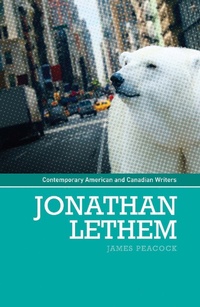
Jonathan Lethem
Published on 1. March 2012
Book
Hardback
200 pages
978-0-7190-8267-2 (ISBN)
Description
Jonathan Lethem is the first full-length study dedicated to the work of an exciting, genre-busting contemporary writer with an increasingly high profile in American literature.
Examining all of Lethem's novels, as well as a number of his short fictions, essays and critical works, this study shows how the author's prolific output, his restlessness and his desire always to be subverting literary forms and genres, are consistent with his interest in subcultural identities. The human need to break off into small groupings, subcultures or miniature utopias is mirrored in the critical tendency to enforce generic boundaries. To break down the boundaries between genres, then, is partly to make a nonsense of critical distinctions between 'high' and 'low' literature, and partly to reflect the wider need to recognise difference, to appreciate that other people, no matter how outlandish and alien they may appear, share similar desires, experiences and problems. With this in mind, James Peacock argues that Lethem's experiments with genre are not merely games or elaborate literary jokes, but ethical necessities, particularly when viewed in the light of the losses and traumas that shadow all of his writing. Jonathan Lethem, therefore, makes an important contribution not just to Lethem studies, but also to debates about genre and its position in postmodern or 'post-postmodern' literature.
It will be of interest to all scholars and students of contemporary American writing, as well as those interested in genre fiction and literature's relationship with subcultures. -- .
Examining all of Lethem's novels, as well as a number of his short fictions, essays and critical works, this study shows how the author's prolific output, his restlessness and his desire always to be subverting literary forms and genres, are consistent with his interest in subcultural identities. The human need to break off into small groupings, subcultures or miniature utopias is mirrored in the critical tendency to enforce generic boundaries. To break down the boundaries between genres, then, is partly to make a nonsense of critical distinctions between 'high' and 'low' literature, and partly to reflect the wider need to recognise difference, to appreciate that other people, no matter how outlandish and alien they may appear, share similar desires, experiences and problems. With this in mind, James Peacock argues that Lethem's experiments with genre are not merely games or elaborate literary jokes, but ethical necessities, particularly when viewed in the light of the losses and traumas that shadow all of his writing. Jonathan Lethem, therefore, makes an important contribution not just to Lethem studies, but also to debates about genre and its position in postmodern or 'post-postmodern' literature.
It will be of interest to all scholars and students of contemporary American writing, as well as those interested in genre fiction and literature's relationship with subcultures. -- .
More details
Series
Language
English
Place of publication
Manchester
United Kingdom
Product notice
sewn/stitched
Cloth over boards
With dust jacket
Dimensions
Height: 224 mm
Width: 146 mm
Thickness: 23 mm
Weight
386 gr
ISBN-13
978-0-7190-8267-2 (9780719082672)
Copyright in bibliographic data and cover images is held by Nielsen Book Services Limited or by the publishers or by their respective licensors: all rights reserved.
Schweitzer Classification
Other editions
Additional editions
James Peacock
Jonathan Lethem
E-Book
07/2013
1st Edition
Manchester University Press
€127.99
Available for download
Person
James Peacock Lecturer in English and American Literature at Keele University -- .
Content
Series editor's foreword
Acknowledgments
Introduction: Genre collisions and mutations
1. Private dicks: science fiction meets detection in Gun, With Occasional Music
2. The nightmare of the local: apocalypse on the road in Amnesia Moon
3. Alice in the academy: As She Climbed Across the Table
4. Far away, so close: Brooklyn goes to space in Girl in Landscape
5. 'We learned to tell our story walking': Tourette's and urban space in Motherless Brooklyn
6. Mixed media: graffiti, writing and coming-of-age in The Fortress of Solitude
7. 'Hiding in plain sight': reality and secrecy in You Don't Love Me Yet and Chronic City
Conclusion
Bibliography
Index -- .
Acknowledgments
Introduction: Genre collisions and mutations
1. Private dicks: science fiction meets detection in Gun, With Occasional Music
2. The nightmare of the local: apocalypse on the road in Amnesia Moon
3. Alice in the academy: As She Climbed Across the Table
4. Far away, so close: Brooklyn goes to space in Girl in Landscape
5. 'We learned to tell our story walking': Tourette's and urban space in Motherless Brooklyn
6. Mixed media: graffiti, writing and coming-of-age in The Fortress of Solitude
7. 'Hiding in plain sight': reality and secrecy in You Don't Love Me Yet and Chronic City
Conclusion
Bibliography
Index -- .