

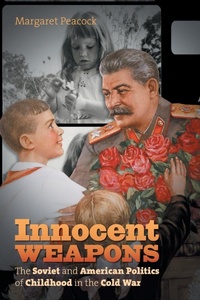
Innocent Weapons
The Soviet and American Politics of Childhood in the Cold War
Published on 28. February 2017
Book
Paperback/Softback
304 pages
978-1-4696-3344-2 (ISBN)
Description
In the 1950s and 1960s, images of children appeared everywhere, from movies to milk cartons, their smiling faces used to sell everything, including war. In this provocative book, Margaret Peacock offers an original account of how Soviet and American leaders used emotionally charged images of children in an attempt to create popular support for their policies at home and abroad.
Groups on either side of the Iron Curtain pushed visions of endangered, abandoned, and segregated children to indict the enemy's state and its policies. Though the Cold War is often characterized as an ideological divide between the capitalist West and the communist East, Peacock demonstrates a deep symmetry in how Soviet and American propagandists mobilized similar images to similar ends, despite their differences. Based on extensive research spanning fourteen archives and three countries, Peacock tells a new story of the Cold War, seeing the conflict not simply as a divide between East and West, but as a struggle between the producers of culture and their target audiences.
Groups on either side of the Iron Curtain pushed visions of endangered, abandoned, and segregated children to indict the enemy's state and its policies. Though the Cold War is often characterized as an ideological divide between the capitalist West and the communist East, Peacock demonstrates a deep symmetry in how Soviet and American propagandists mobilized similar images to similar ends, despite their differences. Based on extensive research spanning fourteen archives and three countries, Peacock tells a new story of the Cold War, seeing the conflict not simply as a divide between East and West, but as a struggle between the producers of culture and their target audiences.
Reviews / Votes
Effectively challenges anthropological portrayals of childhood as strictly culture-bound. . . . Leaves us with a deeply uneasy sense of the political polyvalence of children and childhood-not just during the Cold War, but for our contemporary political moment as well.-Allegra Laboratory[A] masterful understanding of both US and Soviet politics and policy. . . . A distinct and useful contribution to the understanding of the experiences of children and youth during Cold War America as well as priorities and politics of this significant period.-Journal of the History of Childhood and Youth
Riveting.-Journal of American History
A provocative rethinking of the role of ideology in the Cold War.""-The Russian Review
More details
Series
Language
English
Place of publication
Chapel Hill
United States
Target group
Professional and scholarly
Illustrations
29 halftones
Dimensions
Height: 234 mm
Width: 156 mm
Thickness: 18 mm
Weight
514 gr
ISBN-13
978-1-4696-3344-2 (9781469633442)
Copyright in bibliographic data and cover images is held by Nielsen Book Services Limited or by the publishers or by their respective licensors: all rights reserved.
Schweitzer Classification
Other editions
Additional editions
E-Book
08/2014
University of North Carolina Press
€19.49
Available for download
Person
Margaret Peacock is assistant professor of history at the University of Alabama.