

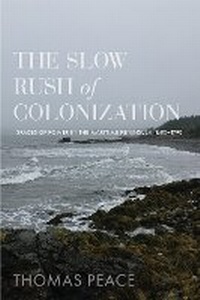
The Slow Rush of Colonization
Spaces of Power in the Maritime Peninsula, 1680-1790
Published on 1. February 2024
Book
Paperback/Softback
350 pages
978-0-7748-6835-8 (ISBN)
Description
In 1760, after Montcalm's defeat at the Plains of Abraham, the French Empire was definitively expelled from the Saint Lawrence Valley.
This history is well known.
Less well known is that this decisive victory had its roots almost a hundred years earlier, when settler colonial systems of power first took root on the peripheries of the Maritime Peninsula (the places known today as Quebec, Maritime Canada, and New England).
Drawing on the concept of spaces of power, historian Thomas Peace demonstrates that despite imperial changes of power and settler colonial incursions on their Lands, local Mi'kmaw, Wabanaki, Peskotomuhkati, Wolastoqiyik, and Wendat nations continued to experience the contested Peninsula as a cohesive whole, rather than one defined by subsequent colonial borders.
This engaging history shows how overlapping concepts of space and power - shaped deeply by Indigenous agency and diplomacy - defined relationships in the eighteenth-century Maritime Peninsula and how, following the Seven Years' War, this history was brushed aside as settlers flooded into the Peninsula, laying the groundwork from which Canada and the United States would develop.
This history is well known.
Less well known is that this decisive victory had its roots almost a hundred years earlier, when settler colonial systems of power first took root on the peripheries of the Maritime Peninsula (the places known today as Quebec, Maritime Canada, and New England).
Drawing on the concept of spaces of power, historian Thomas Peace demonstrates that despite imperial changes of power and settler colonial incursions on their Lands, local Mi'kmaw, Wabanaki, Peskotomuhkati, Wolastoqiyik, and Wendat nations continued to experience the contested Peninsula as a cohesive whole, rather than one defined by subsequent colonial borders.
This engaging history shows how overlapping concepts of space and power - shaped deeply by Indigenous agency and diplomacy - defined relationships in the eighteenth-century Maritime Peninsula and how, following the Seven Years' War, this history was brushed aside as settlers flooded into the Peninsula, laying the groundwork from which Canada and the United States would develop.
Reviews / Votes
"[Peace] highlights evidence that shows Indigenous people standing up to colonizing powers and significantly shaping encounters."- L. De Danaan, emeritus, Evergreen State College. (CHOICE Connect)
More details
Language
English
Place of publication
Vancouver
Canada
Target group
Professional and scholarly
Product notice
Paperback (trade)
Illustrations
2 b&w photos, 9 maps, 1 diagram, 3 tables
Dimensions
Height: 229 mm
Width: 152 mm
Weight
650 gr
ISBN-13
978-0-7748-6835-8 (9780774868358)
Copyright in bibliographic data and cover images is held by Nielsen Book Services Limited or by the publishers or by their respective licensors: all rights reserved.
Schweitzer Classification
Person
Thomas Peace is an associate professor of history and co-director of the Community History Centre at Huron University College. He has authored numerous articles on the history of schooling and settler colonialism, historical relationships between the Mi'kmaw and Acadians, and the influence of digital technologies on the historian's craft. He has edited two Open Educational primary source readers: The Open History Seminar (with Sean Kheraj) and A Few Words that Changed the World. Since 2009 he has edited ActiveHistory.ca, one of Canada's leading history blogs, and in 2016, with Kathryn Labelle, he edited From Huronia to Wendakes: Adversity, Migrations, and Resilience, 1650-1900.