

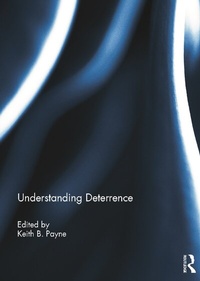
Understanding Deterrence
1st Edition
Published on 29. November 2012
Book
Hardback
136 pages
978-0-415-63899-9 (ISBN)
Description
For decades, the rational actor model served as the preferred guide for U.S. deterrence policy. It has been a convenient and comforting guide because it requires little detailed knowledge of an opponent's unique decision-making process and yet typically provides confident generalizations about how deterrence works. The model tends to postulate common decision-making parameters across the globe to reach generalizations about how deterrence will function and the types of forces that will be "stabilizing" or "destabilizing." Yet a broad spectrum of unique factors can influence an opponent's perceptions and his calculations, and these are not easily captured by the rational actor model. The absence of uniformity means there can be very few deterrence generalizations generated by the use of the rational actor model that are applicable to the entire range of opponents.
Understanding Deterrence considers how factors such as psychology, history, religion, ideology, geography, political structure, culture, proliferation and geopolitics can shape a leadership's decision-making process, in ways that are specific and unique to each opponent. Understanding Deterrence demonstrates how using a multidisciplinary approach to deterrence analysis can better identify and assess factors that influence an opponent's decision-making process. This identification and assessment process can facilitate the tailoring of deterrence strategies to specific purposes and result in a higher likelihood of success than strategies guided by the generalizations about opponent decision-making typically contained in the rational actor model.
This book was published as a special issue of Comparative Strategy.
Understanding Deterrence considers how factors such as psychology, history, religion, ideology, geography, political structure, culture, proliferation and geopolitics can shape a leadership's decision-making process, in ways that are specific and unique to each opponent. Understanding Deterrence demonstrates how using a multidisciplinary approach to deterrence analysis can better identify and assess factors that influence an opponent's decision-making process. This identification and assessment process can facilitate the tailoring of deterrence strategies to specific purposes and result in a higher likelihood of success than strategies guided by the generalizations about opponent decision-making typically contained in the rational actor model.
This book was published as a special issue of Comparative Strategy.
More details
Language
English
Place of publication
London
United Kingdom
Publishing group
Taylor & Francis Ltd
Target group
College/higher education
Dimensions
Height: 246 mm
Width: 174 mm
Weight
410 gr
ISBN-13
978-0-415-63899-9 (9780415638999)
Copyright in bibliographic data and cover images is held by Nielsen Book Services Limited or by the publishers or by their respective licensors: all rights reserved.
Schweitzer Classification
Other editions
Additional editions
Keith B. Payne
Understanding Deterrence
Book
08/2015
1st Edition
Routledge
€74.46
Shipment within 10-20 days
Keith B. Payne
Understanding Deterrence
E-Book
06/2014
1st Edition
Routledge
€61.99
Available for download
Keith B. Payne
Understanding Deterrence
E-Book
06/2014
1st Edition
Routledge
€61.99
Available for download
Person
Keith B. Payne is President and co-founder of the National Institute for Public Policy, a non-profit research center located in Fairfax, Virginia. Dr Payne is Professor and Head of the Graduate Department of Defense and Strategic Studies, Missouri State University (Washington Campus).
Content
1. Introduction Keith B. Payne 2. Understanding Deterrence Keith B. Payne 3. God, Nations, and Deterrence: The Impact of Religion on Deterrence Shmuel Bar 4. Evolutionary Psychology, Cognitive Function, and Deterrence Thomas Scheber 5. Nuclear Weapons Acquisition and Deterrence Kurt Guthe