

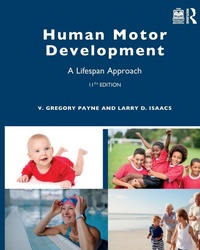
Human Motor Development
A Lifespan Approach
11th Edition
Published on 13. August 2024
Book
Paperback/Softback
510 pages
978-1-032-69713-0 (ISBN)
Description
Human Motor Development: A Lifespan Approach, Eleventh Edition provides an overview of the academic field of study known as human motor development, the examination of lifelong changes in human movement. The book uses a holistic approach and emphasizes the importance of intellectual, social, and physical development and their impact on human motor development at all ages. The unique approach of this book includes the relationships between motor development and critical interactions with cognitive, social, and physical changes across the lifespan.
Organized into five parts, the book examines key topics in motor development, including the relationship between cognitive and social development and motor development, factors affecting development, changes across the lifespan, and assessment in motor development, with special attention being applied to adulthood and older adulthood, given the increasing numbers of people in those age groups worldwide. Each chapter includes chapter objectives, a summary, a list of key concepts, questions for reflection, a list of related online resources, and an extensive reference list.
Highly illustrated and written for student accessibility by providing access to a fully updated companion website, which includes laboratory exercises, an instructors' manual, a test bank, and lecture slides, Human Motor Development: A Lifespan Approach is essential reading for students of motor control and development, kinesiology, and human performance and for students interested in physical therapy, physical education, and exercise science.
Organized into five parts, the book examines key topics in motor development, including the relationship between cognitive and social development and motor development, factors affecting development, changes across the lifespan, and assessment in motor development, with special attention being applied to adulthood and older adulthood, given the increasing numbers of people in those age groups worldwide. Each chapter includes chapter objectives, a summary, a list of key concepts, questions for reflection, a list of related online resources, and an extensive reference list.
Highly illustrated and written for student accessibility by providing access to a fully updated companion website, which includes laboratory exercises, an instructors' manual, a test bank, and lecture slides, Human Motor Development: A Lifespan Approach is essential reading for students of motor control and development, kinesiology, and human performance and for students interested in physical therapy, physical education, and exercise science.
More details
Edition
11th edition
Language
English
Place of publication
London
United Kingdom
Publishing group
Taylor & Francis Ltd
Target group
College/higher education
Professional and scholarly
Academic, Postgraduate, Undergraduate Advanced, and Undergraduate Core
Illustrations
198 farbige Abbildungen, 163 Farbfotos bzw. farbige Rasterbilder, 35 farbige Zeichnungen, 105 s/w Tabellen
105 Tables, black and white; 35 Line drawings, color; 163 Halftones, color; 198 Illustrations, color
Dimensions
Height: 254 mm
Width: 203 mm
Thickness: 28 mm
Weight
1115 gr
ISBN-13
978-1-032-69713-0 (9781032697130)
Copyright in bibliographic data and cover images is held by Nielsen Book Services Limited or by the publishers or by their respective licensors: all rights reserved.
Schweitzer Classification
Other editions
Additional editions
E-Book
08/2024
11th Edition
Routledge
€104.99
Available for download
E-Book
08/2024
11th Edition
Routledge
€104.99
Available for download
Book
08/2024
11th Edition
Routledge
€248.50
Shipment within 10-20 days
Previous edition
Book
06/2020
10th Edition
Routledge
€99.03
Article exhausted; check for reprint
Persons
V. Gregory Payne is a Professor Emeritus of Kinesiology at San Jose State University (SJSU). He formerly served as the Associate Dean for Research in the College of Applied Sciences and Arts and Chair of the Department of Kinesiology. Payne earned a BS at Western Illinois University and later received that institution's Alumni Achievement Award. He earned an MA at the University of Iowa and a PED at Indiana University with a specialization in human motor development. Payne was a Peace Corps Volunteer after his undergraduate degree, working for the Venezuelan Ministry of Education. He has produced over 170 publications, including numerous refereed articles and 19 editions of five books, and has made nearly 300 presentations around the world. Payne was an International Professor of the Year at SJSU and is a Distinguished Honorary Professor at the Shenyang Sport University, China. He received the Distinguished Service Award from the California Governor's Council on Physical Fitness and Sports and the prestigious Research Quarterly for Exercise and Sport Research Writing Award. He has held offices in several organizations, including NASPE President and Chair of the Motor Development Academy. He is an elected Fellow of the National Academy of Kinesiology, a group generally considered the top leaders and scholars in kinesiology, and the Research Consortium of AAHPERD/SHAPE, has chaired two editorial boards, and has reviewed for numerous journals. He was a member of the task force that developed the NASPE National Physical Education Standards. Payne lives in San Jose, California, with his wife, Linda, and their dog Jake, who is a mature runner, jumper, and catcher (Frisbee specialist).
Larry D. Isaacs is a Professor Emeritus and former Director of the Exercise Physiology Program, Department of Biological Sciences, College of Science and Mathematics, Wright State University, Dayton, Ohio, USA. Since receiving his doctorate in the biological and physiological basis of human motor development from the University of Maryland, he has published numerous scholarly articles and has authored, co-authored, and contributed to 21 textbooks. In retirement, he continues to serve on several editorial boards. Additionally, he has attained certification with the American College of Sports Medicine (Certified Exercise Physiologist) and was awarded the Research Fellow Status by AAHPERD/SHAPE. In addition, he has received the Wright State University Presidential Recognition Award for Research. After his retirement from Wright State University, he continued to work part-time for a period of 17 years as a clinical exercise physiologist at Hilton Head Hospital, Hilton Head Island, South Carolina, where he worked with both cardiac and pulmonary patients. He now enjoys his hobbies, which include writing, golfing, biking, and photography.
Larry D. Isaacs is a Professor Emeritus and former Director of the Exercise Physiology Program, Department of Biological Sciences, College of Science and Mathematics, Wright State University, Dayton, Ohio, USA. Since receiving his doctorate in the biological and physiological basis of human motor development from the University of Maryland, he has published numerous scholarly articles and has authored, co-authored, and contributed to 21 textbooks. In retirement, he continues to serve on several editorial boards. Additionally, he has attained certification with the American College of Sports Medicine (Certified Exercise Physiologist) and was awarded the Research Fellow Status by AAHPERD/SHAPE. In addition, he has received the Wright State University Presidential Recognition Award for Research. After his retirement from Wright State University, he continued to work part-time for a period of 17 years as a clinical exercise physiologist at Hilton Head Hospital, Hilton Head Island, South Carolina, where he worked with both cardiac and pulmonary patients. He now enjoys his hobbies, which include writing, golfing, biking, and photography.
Content
Part I: An Overview of Development. 1. Introduction to Motor Development. 2. Cognitive and Motor Development. 3. Social and Motor Development. Part II: Factors That Affect Development. 4. Prenatal Development Factors. 5. Effects of Early Stimulation and Deprivation. Part III: Physical Changes across the Lifespan. 6. Growth and Maturation. 7. Physiological Changes: Health-Related Physical Fitness. 8. Movement and the Changing Senses. Part IV: Movement across the Lifespan. 9. Infant Reflexes and Stereotypies. 10. Voluntary Movements of Infancy. 11. Fine Motor Development. 12. Fundamental Locomotion Skills of Childhood. 13. Fundamental Object-Control Skills of Childhood. 14. Youth Sports. 15. Movement in Adulthood. Part V: Assessing Motor Development. 16. Assessment.