

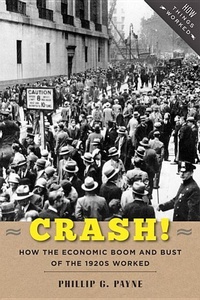
Crash!
How the Economic Boom and Bust of the 1920s Worked
Published on 26. January 2016
Book
Hardback
152 pages
978-1-4214-1855-1 (ISBN)
Description
Speculation - an economic reality for centuries-is a hallmark of the modern US economy. But how does speculation work? Is it really caused, as some insist, by popular delusions and the madness of crowds, or do failed regulations play a greater part? And why is it that investors never seem to learn the lessons of past speculative bubbles? Crash! explores these questions by examining the rise and fall of the American economy in the 1920s. Phillip G Payne frames the story of the 1929 stock market crash within the booming New Era economy of the 1920s and the bust of the Great Depression. Taking into account the emotional drivers of the consumer market, he offers a clear, concise explanation of speculation's complex role in creating one of the greatest financial panics in US history. Crash! explains how post-World War I changes in the global financial markets transformed the world economy, examines the role of boosters and politicians in promoting speculation, and describes in detail the disastrous aftermath of the 1929 panic. Payne's book will help students recognize the telltale signs of bubbles and busts, so that they may become savvier consumers and investors.
Reviews / Votes
Comparing favorably with works by John Kenneth Galbraith, Frederick Lewis Allen, and Maury Klein, Crash! is an invaluable resource for students of history as well as economics. Essential. ChoiceMore details
Series
Language
English
Place of publication
Baltimore, MD
United States
Target group
College/higher education
Product notice
sewn/stitched
Cloth over boards
Illustrations
6 s/w Abbildungen, 5 s/w Abbildungen
5 Illustrations, black and white; 6 Illustrations, black and white
Dimensions
Height: 231 mm
Width: 155 mm
Thickness: 15 mm
Weight
318 gr
ISBN-13
978-1-4214-1855-1 (9781421418551)
DOI
10.1353/book.72247
Copyright in bibliographic data and cover images is held by Nielsen Book Services Limited or by the publishers or by their respective licensors: all rights reserved.
Schweitzer Classification
Other editions
Additional editions
Book
01/2016
Johns Hopkins University Press
€21.50
Shipment within 10-20 days
E-Book
01/2016
Johns Hopkins University Press
€14.99
Available for download
Person
Phillip G. Payne is a professor of history at St. Bonaventure University. He is the author of Dead Last: The Public Memory of Warren G. Harding's Scandalous Legacy.
Content
Preface
Prologue
1. How in the 1920s the American Economy Promoted Speculation
2. How Business Culture Encouraged Consumer Spending
3. How the Market Grew Bullish
4. How the Economy Crashed
5. How the New Deal Changed the Financial Sector
Epilogue
Notes
Suggested Further Reading
Index
Prologue
1. How in the 1920s the American Economy Promoted Speculation
2. How Business Culture Encouraged Consumer Spending
3. How the Market Grew Bullish
4. How the Economy Crashed
5. How the New Deal Changed the Financial Sector
Epilogue
Notes
Suggested Further Reading
Index