

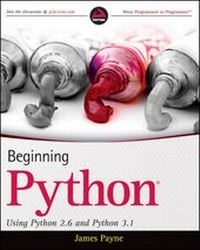
Beginning Python
Using Python 2.6 and Python 3.1
1st Edition
Published on 28. January 2010
Book
Paperback/Softback
624 pages
978-0-470-41463-7 (ISBN)
Description
Beginning Python: Using Python 2.6 and Python 3.1 introduces this open source, portable, interpreted, object-oriented programming language that combines remarkable power with clear syntax. This book enables you to quickly create robust, reliable, and reusable Python applications by teaching the basics so you can quickly develop Web and scientific applications, incorporate databases, and master systems tasks on various operating systems, including Linux, MAC OS, and Windows. You'll get a comprehensive tutorial that guides you from writing simple, basic Python scripts all the way through complex concepts, and also features a reference of the standard modules with examples illustrating how to implement features in the various modules. Plus, the book covers using Python in specific program development domains, such as XML, databases, scientific applications, network programming, and Web development.
Note: CD-ROM/DVD and other supplementary materials are not included as part of eBook file.
More details
Product info
PB
Edition
1., Auflage
Language
English
Place of publication
United States
Publishing group
John Wiley & Sons Inc
Target group
College/higher education
Product notice
Paperback (trade)
Unsewn / adhesive bound
Illustrations
Screen captures: 150 B&W, 0 Color
Dimensions
Height: 235 mm
Width: 191 mm
Thickness: 33 mm
Weight
1151 gr
ISBN-13
978-0-470-41463-7 (9780470414637)
Schweitzer Classification
Other editions
Additional editions
E-Book
01/2011
Wrox
€28.99
Available for download
E-Book
02/2010
Wrox
€27.99
Available for download
Person
James Payne is Editor in Chief of www.developershed.com, a network of high-technology sites that serves millions of unique visitors every month who are seeking tutorials, advice, answers, or articles.
Content
Introduction.
Part I: Dipping Your Toe into Python.
Chapter 1: Programming Basics and Strings.
Chapter 2: Numbers and Operators.
Chapter 3: Variables -- Names for Values.
Part II: Python Language and the Standard Library.
Chapter 4: Making Decisions.
Chapter 5: Functions.
Chapter 6: Classes and Objects.
Chapter 7: Organizing Programs.
Chapter 8: Files and Directories.
Chapter 9: Other Features of the Language.
Chapter 10: Building a Module.
Chapter 11: Text Processing.
Part III: Putting Python to Work.
Chapter 12: Testing.
Chapter 13: Writing a GUI with Python.
Chapter 14: Accessing Databases.
Chapter 15: Using Python for XML.
Chapter 16: Network Programming.
Chapter 17: Extension Programming with C.
Chapter 18: Numerical Programming.
Chapter 19: An Introduction to Django.
Chapter 20: Web Applications and Web Services.
Chapter 21: Integrating Java with Python.
Part IV: Appendices.
Appendix A: Answers to the Exercises.
Appendix B: Online Resources.
Appendix C: What's New in Python 3.1.
Appendix D: Glossary.
Index.