

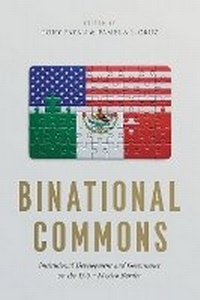
Binational Commons
Institutional Development and Governance on the U.S.-Mexico Border
Will be published approx. on 30. October 2020
Book
Hardback
416 pages
978-0-8165-4142-3 (ISBN)
Description
Studying institutional development is not only about empowering communities to withstand political buccaneering; it is also about generating effective and democratic governance so that all members of a community can enjoy the benefits of social life. In the U.S.-Mexico borderlands, cross-border governance draws only sporadic-and even erratic-attention, primarily in times of crises, when governance mechanisms can no longer provide even moderately adequate solutions.
This volume addresses the most pertinent binational issues and how they are dealt with by both countries. In this important and timely volume, experts tackle the important problem of cross-border governance by an examination of formal and informal institutions, networks, processes, and mechanisms. Contributors also discuss various social, political, and economic actors and agencies that make up the increasingly complex governance space that is the U.S.-Mexico border.
Binational Commons focuses on whether the institutions that presently govern the U.S.-Mexico transborder space are effective in providing solutions to difficult binational problems as they manifest themselves in the borderlands. Critical for policy-making now and into the future, this volume addresses key binational issues. It explores where there are strong levels of institutional governance development, where it is failing, how governance mechanisms have evolved over time, and what can be done to improve it to meet the needs of the U.S.-Mexico borderlands in the next decades.
This volume addresses the most pertinent binational issues and how they are dealt with by both countries. In this important and timely volume, experts tackle the important problem of cross-border governance by an examination of formal and informal institutions, networks, processes, and mechanisms. Contributors also discuss various social, political, and economic actors and agencies that make up the increasingly complex governance space that is the U.S.-Mexico border.
Binational Commons focuses on whether the institutions that presently govern the U.S.-Mexico transborder space are effective in providing solutions to difficult binational problems as they manifest themselves in the borderlands. Critical for policy-making now and into the future, this volume addresses key binational issues. It explores where there are strong levels of institutional governance development, where it is failing, how governance mechanisms have evolved over time, and what can be done to improve it to meet the needs of the U.S.-Mexico borderlands in the next decades.
More details
Language
English
Place of publication
Tucson
United States
Target group
Professional and scholarly
Illustrations
17 black & white illustrations, 5 maps, 30 tables
Dimensions
Height: 229 mm
Width: 152 mm
Weight
710 gr
ISBN-13
978-0-8165-4142-3 (9780816541423)
Copyright in bibliographic data and cover images is held by Nielsen Book Services Limited or by the publishers or by their respective licensors: all rights reserved.
Schweitzer Classification
Persons
Tony Payan, PhD, is the Francoise and Edward Djerejian Fellow for Mexico Studies and director of the Center for the United States and Mexico at the Baker Institute. He is also a professor at the Universidad Autonoma de Ciudad Juarez (UACJ).
Pamela L. Cruz is the research analyst for the Baker Institute Center for the United States and Mexico. She works with the director and affiliated scholars to carry out research on Mexico's policy issues and U.S.-Mexico relations.
Pamela L. Cruz is the research analyst for the Baker Institute Center for the United States and Mexico. She works with the director and affiliated scholars to carry out research on Mexico's policy issues and U.S.-Mexico relations.
Content
Abbreviations
Introduction: Governing the Binational Commons
Tony Payan and Pamela L. Cruz
PART I. FRAMING INSTITUTIONAL DEVELOPMENT AT THE U.S.-MEXICO BORDER
1. Place and Space Governance at the U.S.-Mexico Border (1944-2017)
Sergio Pena
2. Defining the Border and the Borderlands: A Precondition for Institutional Development?
Tony Payan and Pamela L. Cruz
3. Data for U.S.-Mexico Border Studies: A Comparison of U.S. and Mexican Data Collection and Distribution
James Gerber and Jorge Eduardo Mendoza Cota
PART II. ISSUES, ACTORS, AND STRUCTURES AT THE U.S.-MEXICO BORDER
4. Collaborative Social Networks: An Exploratory Study of the U.S.-Mexico Border
Victor Daniel Jurado Flores and Cecilia Sarabia Rios
5. Governing the Borderlands Commons: Local Actors at Work
Manuel A. Gutierrez and Kathleen Staudt
6. Environmental Governance at the U.S.-Mexico Border: Institutions at Risk
Irasema Coronado and Stephen Mumme
7. Health Institutions at the U.S.-Mexico Border
Eva M. Moya, Silvia M. Chavez-Baray, and Miriam S. Monroy
8. From the Institutional to the Informal: Security Cooperation Between the United States and Mexico
Octavio Rodriguez Ferreira
9. U.S.-Mexico Law Enforcement and Border Security Cooperation: An Institutional-Historical Perspective
Guadalupe Correa-Cabrera and Evan D. McCormick
10. Transportation Institutions Along the U.S.-Mexico Border
Kimberly Collins
11. Human Mobility at the U.S.-Mexico Border
Tony Payan, Pamela L. Cruz, and Carla Pederzini Villarreal
12. Governance and Energy Trade on the U.S.-Mexico Border
Adrian Duhalt
Conclusion: Uneven Institutional Development and Governance at the U.S.-Mexico Border
Tony Payan
Contributors
Index
Introduction: Governing the Binational Commons
Tony Payan and Pamela L. Cruz
PART I. FRAMING INSTITUTIONAL DEVELOPMENT AT THE U.S.-MEXICO BORDER
1. Place and Space Governance at the U.S.-Mexico Border (1944-2017)
Sergio Pena
2. Defining the Border and the Borderlands: A Precondition for Institutional Development?
Tony Payan and Pamela L. Cruz
3. Data for U.S.-Mexico Border Studies: A Comparison of U.S. and Mexican Data Collection and Distribution
James Gerber and Jorge Eduardo Mendoza Cota
PART II. ISSUES, ACTORS, AND STRUCTURES AT THE U.S.-MEXICO BORDER
4. Collaborative Social Networks: An Exploratory Study of the U.S.-Mexico Border
Victor Daniel Jurado Flores and Cecilia Sarabia Rios
5. Governing the Borderlands Commons: Local Actors at Work
Manuel A. Gutierrez and Kathleen Staudt
6. Environmental Governance at the U.S.-Mexico Border: Institutions at Risk
Irasema Coronado and Stephen Mumme
7. Health Institutions at the U.S.-Mexico Border
Eva M. Moya, Silvia M. Chavez-Baray, and Miriam S. Monroy
8. From the Institutional to the Informal: Security Cooperation Between the United States and Mexico
Octavio Rodriguez Ferreira
9. U.S.-Mexico Law Enforcement and Border Security Cooperation: An Institutional-Historical Perspective
Guadalupe Correa-Cabrera and Evan D. McCormick
10. Transportation Institutions Along the U.S.-Mexico Border
Kimberly Collins
11. Human Mobility at the U.S.-Mexico Border
Tony Payan, Pamela L. Cruz, and Carla Pederzini Villarreal
12. Governance and Energy Trade on the U.S.-Mexico Border
Adrian Duhalt
Conclusion: Uneven Institutional Development and Governance at the U.S.-Mexico Border
Tony Payan
Contributors
Index