

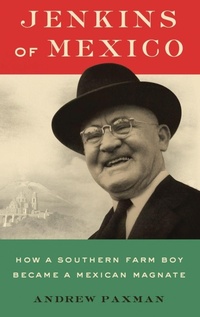
Jenkins of Mexico
How a Southern Farm Boy Became a Mexican Magnate
Published on 8. June 2017
Book
Hardback
542 pages
978-0-19-045574-3 (ISBN)
Description
In the Mexican city of Puebla, several decades ago, there lived an old American as wealthy as a Rockefeller. He strode the streets with a purposeful step and his head slightly bowed, as though he wished not to be interrupted. For daily visits to his country club, he had his chauffeur drive him, in one of his second-hand Packards. But he walked often enough that his aspect was familiar to all who lived or worked near his downtown home: tall and well-built, cropped hair beneath a black fedora, and seeming always to wear the same black tie and shabby dark suit. His head was large and solid, like a marble bowling ball, the roundness interrupted by a stern jaw and heavy chin. His blue eyes were sharp. William O. Jenkins, said to be the richest man in Mexico, had an austere routine. He rose early and worked all morning in his office, which shared the same vast space as his apartment: the penthouse above Puebla's leading department store. Though his assets included several hundred movie theaters, substantial rural and urban real estate, various textile mills, and Mexico's second-largest bank, his entire staff consisted of a personal assistant, an accountant, and a secretary. People who came to him for money - a farmer hoping for a loan, a businessman seeking venture capital, a state governor keen for him to finance a school - all had to climb the ninety stairs to his rooms. Even as an octogenarian, he refused to install an elevator, for he was a champion of physical fitness and advancement by merit. And of course he was frugal. On more than one occasion, visitors entered his office to find him peeling an unmarked stamp from an envelope. He would explain: "I hate to see anything go to waste."
The biography looks at the significance of William Jenkins within the formative period of the Mexican Revolution and the several decades of political institutionalization and evolution that follow it. The author shows Jenkins' involvement, particularly in the state of Puebla, in politics and economics, and details his ability to survive and keep and develop major holdings despite the anti-American ethos of the Revolution itself. It also delves deeply into his personal life and the choices that he made between the well-being of his wife and daughters and his own desire to maintain his important social, political, and economic position in Mexico. It explores at length Jenkins's kidnapping in 1919 which some U. S. politicians tried unsuccessfully to exploit to cause U. S. intervention in Mexico. At the same time, it explores anti-American sentiment in Mexico extensively, and it also discusses a kind of "Black Legend" that developed around Jenkins that lasted for many years, indeed, until the present. Nevertheless, he shows that Jenkins overcame the setbacks and bad publicity to become exceptionally wealthy and active in many areas, ranging from sugar production to the development of a huge and virtually monopolistic network of movie theaters in the country. However singular his persona, Jenkins illustrated how much the "revolutionary" state depended on the business elite: at first for its very survival, then for the ascendance and supremacy of its conservatives, whose ideological descendants remain in power today.
This book is a larger than life biography featuring Mexican history, American history of the late 19th/early 20th century, borderlands history, the history of business, and US-Mexican diplomatic history. Written with verve, it should appeal to general readers interested in business history, readers of biography, and those interested in the Mexican Revolution.
The biography looks at the significance of William Jenkins within the formative period of the Mexican Revolution and the several decades of political institutionalization and evolution that follow it. The author shows Jenkins' involvement, particularly in the state of Puebla, in politics and economics, and details his ability to survive and keep and develop major holdings despite the anti-American ethos of the Revolution itself. It also delves deeply into his personal life and the choices that he made between the well-being of his wife and daughters and his own desire to maintain his important social, political, and economic position in Mexico. It explores at length Jenkins's kidnapping in 1919 which some U. S. politicians tried unsuccessfully to exploit to cause U. S. intervention in Mexico. At the same time, it explores anti-American sentiment in Mexico extensively, and it also discusses a kind of "Black Legend" that developed around Jenkins that lasted for many years, indeed, until the present. Nevertheless, he shows that Jenkins overcame the setbacks and bad publicity to become exceptionally wealthy and active in many areas, ranging from sugar production to the development of a huge and virtually monopolistic network of movie theaters in the country. However singular his persona, Jenkins illustrated how much the "revolutionary" state depended on the business elite: at first for its very survival, then for the ascendance and supremacy of its conservatives, whose ideological descendants remain in power today.
This book is a larger than life biography featuring Mexican history, American history of the late 19th/early 20th century, borderlands history, the history of business, and US-Mexican diplomatic history. Written with verve, it should appeal to general readers interested in business history, readers of biography, and those interested in the Mexican Revolution.
Reviews / Votes
"Deeply researched and vividly written....Paxman has produced a novel and often brilliant analysis of business and politics in modern Mexico....Paxman's interpretation of multiple industries--textiles, film, sugar, banking, philanthropy--is deft, and his research is extraordinarily deep and broad....Paxman has produced a complex, significant biography that provides an essential interpretation of Mexico's modern economic, political, and socialinstitutions."--Susan Gauss, Business History Review
"Jenkins of Mexico is a well-researched, interesting, engaging biography of an enigmatic, conflicted, complex man, who some argue became one of the richest men in Mexico....The author masterfully describes how Jenkins created businesses partnerships in Mexico by striking deals with the Mexican and political elite, simultaneously safeguarding his wealth and avoiding paying taxes in the US. His ventures into Mexican capitalism included sugar plantations
and movie theaters. Throughout the text, the author describes how Jenkins's politicking evolved and eventually affected national politics through a loan he made to then future President Manuel Avila Camacho.
This book, rich in details, is highly recommended for serious students of Mexican history and politics. Highly recommended."--CHOICE
"Historian Paxman's exhaustive biography of the enigmatic William O. Jenkins reveals that his life had romance, high adventure, mystery, and (movie) magic...[Jenkins of Mexico] is an impressive accomplishment, and readers interested in the evolution of the modern Mexican state will find a fascinating treasure trove here."--Booklist
"Researched with care and written with verve, Andrew Paxman's highly original study of the long and convoluted life of William Jenkins-entrepreneur, patriarch, philanthropist, and political fixer--is a fascinating read; it also sheds ample light on business and political (mal)practices during the Mexican Revolution and subsequent decades of state-formation and economic growth. For once, a book that manages to combine cogent scholarly research and stylistic
flair."--Alan Knight, author of The Mexican Revolution
"No one has shown the life of any other US businessman in such engaging detail during these decades. Through Jenkins's life Andrew Paxman has been able to show very clearly Mexican political and economic development outside of but impinging on Mexico City."--Linda B. Hall, University of New Mexico
"Paxman's masterful biography is the story of an enigmatic American in Mexico. Above all, Jenkins of Mexico demonstrates the chameleon-like character of capital's--and the capitalist's--pursuit of financial and personal rewards wherever they could be found, on farms, in cinema, and in charitable foundations. Given the staggering inequalities of our own times, it's a lesson as valuable today as it was during the days of Jenkins."--Geraldo L. Cadava, author of
Standing on Common Ground: The Making of a Sunbelt Borderland
"A wonderful achievement and a path-breaking example of what good biography can achieve. Andrew Paxman's impressively researched study of a hugely influential US businessman is also a rich political and economic history of twentieth-century Mexico. William Jenkins, traditionally caricatured as benevolent hero or imperialist meddler, emerges as a complex and contradictory figure."--Barry Carr, La Trobe University
"Jenkins of Mexico is a well-researched, interesting, engaging biography of an enigmatic, conflicted, complex man, who some argue became one of the richest men in Mexico....This book, rich in details, is highly recommended."--CHOICE
"Magnificent...Paxman has written a work that interweaves the personal and family take of Jenkins with a broad examination of Mexican history from the early 20th century until the 1960s-a remarkable achievement...The book is held together by its systematic analysis of the shifting relationships between government and business, and between political power and capital in the context of the Mexican revolution and the changes it produced in subsequent
decades...Thoroughly researched, this book is written with outstanding elegance, skill, and persuasion. Jenkins of Mexico is both a major history of state-business relations during the first half of the 20th
century and a superb biography."--Wil G. Pansters, European Review of Latin American and Caribbean Studies
"Andrew Paxman has written the definitive account of William Jenkins-often considered the richest man in mid-twentieth century Mexico. Paxman's lengthy biography is extensively investigated and...this, combined with Paxman's spirited writing style, makes for a compelling read that will engage scholars interested in modern Mexico, bilateral relations, and the evolution of capitalism in the developing world...The interdependent relationship between big business
and the Mexican government enabled both sides to get what they wanted, often at the expense of Mexico's working poor despite revolutionary rhetoric to the contrary...In recent years, as Mexico
democratized, and the shortcomings of the Revolution are more readily admitted, critical views of Jenkins have softened and a more balanced portrayal of this complex figure has emerged. Paxman's excellent biography of Jenkins is at the forefront of this important historical revision."--John J. Dwyer, Diplomatic History
More details
Language
English
Place of publication
New York
United States
Illustrations
40 hts
Dimensions
Height: 240 mm
Width: 161 mm
Thickness: 33 mm
Weight
972 gr
ISBN-13
978-0-19-045574-3 (9780190455743)
Copyright in bibliographic data and cover images is held by Nielsen Book Services Limited or by the publishers or by their respective licensors: all rights reserved.
Schweitzer Classification
Other editions
Additional editions
E-Book
04/2017
1st Edition
OUP eBook
€19.49
Available for download
E-Book
04/2017
1st Edition
OUP eBook
€19.49
Available for download
Person
Andrew Paxman teaches history and journalism at the Center for Research and Teaching in Economics (CIDE) in Mexico City and Aguascalientes. He is the co-author of El Tigre, a biography of the Mexican media mogul Emilio Azcarraga Milmo.
Content
Introduction: The Black Legend of William O. Jenkins
Chapter 1: Coming of Age in Tennessee
Chapter 2: Fortune-Seeking in Mexico
Chapter 3: How to Get Rich in a Revolution
Chapter 4: Kidnapped, Jailed, Vilified
Chapter 5: Empire at Atencingo
Chapter 6: Resistance at Atencingo
Chapter 7: With Maximino
Chapter 8: Mining the Golden Age of Mexican Cinema
Chapter 9: Enterprise, Profiteering, and the Death of the Golden Age
Chapter 10: The Jenkins Foundation and the Battle for the Soul of the PRI
Chapter 11: Jenkins' Earthly Afterlife
Epilogue: The Mixed Legacy of William O. Jenkins
Acknowledgments
Notes
Bibliography
Index
Chapter 1: Coming of Age in Tennessee
Chapter 2: Fortune-Seeking in Mexico
Chapter 3: How to Get Rich in a Revolution
Chapter 4: Kidnapped, Jailed, Vilified
Chapter 5: Empire at Atencingo
Chapter 6: Resistance at Atencingo
Chapter 7: With Maximino
Chapter 8: Mining the Golden Age of Mexican Cinema
Chapter 9: Enterprise, Profiteering, and the Death of the Golden Age
Chapter 10: The Jenkins Foundation and the Battle for the Soul of the PRI
Chapter 11: Jenkins' Earthly Afterlife
Epilogue: The Mixed Legacy of William O. Jenkins
Acknowledgments
Notes
Bibliography
Index