

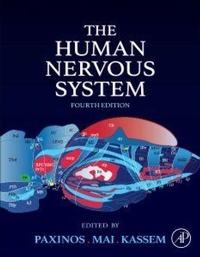
The Human Nervous System
4th Edition
Will be published approx. on 1. December 2026
Book
Hardback
1190 pages
978-0-443-24076-8 (ISBN)
Description
The 4th Edition of the classic book The Human Nervous System continues to assemble contributions from world leaders in research on the brain, spinal cord and peripheral nervous system. This book has been edited by the best-known team of brain cartographers, and it has been completely revised to present the cutting edge of human neuroscience. The structure, connections and function are explained in depth, making this book essential to any student or scientist interested in brain anatomy and function.
More details
Edition
4th edition
Language
English
Place of publication
San Diego
United States
Publishing group
Elsevier Science Publishing Co Inc
Target group
Professional and scholarly
Product notice
sewn/stitched
Cloth over boards
Illustrations
Approx. 300 illustrations (300 in full color); Illustrations
Dimensions
Height: 279 mm
Width: 216 mm
Weight
450 gr
ISBN-13
978-0-443-24076-8 (9780443240768)
Copyright in bibliographic data and cover images is held by Nielsen Book Services Limited or by the publishers or by their respective licensors: all rights reserved.
Schweitzer Classification
Other editions
Previous edition
Juergen K Mai | George Paxinos
The Human Nervous System
Book
11/2011
3rd Edition
Academic Press
€276.50
Article exhausted; check for reprint
Persons
George Paxinos has written 62 books on the brain of humans, monkeys, rodents and birds. His first atlas, The Rat Brain in Stereotaxic Coordinates, is the most cited neuroscience publication. His Atlas of the Human Brain received The Award for Excellence in Publishing in Medical Science (Assoc American Publishers, 1997) and The British Medical Association Illustrated Book Award (2016). His eco-fiction book A River Divided (georgepaxinos.com.au) considers the question of whether the brain in the Goldilocks Zone - the right "size? for survival.
Professor Mai studied medicine in Freiburg, Germany, Vienna and UT Southwestern Medical School, Dallas, U.S.A. Student and Medical practices in Freiburg (Clinic for Neurosurgery), Berlin and Duesseldorf. Dissertation ("summa cum laude") and habilitation were awarded by the University of Duesseldorf: After a period as GP in private practice (Titisee-Neustadt) he became scientific assistant and senior assistant at the C. and O. Vogt-Institute for Brain Research, University of Duesseldorf (1972 - 1983) and Professor of Neuroanatomy at the Institute of Neuroanatomy, H.-Heine-University of Duesseldorf. He served as director of the Department of the Institute of Anatomy 1 until retirement in 2011. His main research interests are (i) the structural and molecular anatomy of the mammalian brain and (ii) expression patterns and regulation of terminal carbohydrates in development, cell activation and disease (III) operation planning in stereotactic neurosurgery. He works on a "Digital Brain Atlas for Planning and Interindividual Registration of Targets in Deep Brain Stimulation" and on a "Spatial Information Management Resource for the Human Brain". J. K. Mai has edited the catalogue of human brain sections from the Vogt collection; he is author and editor of several books, e.g. the awarded "Atlas of the Human Brain" (Academic Press/Elsevier, San Diego), "The Human Nervous System" (Academic Press/Elsevier, San Diego, Amsterdam, 3rd ed. 2012), Human Brain in Standard MNI Space: A Comprehensive Pocket Atlas (Academic Press/Elsevier, San Diego, 2017; with M. Majtanik), Funktionelle Anatomie fuer Zahnmediziner (Quintessenz, Berlin, 2nd. ed. 2008; Sensi Divini (ital., engl., ger, russ. eds). J. K. Mai is founder and CEO of MR-X-Brain GmbH. Dr. Mustafa (Steve) Kassem is a Senior Research Fellow at Neuroscience Research Australia and The University of New South Wales. He has authored two brain atlases, Atlas of the Developing Mouse Brain and Chemoarchitectonic Atlas of the Rat Brain. He developed a modification of the Golgi Stain, the Ultra-Rapid-Golgi stain, permitting use on cleared and fixed tissue and has assembled one of the largest online collections of histological material, brainreservoir.neura.edu.au. With Paxinos, Dalton and Smith, he constructed a unified list of CNS terms for humans, monkeys, rodents and birds, cnsterms.neura.edu.au.
Professor Mai studied medicine in Freiburg, Germany, Vienna and UT Southwestern Medical School, Dallas, U.S.A. Student and Medical practices in Freiburg (Clinic for Neurosurgery), Berlin and Duesseldorf. Dissertation ("summa cum laude") and habilitation were awarded by the University of Duesseldorf: After a period as GP in private practice (Titisee-Neustadt) he became scientific assistant and senior assistant at the C. and O. Vogt-Institute for Brain Research, University of Duesseldorf (1972 - 1983) and Professor of Neuroanatomy at the Institute of Neuroanatomy, H.-Heine-University of Duesseldorf. He served as director of the Department of the Institute of Anatomy 1 until retirement in 2011. His main research interests are (i) the structural and molecular anatomy of the mammalian brain and (ii) expression patterns and regulation of terminal carbohydrates in development, cell activation and disease (III) operation planning in stereotactic neurosurgery. He works on a "Digital Brain Atlas for Planning and Interindividual Registration of Targets in Deep Brain Stimulation" and on a "Spatial Information Management Resource for the Human Brain". J. K. Mai has edited the catalogue of human brain sections from the Vogt collection; he is author and editor of several books, e.g. the awarded "Atlas of the Human Brain" (Academic Press/Elsevier, San Diego), "The Human Nervous System" (Academic Press/Elsevier, San Diego, Amsterdam, 3rd ed. 2012), Human Brain in Standard MNI Space: A Comprehensive Pocket Atlas (Academic Press/Elsevier, San Diego, 2017; with M. Majtanik), Funktionelle Anatomie fuer Zahnmediziner (Quintessenz, Berlin, 2nd. ed. 2008; Sensi Divini (ital., engl., ger, russ. eds). J. K. Mai is founder and CEO of MR-X-Brain GmbH. Dr. Mustafa (Steve) Kassem is a Senior Research Fellow at Neuroscience Research Australia and The University of New South Wales. He has authored two brain atlases, Atlas of the Developing Mouse Brain and Chemoarchitectonic Atlas of the Rat Brain. He developed a modification of the Golgi Stain, the Ultra-Rapid-Golgi stain, permitting use on cleared and fixed tissue and has assembled one of the largest online collections of histological material, brainreservoir.neura.edu.au. With Paxinos, Dalton and Smith, he constructed a unified list of CNS terms for humans, monkeys, rodents and birds, cnsterms.neura.edu.au.
Content
I. Evolution and development
1. Brain Evolution
2. Development of the Peripheral Nervous System
3. Fetal Development of the Central Nervous System
II. Peripheral nervous system and spinal cord
4. Peripheral Nervous System Topics
5. Peripheral Autonomic Pathways
6. Spinal Cord: Regional Anatomy, Cytoarchitecture and Chemoarchitecture
7. Spinal Cord: Connections
III. Brainstem and cerebellum
8. Organization of Brainstem Nuclei
9. Reticular Formation
10. Periaqueductal Gray
11. Raphe Nuclei
12. Locus Coeruleus
13. Substantia Nigra, Ventral Tegmental Area, and Retrorubral Fields
14. Brainstem Cholinergic Systems
15. Cerebellum and Precerebellar Nuclei
IV. Diencephalon, basal ganglia, basal forebrain and amygdala
16. Hypothalamus
17. Hypophysis
18. Circumventricular Organs
19. Thalamus
20. The Basal Ganglia
21. Sex Differences in the Forebrain
22. Amygdala
V. Cortex
23. Architecture of the Cerebral Cortex
24. Hippocampal Formation
25. Cingulate Cortex
26. The Frontal Cortex
27. Motor Cortex
28. Posterior Parietal Cortex
VI. Systems
29. Lower Brainstem Regulation of Visceral, Cardiovascular, and Respiratory Function
30. Somatosensory System
31. Trigeminal Sensory System
32. Pain System
33. Gustatory System
34. The Olfactory System
35. The Vestibular System
36. Auditory System
37. Visual System
38. The Emotional Systems
39. Cerebral Vascular System
Index
1. Brain Evolution
2. Development of the Peripheral Nervous System
3. Fetal Development of the Central Nervous System
II. Peripheral nervous system and spinal cord
4. Peripheral Nervous System Topics
5. Peripheral Autonomic Pathways
6. Spinal Cord: Regional Anatomy, Cytoarchitecture and Chemoarchitecture
7. Spinal Cord: Connections
III. Brainstem and cerebellum
8. Organization of Brainstem Nuclei
9. Reticular Formation
10. Periaqueductal Gray
11. Raphe Nuclei
12. Locus Coeruleus
13. Substantia Nigra, Ventral Tegmental Area, and Retrorubral Fields
14. Brainstem Cholinergic Systems
15. Cerebellum and Precerebellar Nuclei
IV. Diencephalon, basal ganglia, basal forebrain and amygdala
16. Hypothalamus
17. Hypophysis
18. Circumventricular Organs
19. Thalamus
20. The Basal Ganglia
21. Sex Differences in the Forebrain
22. Amygdala
V. Cortex
23. Architecture of the Cerebral Cortex
24. Hippocampal Formation
25. Cingulate Cortex
26. The Frontal Cortex
27. Motor Cortex
28. Posterior Parietal Cortex
VI. Systems
29. Lower Brainstem Regulation of Visceral, Cardiovascular, and Respiratory Function
30. Somatosensory System
31. Trigeminal Sensory System
32. Pain System
33. Gustatory System
34. The Olfactory System
35. The Vestibular System
36. Auditory System
37. Visual System
38. The Emotional Systems
39. Cerebral Vascular System
Index